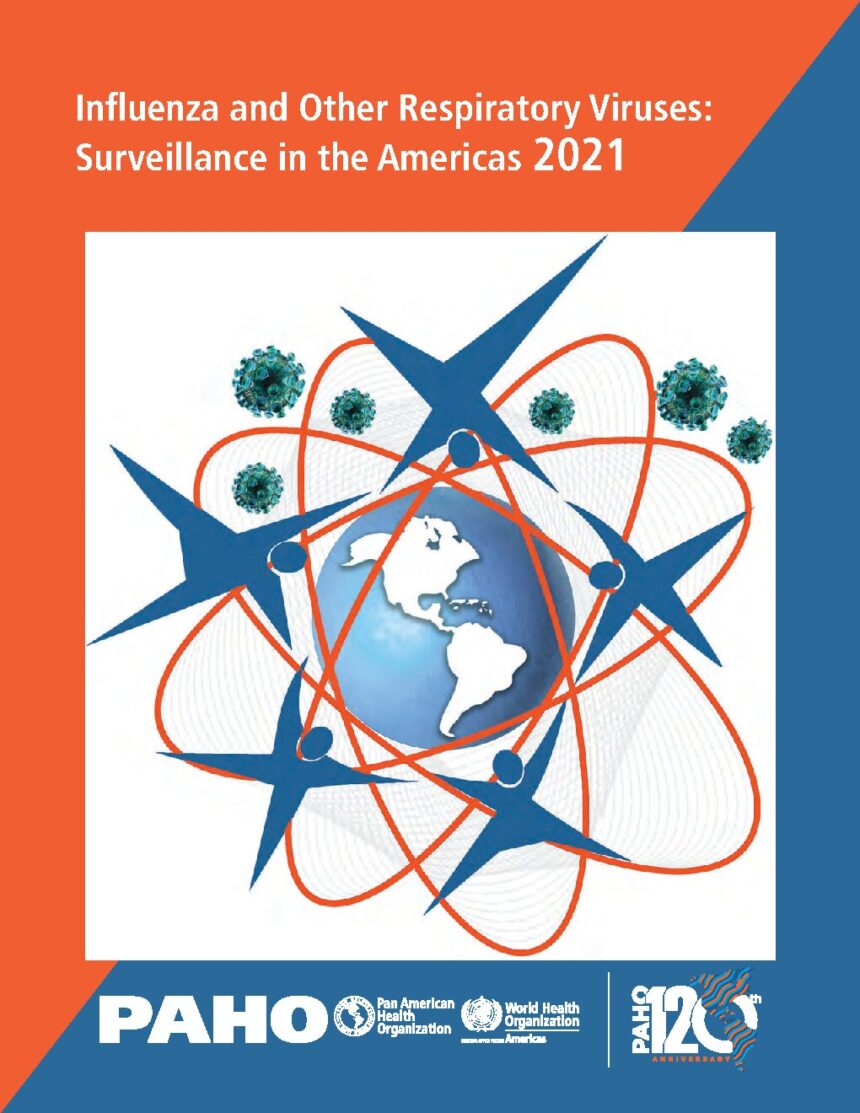
Pan American Health Organization · 2021 edition
Regional surveillance capacity assessment for influenza, RSV and COVID-19 in 37 countries across North, Central and South America.
- Issuer
- Pan American Health Organization
- Edition
- 2021 edition
- Audience
- Public health authorities, epidemiologists, laboratory directors, influenza surveillance coordinators, WHO regional offices
- Evidence
- Surveillance data compilation and country self-reporting (not a clinical guideline)
- Reviewed
- 18 Oct 2026 · GMJ
What this guideline says
GMJ summary
This surveillance report provides a comprehensive assessment of influenza and respiratory virus surveillance systems across the Americas during 2020, the first year of the COVID-19 pandemic. It documents surveillance capacity, laboratory networks, vaccination coverage, and pandemic preparedness for 37 countries and territories, from Canada to Argentina.
The report demonstrates how existing influenza surveillance platforms—comprising 7,128 SARI hospitals and 239 ILI sentinel sites in Brazil alone, plus extensive networks in other countries—were rapidly adapted to detect SARS-CoV-2. During 2020, participating countries analyzed over 1 million influenza samples and millions of COVID-19 samples, while maintaining sentinel surveillance for severe acute respiratory infection (SARI, defined as fever ≥38°C, cough, and hospitalization) and influenza-like illness (ILI, defined as fever ≥38°C and cough).
Key findings include high participation in WHO External Quality Assessment Programs (95% of laboratories scoring ≥90%), integration of FluNet/FluID reporting systems, and variable influenza vaccination coverage: older adult coverage ranged from 6% (El Salvador) to 100% (Cuba, Chile), while pregnant women coverage ranged from 9% (Dominican Republic) to 86% (Colombia). The document underscores the resilience of respiratory surveillance networks during the pandemic transition.
Key points
For clinicians — doses and thresholds as stated in the guideline
- SARI case definition: acute respiratory infection with fever ≥38°C, cough, onset within 10 days, requiring hospitalization (WHO 2014 standard)
- ILI case definition: acute respiratory infection with measured fever ≥38°C and cough, onset within 10 days (WHO 2014 standard)
- 95% (n=22) of participating laboratories achieved ≥90% scores on WHO External Quality Assessment Program for influenza during 2020–2021
- Brazil processed 1,185,084 influenza samples and 1,477,404 SARS-CoV-2 samples through 7,128 SARI hospitals and 239 ILI sentinel sites in 2020
- Influenza vaccination coverage for older adults (≥60–65 years): ranged from 6% in Bahamas to 100% in Cuba and Chile; pregnant women: 9% (Dominican Republic) to 86% (Colombia)
- Canada analyzed 2,724,038 influenza samples and 15,314,339 SARS-CoV-2 samples through its hospital-based active surveillance network in 2020
- National Influenza Centers: 18 countries maintain WHO-designated centers with RT-PCR, viral isolation, sequencing, and antigenic characterization capacity
- Real-time reporting: Argentina, Brazil, Chile, Colombia, Costa Rica, and Mexico maintained weekly FluNet/FluID reporting to WHO throughout 2020 despite pandemic pressures
Country Indicators: Surveillance Systems and Laboratory Capacity (Selected Countries, 2020)
Table extracted from the guideline
| Country | SARI surveillance | ILI surveillance | National RT-PCR Center | EQAP participation 2021 | FluNet reporting | Influenza samples 2020 |
|---|---|---|---|---|---|---|
| Argentina | Sentinel + national | Sentinel + national | Yes (3 centers) | Yes | Yes (>33%) | 32,480 |
| Brazil | National (7,128 sites) | Sentinel (239 sites) | Yes (3 centers) | Yes | Yes (>33%) | 1,185,084 |
| Canada | Sentinel (20 sites) | Sentinel (125 sites) | Yes (1 center) | Yes | Yes (>33%) | 2,724,038 |
| Chile | Sentinel (7 sites) | Sentinel (42 sites) | Yes (1 center) | Yes | Yes (>33%) | 44,241 |
| Colombia | Sentinel (11 sites) | Sentinel (2 sites) | Yes (1 center) | Yes | Yes (>33%) | 7,636 |
| Costa Rica | Sentinel (9 sites) | Sentinel (9 sites) | Yes (1 center) | Yes | Yes (>33%) | 4,698 |
| Ecuador | Sentinel (15 sites) | No | Yes (1 center) | Yes | Yes (>33%) | 2,178 |
| Mexico | Sentinel + national | Sentinel + national | Yes (1 center) | Yes | Yes (>33%) | Data not shown |
Source: Pan American Health Organization, Influenza and Other Respiratory Viruses: Surveillance in the Americas 2021. Reproduced in summary form.
From the guideline
Verbatim
“An acute respiratory infection with history of fever or measured fever ≥38 °C, and cough; onset within the last 10 days; requires hospitalization.”
Editor’s perspective
Why this matters for Georgia and the region
Prof. Giorgi Pkhakadze, MD, MPH, PhD
Editor-in-Chief, Georgian Medical Journal · Chair, Public Health Institute of Georgia · WHO consultant, health and migration
As Chair of Georgia's Public Health Institute and WHO consultant, I find this surveillance compendium essential reading for understanding how resilient respiratory pathogen surveillance is built. The stark contrast in influenza vaccination coverage—5–10% in Georgia versus 70–100% in Chile or Canada—highlights our most urgent gap; Georgia's NCDC sentinel sites use these same SARI/ILI definitions, but coverage data are not systematically published. The documentation of Brazil's 7,128 SARI hospitals integrated into a single electronic platform (SIVEP-Gripe) or Argentina's SNVS 2.0 real-time system offers concrete models: Georgia's existing hospital reporting could similarly integrate respiratory pathogens if we invest in laboratory capacity beyond Tbilisi and train sentinel site clinicians in standardized case ascertainment. The 95% laboratory proficiency rate achieved through WHO External Quality Assessment demonstrates that even middle-income countries can maintain reference-level diagnostics. For Georgian colleagues, I would emphasize weekly reporting discipline—many countries here reported >33 weeks to FluNet despite COVID-19 disruptions—and the critical need to expand RT-PCR beyond the national reference laboratory to regional hubs in Kutaisi, Batumi, and Telavi, as our South Caucasus neighbors Armenia and Azerbaijan are now doing. The most sobering lesson: countries without pre-existing SARI surveillance struggled to characterize COVID-19 severity in real time.
ORCID 0000-0001-7609-4515 · Perspective written for the GMJ Guidelines Library, 18 Oct 2026
Applicability
Georgia and the South Caucasus
This surveillance framework is directly relevant for Georgia and South Caucasus countries developing or strengthening respiratory pathogen surveillance. Georgia’s National Center for Disease Control and Public Health (NCDC) operates influenza sentinel surveillance sites and participates in WHO FluNet reporting; the standardized SARI (fever ≥38°C, cough, hospitalization) and ILI (fever ≥38°C, cough, ambulatory) case definitions presented here align with Georgia’s existing surveillance protocols. The report’s documentation of how 37 countries pivoted existing influenza platforms to COVID-19 surveillance offers practical lessons: countries with established SARI/ILI networks, laboratory capacity for RT-PCR, and real-time reporting infrastructure (like Argentina’s SNVS.2.0 or Chile’s integrated systems) maintained pandemic situational awareness. For Georgia, key considerations include expanding RT-PCR capacity beyond the NCDC reference laboratory to regional sites (as demonstrated by Brazil’s network of over 100 laboratories), increasing influenza vaccination coverage in priority groups (currently estimated at 5–10% in older adults, far below the 70–100% achieved in Chile, Cuba, or Canada), and ensuring consistent weekly reporting to global surveillance platforms. Armenia and Azerbaijan face similar capacity-building needs in laboratory networks and data integration systems.
Questions this guideline answers
Quick answers
What are the WHO standard case definitions for SARI and ILI used across the Americas?
SARI: acute respiratory infection with history of fever or measured fever ≥38°C and cough, onset within the last 10 days, requiring hospitalization. ILI: acute respiratory infection with measured fever ≥38°C and cough, onset within the last 10 days. These WHO 2014 definitions are used by sentinel sites to identify cases for virological testing.
How many influenza and COVID-19 samples were processed by surveillance networks in 2020?
Large networks processed millions of samples: Brazil analyzed 1,185,084 influenza and 1,477,404 SARS-CoV-2 samples; Canada processed 2,724,038 influenza and 15,314,339 COVID-19 samples; Colombia tested 442,758 COVID-19 samples. Smaller countries like Costa Rica analyzed 4,698 influenza and 37,893 COVID-19 samples, demonstrating scalable surveillance approaches.
What influenza vaccination coverage was achieved in priority groups during 2020?
Coverage varied widely: older adults (≥60–65 years) ranged from 6% (Bahamas) to 100% (Cuba, Chile); pregnant women from 9% (Dominican Republic) to 86% (Colombia); health workers from 12% (Belize) to 100% (multiple countries). Most countries used Southern Hemisphere trivalent or quadrivalent formulations administered March–June 2020.
What laboratory quality standards do National Influenza Centers maintain?
During 2020–2021, 95% (n=22) of participating laboratories attained scores ≥90% on the WHO External Quality Assessment Program for influenza. National Influenza Centers (18 countries) maintain capacity for RT-PCR, viral isolation, antigenic characterization by hemagglutination inhibition, sequencing, and antiviral susceptibility testing; they ship isolates to WHO Collaborating Centers (CDC, Atlanta) for further characterization.
Related on GMJ
Interconnected resources
GMJ News coverage
- Influenza surge in Southern Hemisphere prompts PAHO call for vaccination and health system readinessSep 2026
- Close Contact Alone May Not Drive Influenza Transmission, Controlled Study SuggestsJul 2026
- UK flu and COVID-19 surveillance data to May 2027 shows continued monitoring amid seasonal trendsOct 2026
- Community Health Workers Boost COVID-19 Testing Among Formerly Incarcerated PeopleAug 2026
Quality & accreditation
- ASF PHC — Standard 4 — Acute & Same-Day Care · Primary Health Clinic
- ASF PHC — Standard 7 — Governance & Staffing · Primary Health Clinic
- ASF Hospital — Standard 5 — Safety & Emergency Preparedness
- ASF Hospital — Standard 11 — Critical Care
- ASF Medical Transport — Standard 6 — Emergency Response During Transport
Other guidelines on this topic
- Updated Recommendations for Determining the Number of People with HIV Receiving Antiretroviral Therapy, September 2021
- Infection Prevention and Control for the Management of Mpox in People in Situations of Vulnerability such as Prisons and Other Custodial Facilities
- Manual for Surveillance of Events Supposedly Attributable to Vaccination or Immunization in the Region of the Americas
- Silence can be damaging: How to talk about monkeypox without doing harm
- Guidance on Clinical Suspicion and Differential Diagnosis of Monkeypox
- Issuer
- Pan American Health Organization
- Type
- Procedures, manuals, guidelines
- Edition
- 2021 edition
- Replaces
- Influenza and Other Respiratory Viruses: Surveillance in the Americas 2019
- Status
- Current
- Published
- 2022-01-01
- Languages
- English
- Scope
- Regional (37 countries/territories in North, Central, South America and Caribbean)
- Audience
- Public health authorities, epidemiologists, laboratory directors, influenza surveillance coordinators, WHO regional offices
- Licence
- CC BY-NC-SA 3.0 IGO
- ISBN
- 978-92-75-12500-7 (print versi
- Evidence
- Surveillance data compilation and country self-reporting (not a clinical guideline)
- Record history
- Created 18 Oct 2026 · updated 18 Oct 2026 · next check Apr 2027
Pan American Health Organization. Influenza and Other Respiratory Viruses: Surveillance in the Americas 2021. Washington, D.C.: PAHO; 2022. 173 p. Licence: CC BY-NC-SA 3.0 IGO. https://doi.org/10.37774/9789275124994GMJ Guidelines Library records are original summaries written by the GMJ editorial team from the issuer’s published document and reviewed by a physician. They do not replace the full guideline. The document is the copyright of its issuer and is linked, not hosted. Spotted an error or a newer edition? Tell the Guidelines Desk.
Was this article helpful?