Pan American Health Organization · 6 May 2020 version
A comprehensive checklist for health system leaders and HRH managers to plan, mobilise and protect the health workforce during the COVID-19 pandemic.
- Issuer
- Pan American Health Organization
- Edition
- 6 May 2020 version
- Audience
- PAHO/WHO health systems advisors, incident command members, national health authorities, HRH directors and managers, health services network directors
- Evidence
- Expert consensus; checklist format for operational use
- Reviewed
- 20 Oct 2026 · GMJ
What this guideline says
GMJ summary
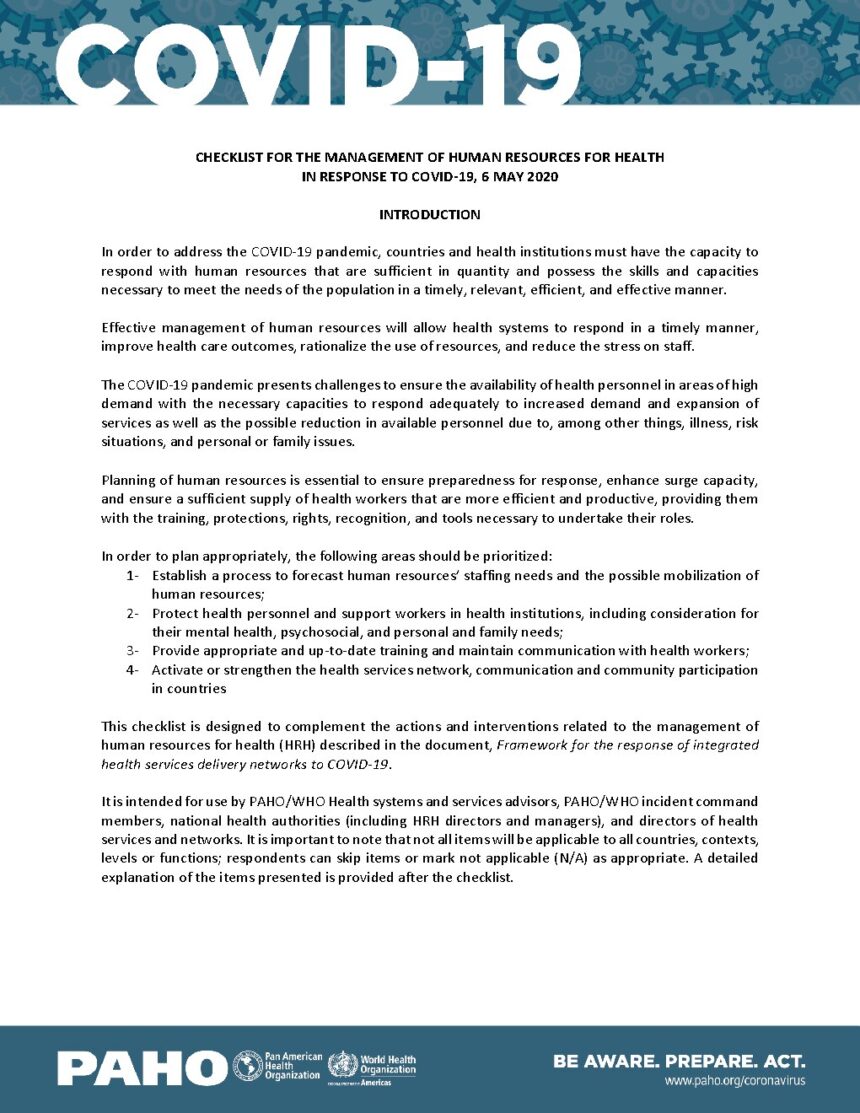
This checklist provides a systematic framework for managing human resources for health (HRH) during the COVID-19 pandemic. It addresses four priority areas: forecasting staffing needs and mobilising human resources; protecting health personnel including mental health support; providing appropriate training and communication; and activating health services networks with community participation.
The document is structured as a series of checklists covering workforce mapping, recruitment of additional health workers, reorganisation and role distribution, contractual and legal considerations, communication and coordination, training, safety and protection, and mental health support. It is designed to complement PAHO’s Framework for the response of integrated health services delivery networks to COVID-19.
The checklist is intended for PAHO/WHO health systems advisors, incident command members, national health authorities including HRH directors and managers, and directors of health services and networks. Users can adapt the checklist to their specific context, marking items as not applicable where appropriate.
Key points
For clinicians — doses and thresholds as stated in the guideline
- Map health worker needs and availability according to levels of care, establishing a centralised roster or database of all available health workforce
- Consider recruitment from multiple sources: private sector deployment, retired health workers, recent graduates, military and veteran providers, and trained volunteers for support tasks
- Implement task-shifting strategies: reorient paediatric intensivists and emergency physicians for adult care, repurpose specialists to first-level care for non-COVID-19 patients
- Establish pathways for accelerated training and early licensing of medical and nursing graduates; deploy final-year students in community activities, home visits and data collection
- Secure and allocate PPE to frontline health workers considering risk of exposure; ensure proper training in rational use and disposal of PPE
- Reassign health workers in high-risk categories for COVID-19 complications to tasks or settings that reduce exposure risk
- Establish a dedicated hotline for psychological support to health workers; implement flexible work schedules with distributed workload and monitored breaks
- Review liability, insurance and clinical indemnity arrangements for changes of assignment across medical sub-specialties and task-sharing measures
From the guideline
Verbatim
“Planning of human resources is essential to ensure preparedness for response, enhance surge capacity, and ensure a sufficient supply of health workers that are more efficient and productive, providing them with the training, protections, rights, recognition, and tools necessary to undertake their roles.”
Editor’s perspective
Why this matters for Georgia and the region
Prof. Giorgi Pkhakadze, MD, MPH, PhD
Editor-in-Chief, Georgian Medical Journal · Chair, Public Health Institute of Georgia · WHO consultant, health and migration
As someone who has worked with WHO on health system strengthening in the region, I recognise that Georgia's experience during COVID-19 highlighted the critical importance of HRH planning—our health workforce emigration patterns make surge capacity particularly challenging. The most immediately actionable recommendation for Georgian health managers is establishing a centralised database of available health workforce by level of care, linked with clear protocols for task-shifting and temporary licensing that comply with our 2015 Law on Healthcare. The caveat is that many of these measures—particularly task-shifting across specialties and early licensing of graduates—require legislative amendments and liability frameworks that take time to establish; pandemic preparedness planning must begin now, not during the next emergency, and should involve our professional associations from the outset to ensure clinical safety standards are maintained.
ORCID 0000-0001-7609-4515 · Perspective written for the GMJ Guidelines Library, 20 Oct 2026
Applicability
Georgia and the South Caucasus
For Georgia and the South Caucasus, this checklist addresses critical workforce challenges in health systems with limited surge capacity and ongoing emigration of health professionals. Georgian health authorities would need to review existing legal frameworks for temporary licensing, task-shifting regulations, and cross-border professional recognition agreements with Armenia and Azerbaijan. The emphasis on protecting health workers through PPE allocation, mental health support and appropriate working hours is particularly relevant given workforce shortages. National programmes should assess feasibility of private-public partnerships for temporary deployment, activation of military medical reserves, and establishment of centralised HRH databases that can track availability across municipal, regional and national levels during health emergencies.
Questions this guideline answers
Quick answers
Can medical and nursing students be deployed during a pandemic emergency?
Yes. The checklist recommends deploying recent graduates awaiting internship and students in their final undergraduate year as support personnel in community activities, home visits, patient orientation, data collection and general examinations. Countries may also consider establishing pathways for accelerated training and early licensing of medical and nursing graduates where appropriate.
How can countries address health worker shortages during COVID-19?
Multiple strategies are recommended: temporary deployment of private sector professionals to public facilities; activation of medical reserve corps and military providers; outreach to retired health workers; training and repurposing of non-health sector workers and volunteers for support tasks; establishing incentives and domestic support measures (travel, childcare) to enhance staff flexibility for shift work.
What legal and contractual issues must be addressed for rapid workforce mobilisation?
Countries should review: requirements for licensure and certification; scope of practice limitations; liability, insurance and clinical indemnity arrangements for task-shifting; regulations regarding provision of care by health personnel from other countries; policies for managing volunteer workers; and administrative procedures and contractual mechanisms for hiring and mobilising personnel.
What measures should be taken to protect the mental health of health workers?
Establish a dedicated hotline for psychological support; review work schedules to enable flexibility and workload distribution; encourage and monitor breaks; monitor workers for illness, stress and burn-out; provide psychological first aid training; ensure childcare and care support options are in place; use buddy systems; and facilitate access to mental health and psychosocial support services.
Related on GMJ
Interconnected resources
Dictionary of Public Health
GMJ News coverage
- UK flu and COVID-19 surveillance data to May 2027 shows continued monitoring amid seasonal trendsOct 2026
- Community Health Workers Boost COVID-19 Testing Among Formerly Incarcerated PeopleAug 2026
- Why Women Doctors Drop Out: A Systematic Review Reveals Critical Gaps in Medical TrainingOct 2026
- Vaccination Requirements for East African Safari: A Clinical GuideOct 2026
Quality & accreditation
- ASF Hospital — Standard 20 — Supporting the Care Workforce
- ASF Laboratory — Standard 3 — Personnel & Competence
- ASF Hospital — Standard 5 — Safety & Emergency Preparedness
- ASF Medical Transport — Standard 5 — Infection Prevention & Control
- ASF Laboratory — Standard 7 — Examination: Process & Safety
- ASF Hospital — Standard 11 — Critical Care
- ASF Medical Transport — Standard 6 — Emergency Response During Transport
Other guidelines on this topic
- Infection prevention and control practices for care of patients in nontraditional settings with focus to the novel coronavirus (COVID-19)
- Immunization throughout the Life Course at the Primary Care Level in the Context of the COVID-19 Pandemic
- Post-authorization Surveillance of Medical Products during a Pandemic Emergency
- Retrofit Measures for COVID-19
- Guidance and strategies to streamline ethics review and oversight of COVID-19-related research
- Issuer
- Pan American Health Organization
- Type
- Procedures, manuals, guidelines
- Edition
- 6 May 2020 version
- Status
- Current
- Published
- 2020-01-01
- Scope
- Human resources for health management during COVID-19 pandemic response
- Audience
- PAHO/WHO health systems advisors, incident command members, national health authorities, HRH directors and managers, health services network directors
- Licence
- CC BY-NC-SA 3.0 IGO
- Evidence
- Expert consensus; checklist format for operational use
- Record history
- Created 20 Oct 2026 · updated 20 Oct 2026 · next check Apr 2027
Pan American Health Organization. Checklist for the Management of Human Resources for Health in Response to COVID-19, 6 May 2020. Washington, D.C.: PAHO; 2020. Available from: https://iris.paho.org/handle/10665.2/52100GMJ Guidelines Library records are original summaries written by the GMJ editorial team from the issuer’s published document and reviewed by a physician. They do not replace the full guideline. The document is the copyright of its issuer and is linked, not hosted. Spotted an error or a newer edition? Tell the Guidelines Desk.
Was this article helpful?