Pan American Health Organization · 2020
Guidance for national regulatory authorities on pharmacovigilance, technovigilance, and hemovigilance systems during pandemic emergencies.
- Issuer
- Pan American Health Organization
- Edition
- 2020
- Audience
- National regulatory authorities, Expanded Program on Immunization, public health programmes, health service professionals
- Evidence
- Expert consensus and regulatory best practices
- Reviewed
- 20 Oct 2026 · GMJ
What this guideline says
GMJ summary
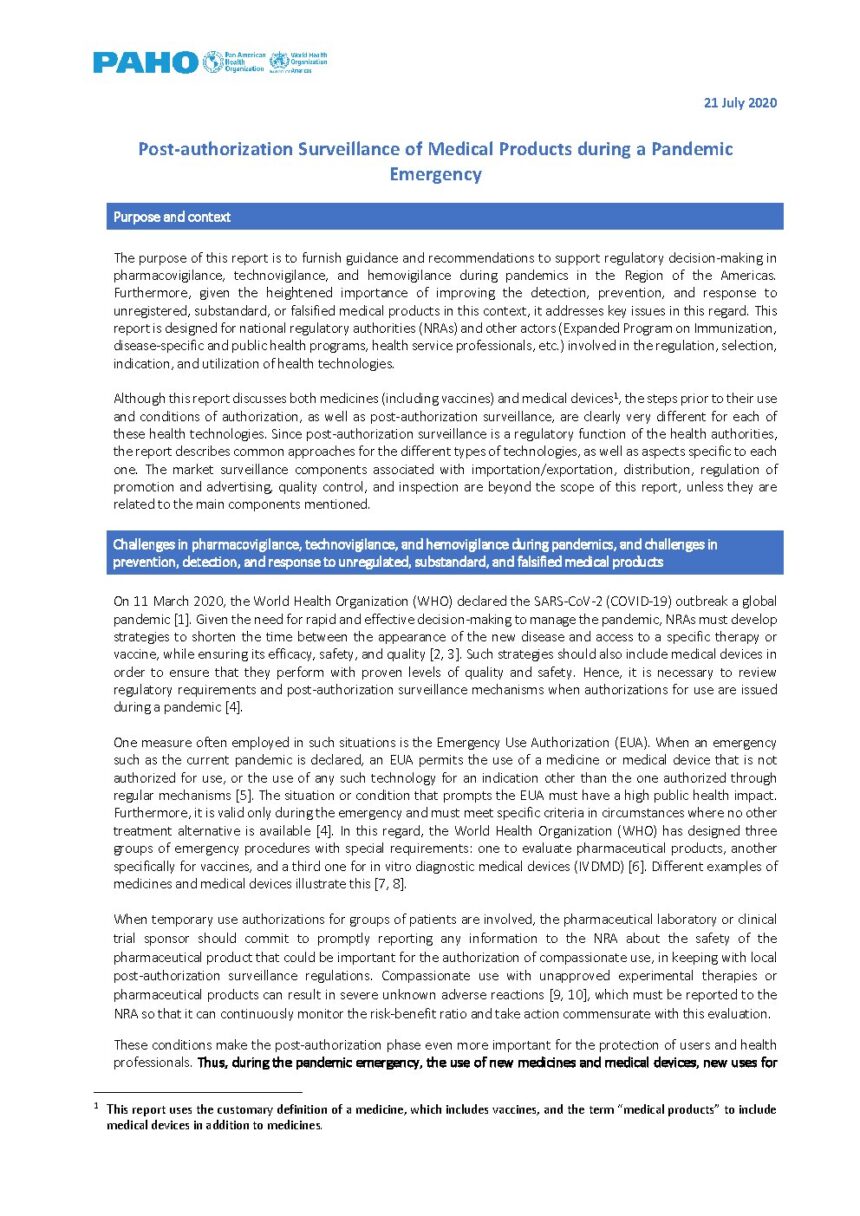
This PAHO report provides comprehensive guidance to national regulatory authorities (NRAs) and public-health programmes on post-authorization surveillance of medicines, vaccines, medical devices, and blood products during pandemic emergencies. It addresses the unique challenges posed by emergency use authorizations (EUA), compassionate use, and the rapid introduction of new or repurposed medical products when evidence is limited.
The document establishes reporting priorities for different product categories: for pharmaceutical products, serious adverse reactions to pandemic-related treatments receive highest priority; for vaccines, programme errors, events affecting groups, and adverse events of special interest (AESI) are prioritized; for medical devices, events causing death or serious harm, especially with ventilators, personal protective equipment, and in vitro diagnostics, require immediate reporting. The guidance recommends combining passive spontaneous reporting systems with active surveillance strategies, particularly sentinel hospital networks for vaccines, and emphasizes the importance of periodic (weekly or biweekly) safety reviews.
The report also addresses prevention, detection, and response to substandard, falsified, and unregistered medical products, which proliferate during pandemics. It provides a framework for risk management plans, periodic safety reporting, communication strategies, and regulatory reliance practices, tailored to different levels of regulatory capacity across Member States.
Key points
For clinicians — doses and thresholds as stated in the guideline
- Prioritize reporting of serious adverse reactions to pandemic-related pharmaceutical products first, followed by serious reactions to other products, then new/unexpected reactions, then non-serious pandemic-related reactions, and finally non-serious reactions to other products
- For vaccines, prioritize reporting of programme errors (regardless of severity), events affecting groups, geographically clustered events, new/undescribed events, abnormally high-frequency events, and adverse events of special interest (AESI) as defined by WHO/PAHO
- Conduct periodic evaluations of event reports weekly or biweekly during pandemics to identify potential risks and signals requiring investigation
- Implement simplified periodic safety reports (PSRs) for pharmaceutical products and vaccines based on risk assessment, with modified submission frequencies and dates as needed during emergencies
- For medical devices, immediately report events leading to death, serious harm requiring hospitalization or intervention, or diagnostic errors from in vitro diagnostic medical devices (IVDMD)
- Establish sentinel hospital networks for active vaccine surveillance, particularly for adverse events following immunization (AEFI), with protocols to evaluate association between events and vaccines
- For convalescent plasma transfusion, immediately report transfusion-related acute lung injury (TRALI) and transfusion-associated circulatory overload (TACO) as leading causes of mortality
- Request risk management plans (RMP) for all new pharmaceutical products and vaccines authorized under emergency conditions, including additional monitoring measures and risk minimization strategies
Situations with specific challenges for surveillance
Table extracted from the guideline
| Product category | Specific surveillance challenges |
|---|---|
| Pharmaceutical Products | Limited safety evaluation in methodologically diverse emergency clinical trials; surveillance of investigational products; therapeutic repurposing for indications other than authorized; unregistered products requiring special authorization |
| Vaccines | Accelerated trials with minimum subject numbers and limited safety data; coordination between NRA and National Immunization Program; new distribution and use plans; adjustments to passive surveillance and observational studies; administration to vulnerable groups |
| Blood | Different surveillance structure for blood/plasma/cells versus blood derivatives; convalescent plasma use in situations of unproven efficacy requiring specific surveillance system; evaluation of donation and transfusion service effectiveness indicators |
| Medical devices | Product scarcities and rapidly developed devices (e.g., IVDMD); ensuring minimum technical specifications; devices authorized for indications other than originally approved; deficiencies in quality management systems as production expands; small/new companies with limited quality control experience |
Source: Pan American Health Organization, Post-authorization Surveillance of Medical Products during a Pandemic Emergency. Reproduced in summary form.
From the guideline
Verbatim
“The spontaneous reporting is an essential and well-developed component of event monitoring in countries. It is usually less expensive/complicated and faster to implement than active strategies for both medicines or medical devices, even in areas with less regulatory development.”
Editor’s perspective
Why this matters for Georgia and the region
Prof. Giorgi Pkhakadze, MD, MPH, PhD
Editor-in-Chief, Georgian Medical Journal · Chair, Public Health Institute of Georgia · WHO consultant, health and migration
As Georgia strengthened its regulatory framework over the past decade, including pharmacovigilance systems and medical device oversight, this PAHO guidance provides a critical operational blueprint for pandemic preparedness that our national regulatory authority should formally adopt. The document's tiered approach recognizing different regulatory capacity levels is particularly valuable—Georgia can realistically implement weekly safety review committees, simplified periodic safety reports, and sentinel hospital networks leveraging our existing National Center for Disease Control infrastructure and the immunization programme's AEFI reporting experience. I would emphasize to Georgian colleagues the importance of establishing regulatory reliance mechanisms with EMA and stringent authorities before the next emergency, as this allows faster authorization without compromising post-market surveillance obligations. The practical caveat is that our regulatory authority currently has limited human resources dedicated to technovigilance; implementing comprehensive medical device surveillance during emergencies will require pre-designated staff from other Ministry of Health units and clear protocols developed now, not during crisis response.
ORCID 0000-0001-7609-4515 · Perspective written for the GMJ Guidelines Library, 20 Oct 2026
Applicability
Georgia and the South Caucasus
Georgia’s national regulatory authority (LEPL Lugar Center under Ministry of Health) operates pharmacovigilance and medical device surveillance systems that would implement this guidance during pandemic response. The country’s experience with COVID-19 emergency use authorizations, its participation in COVAX vaccine introduction, and ongoing surveillance through the National Center for Disease Control make this framework directly applicable. Georgian regulators should assess their capacity level (likely category B or C in the document’s classification) to prioritize feasible surveillance activities, strengthen spontaneous reporting systems, and establish coordinated mechanisms between the regulatory authority, immunization programme, blood service, and clinical networks. The guidance on regulatory reliance practices is particularly relevant given Georgia’s tendency to reference decisions from EMA and stringent regulatory authorities. National programmes would need to consider establishing weekly safety review committees during emergencies and developing simplified reporting forms in Georgian to facilitate healthcare worker participation in passive surveillance.
Questions this guideline answers
Quick answers
What type of adverse events should be reported first during a pandemic?
Serious adverse reactions associated with pharmaceutical products or vaccines used for treatment or prevention of the pandemic infection receive highest reporting priority, followed by serious reactions to other products, then new or unexpected reactions of any kind, then non-serious reactions to pandemic products, and finally non-serious reactions to other products.
How often should safety data be reviewed during a pandemic emergency?
Periodic evaluations should be conducted weekly or biweekly to study event reports, review data from other databases and agencies, and assess potential risks. This frequent review allows for rapid identification of signals and timely regulatory action including possible suspension or cancellation of emergency authorizations.
What are adverse events of special interest (AESI) for pandemic vaccines?
AESI are pre-specified events identified based on preclinical and clinical trial data, disease behavior, and vaccine/adjuvant type that require enhanced monitoring. For COVID-19 vaccines, examples include events identified by the SPEAC project. These should be included in the vaccine's risk management plan using standardized definitions (such as Brighton criteria) and monitored through prospective observational studies.
What surveillance approach is recommended for countries with limited regulatory capacity?
Countries without established technovigilance systems can adapt their pharmacovigilance processes for medical devices, or appoint ad hoc committees. At minimum, implement: a system to receive complaints, procedures to evaluate reports for critical measures, mechanisms to receive manufacturer field safety corrective actions, procedures to withdraw unsafe products, alert mechanisms for users, and monitoring of alerts from other regulatory authorities.
Related on GMJ
Interconnected resources
Dictionary of Public Health
Drugs A–Z
GMJ News coverage
- UK flu and COVID-19 surveillance data to May 2027 shows continued monitoring amid seasonal trendsOct 2026
- Community Health Workers Boost COVID-19 Testing Among Formerly Incarcerated PeopleAug 2026
- Generic Flu Antivirals Won't Save Us Unless Rich Nations Commit to Using ThemSep 2026
- Air France Flight Diverted Over Ebola Travel Restrictions Amid DRC OutbreakMay 2026
Quality & accreditation
Other guidelines on this topic
- Retrofit Measures for COVID-19
- Guidance and strategies to streamline ethics review and oversight of COVID-19-related research
- Summary on Advances in the Development of Vaccines against COVID-19, 3 April 2020
- A Checklist for COVID-19 Pandemic Risk and Impact Management
- Recommendations for the Preparation of Disinfectant Solutions
- Issuer
- Pan American Health Organization
- Type
- Procedures, manuals, guidelines
- Status
- Current
- Published
- 2020-01-01
- Scope
- Pharmacovigilance, technovigilance, and hemovigilance during pandemic emergencies in the Americas
- Audience
- National regulatory authorities, Expanded Program on Immunization, public health programmes, health service professionals
- Licence
- CC BY-NC-SA 3.0 IGO
- Evidence
- Expert consensus and regulatory best practices
- Record history
- Created 20 Oct 2026 · updated 20 Oct 2026 · next check Apr 2027
Pan American Health Organization. Post-authorization Surveillance of Medical Products during a Pandemic Emergency. Washington, D.C.: PAHO; 2020.GMJ Guidelines Library records are original summaries written by the GMJ editorial team from the issuer’s published document and reviewed by a physician. They do not replace the full guideline. The document is the copyright of its issuer and is linked, not hosted. Spotted an error or a newer edition? Tell the Guidelines Desk.
Was this article helpful?