Pan American Health Organization · 2020
Early pandemic-era status report on global COVID-19 vaccine development for public health planners and immunisation programmes.
- Issuer
- Pan American Health Organization
- Edition
- 2020
- Evidence
- expert consensus
- Reviewed
- 20 Oct 2026 · GMJ
What this guideline says
GMJ summary
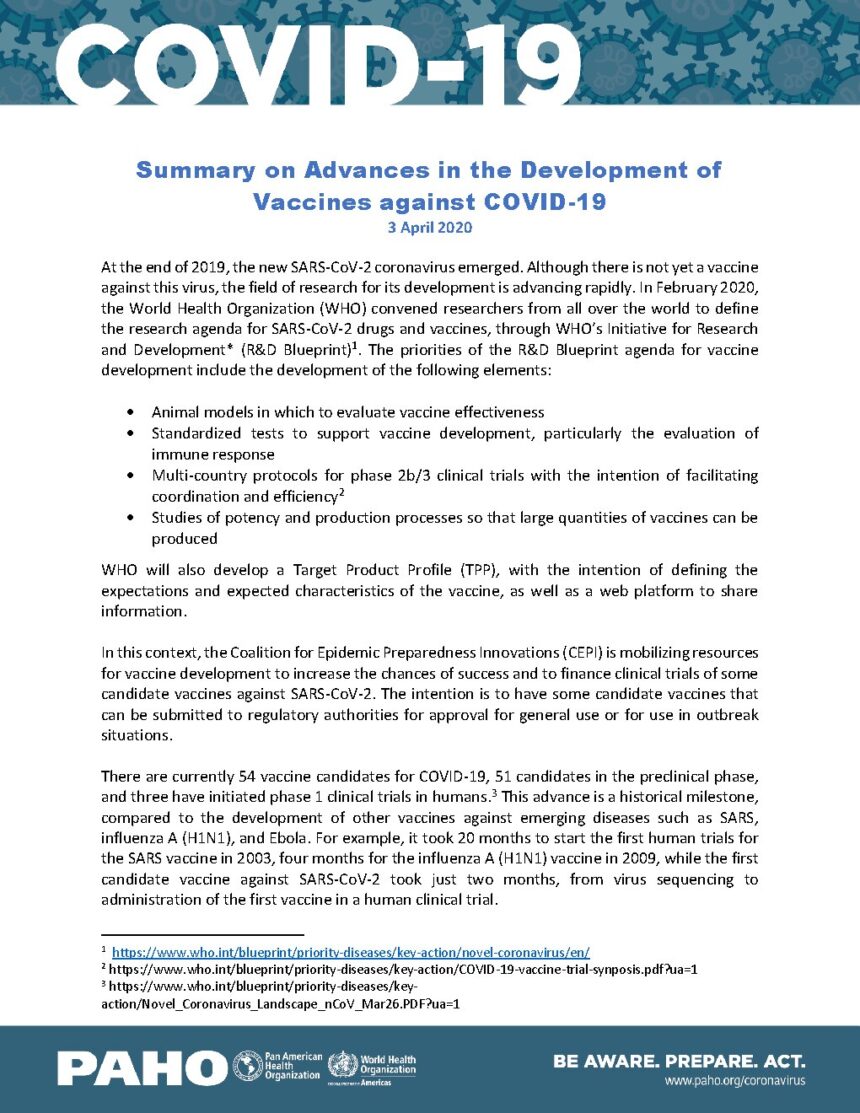
This summary, published at the beginning of the COVID-19 pandemic, describes the global landscape of vaccine development as of 3 April 2020. At that date, 54 vaccine candidates were under development: 51 in preclinical phase and three in phase 1 clinical trials. The WHO R&D Blueprint set priorities including animal models, standardised tests, multi-country phase 2b/3 trial protocols, and potency studies for large-scale production.
Three phase 1 trials are detailed: Moderna’s mRNA-1273 (45 healthy adults aged 18–55 years, recruitment completed 19 March), CanSino Biological’s Ad5-nCoV adenovirus vector vaccine (108 participants aged 18–60 years receiving low, medium and high doses), and Oxford University’s ChAdOx1 (510 healthy adults aged 18–55 years). The document notes that vaccine approval was expected in 12–18 months, representing unprecedented speed compared with prior epidemics (20 months for SARS, 4 months for H1N1).
The summary emphasises that once developed, equitable access for the Americas would be critical, with PAHO’s Revolving Fund positioned to negotiate vaccines as it did during H1N1. Countries are urged to prepare national vaccination plans, strengthen cold chain infrastructure, information systems, and surveillance for adverse events supposedly attributable to vaccination or immunisation (ESAVIs), with priority for risk groups including older adults, people with chronic diseases, and health workers.
Key points
For clinicians — doses and thresholds as stated in the guideline
- As of 3 April 2020, 54 COVID-19 vaccine candidates were under development: 51 in preclinical phase and 3 in phase 1 clinical trials in humans
- Moderna's mRNA-1273 phase 1 study enrolled 45 healthy adults aged 18–55 years, with recruitment completed 19 March 2020
- CanSino Biological's Ad5-nCoV phase 1 study enrolled 108 participants aged 18–60 years receiving low, medium and high doses
- Oxford University's ChAdOx1 phase 1 study planned for 510 healthy adult volunteers aged 18–55 years
- Vaccines approved for human use were expected to be available in 12–18 months from the date of publication
- Priority vaccination target groups identified as older adults, people with chronic diseases and health workers
- National immunisation programmes should prioritise elaboration of national vaccination plans, cold chain infrastructure and information systems
- Active surveillance at sentinel sites for adverse events supposedly attributable to vaccination or immunisation (ESAVIs) should be strengthened
From the guideline
Verbatim
“Immunization programs should give priority to the elaboration of national vaccination plans, as well as having the necessary infrastructure, including the cold chain and information systems.”
Editor’s perspective
Why this matters for Georgia and the region
Prof. Giorgi Pkhakadze, MD, MPH, PhD
Editor-in-Chief, Georgian Medical Journal · Chair, Public Health Institute of Georgia · WHO consultant, health and migration
This document captures a pivotal moment in pandemic history and provides valuable lessons for Georgia's preparedness for future emerging infectious diseases. The emphasis on strengthening surveillance systems for adverse events—ESAVIs—was particularly relevant for Georgia, where pharmacovigilance capacity has been progressively strengthened through the National Centre for Disease Control. The prioritisation framework for risk groups outlined here—older adults, chronic disease patients, health workers—informed Georgia's own COVID-19 vaccine rollout strategy when vaccines became available in 2021. One critical lesson is the importance of maintaining year-round cold chain infrastructure and information systems; Georgia's experience with annual influenza vaccination and the childhood immunisation programme provided the operational foundation that enabled rapid COVID-19 vaccine deployment, though challenges in vaccine hesitancy and rural access required additional community engagement strategies not fully anticipated in this early technical document.
ORCID 0000-0001-7609-4515 · Perspective written for the GMJ Guidelines Library, 20 Oct 2026
Applicability
Georgia and the South Caucasus
This historical document provides context for Georgia’s subsequent COVID-19 vaccine introduction. Georgia’s established immunisation programme infrastructure—including the national cold chain system, ERAVE (adverse event) surveillance, and experience with annual influenza vaccination for risk groups—provided the foundation for COVID-19 vaccine deployment when vaccines became available in 2021. National immunisation technical advisory groups would have used the risk group framework (older adults, chronic disease patients, health workers) outlined here to develop prioritisation strategies. The document’s emphasis on equitable access through pooled procurement mechanisms remains relevant for emerging vaccine-preventable diseases, as Georgia continues to rely on international procurement mechanisms including Gavi support for some vaccines.
Questions this guideline answers
Quick answers
How many COVID-19 vaccine candidates were in clinical trials as of 3 April 2020?
Three vaccine candidates had initiated phase 1 clinical trials: Moderna's mRNA-1273 (45 participants aged 18–55 years), CanSino Biological's Ad5-nCoV (108 participants aged 18–60 years), and Oxford University's ChAdOx1 (510 participants aged 18–55 years). An additional 51 candidates were in preclinical phase.
What was the expected timeline for COVID-19 vaccine availability?
The document anticipated that vaccines approved for use in humans would be available in 12–18 months from 3 April 2020. This represented unprecedented speed: the SARS vaccine took 20 months to reach first human trials in 2003, influenza A (H1N1) took 4 months in 2009, whilst SARS-CoV-2 vaccines took just 2 months from virus sequencing to first human trial.
Which population groups were identified as vaccination priorities?
Risk groups for priority vaccination included older adults, people with chronic diseases, and health workers. These priorities drew on lessons learned from the 2009 influenza pandemic and annual seasonal influenza vaccination programmes.
What infrastructure did countries need to prepare for vaccine introduction?
National immunisation programmes were advised to prioritise elaboration of national vaccination plans, ensure necessary infrastructure including cold chain and information systems, and strengthen epidemiological surveillance systems including active surveillance at sentinel sites for adverse events supposedly attributable to vaccination or immunisation (ESAVIs).
Related on GMJ
Interconnected resources
Dictionary of Public Health
GMJ News coverage
- UK flu and COVID-19 surveillance data to May 2027 shows continued monitoring amid seasonal trendsOct 2026
- Community Health Workers Boost COVID-19 Testing Among Formerly Incarcerated PeopleAug 2026
- Controversial COVID-19 Vaccine Study Published After CDC Journal RejectionAug 2026
- Lassa Fever Vaccine and Therapeutic Trials Mark First Major Clinical Progress in DecadesOct 2026
Quality & accreditation
- ASF PHC — Standard 4 — Acute & Same-Day Care · Primary Health Clinic
- ASF PHC — Standard 7 — Governance & Staffing · Primary Health Clinic
- ASF Hospital — Standard 5 — Safety & Emergency Preparedness
- ASF Hospital — Standard 11 — Critical Care
- ASF Medical Transport — Standard 6 — Emergency Response During Transport
Other guidelines on this topic
- Ongoing Living Update of Potential COVID-19 Therapeutics: summary of rapid systematic reviews
- A Checklist for COVID-19 Pandemic Risk and Impact Management
- Recommendations for the Preparation of Disinfectant Solutions
- COVID-19: Chloroquine and hydroxychloroquine research
- Promoting health equity, gender and ethnic equality, and human rights in COVID-19 responses: Key considerations
- Issuer
- Pan American Health Organization
- Type
- Procedures, manuals, guidelines
- Status
- Current
- Published
- 2020-01-01
- Licence
- CC BY-NC-SA 3.0 IGO
- Evidence
- expert consensus
- Record history
- Created 20 Oct 2026 · updated 20 Oct 2026 · next check Apr 2027
Pan American Health Organization. Summary on Advances in the Development of Vaccines against COVID-19, 3 April 2020. Washington, D.C.: PAHO; 2020. Reference number: PAHO/FPL/IM/COVID-19/20-0009.GMJ Guidelines Library records are original summaries written by the GMJ editorial team from the issuer’s published document and reviewed by a physician. They do not replace the full guideline. The document is the copyright of its issuer and is linked, not hosted. Spotted an error or a newer edition? Tell the Guidelines Desk.
Was this article helpful?