Pan American Health Organization · 1st edition, 2020
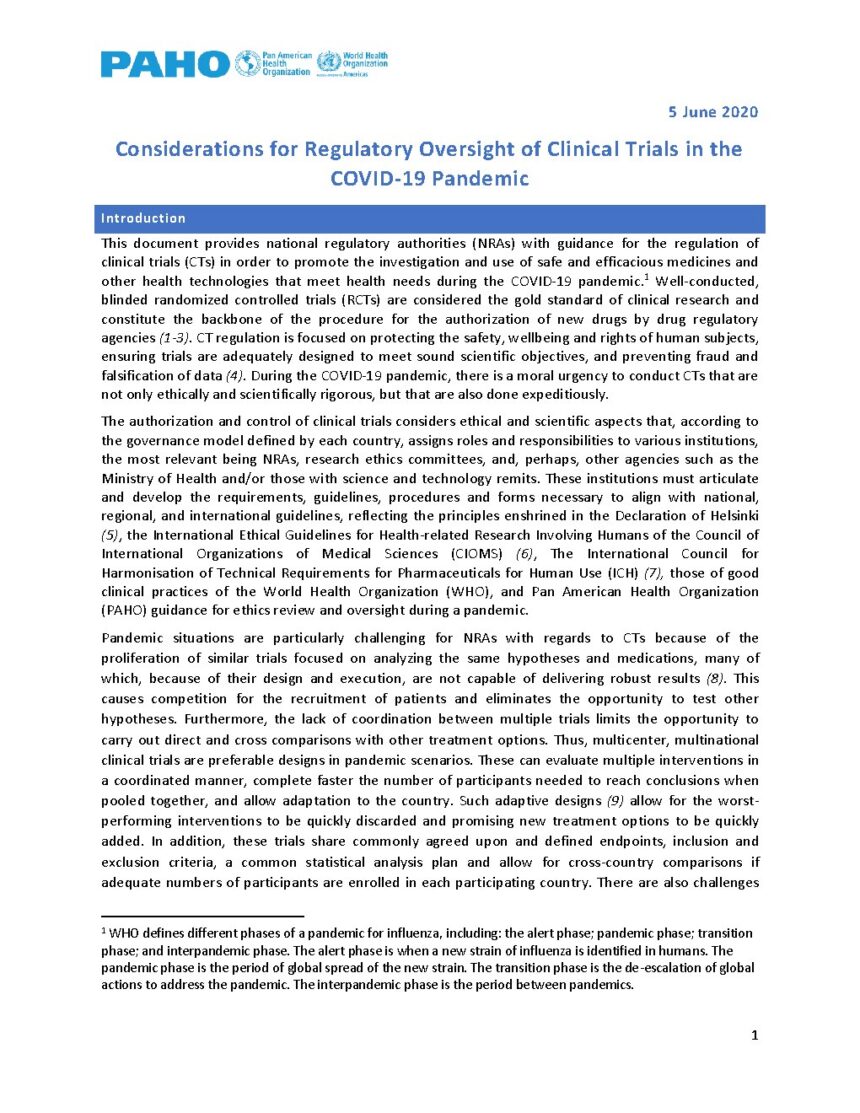
Guidance for national regulatory authorities to expedite ethical and rigorous COVID-19 clinical trial oversight while maintaining standards.
- Issuer
- Pan American Health Organization
- Edition
- 1st edition, 2020
- Audience
- National regulatory authorities, research ethics committees, health authorities, clinical trial sponsors and investigators
- Evidence
- Expert consensus based on WHO frameworks and international guidelines
- Reviewed
- 21 Oct 2026 · GMJ
What this guideline says
GMJ summary
This Pan American Health Organization (PAHO) document provides national regulatory authorities (NRAs) with comprehensive guidance on regulating clinical trials during the COVID-19 pandemic. It emphasises that well-conducted randomised controlled trials remain the gold standard for evidence generation, but regulatory processes must be streamlined during emergencies without compromising ethical and scientific rigour. The guidance addresses the challenge of proliferating trials testing the same hypotheses, which compete for patients and waste resources, advocating instead for multicentre, multinational, adaptive trial designs.
The document outlines essential regulatory capacities based on WHO’s Global Benchmarking Tool maturity levels 1–3, including legal provisions for clinical trial oversight, requirements for ethics committee review, good clinical practice (GCP) compliance, adverse event monitoring, and authority to inspect, suspend or stop trials. It provides specific recommendations for expediting review during the pandemic: digital submissions, virtual meetings, tight deadlines (72 hours for ethics review, 48 hours for researcher response), reduced quorum requirements, and simultaneous rather than sequential reviews by regulators and ethics committees.
The guidance also addresses oversight of non-COVID-19 trials during the pandemic and the ethical framework for monitored emergency use of unregistered interventions (MEURI). It stresses that emergency use of unproven interventions must not compromise resources for conducting rigorous clinical trials, which generate evidence more quickly and reliably. All COVID-19 trials must be prospectively registered in WHO’s International Clinical Trials Registry Platform before enrolling the first participant.
Key points
For clinicians — doses and thresholds as stated in the guideline
- Ethics committees should review COVID-19 trial protocols within 72 hours of receipt, with researchers responding to queries within 48 hours
- All COVID-19 clinical trials must be prospectively registered in a WHO International Clinical Trials Registry Platform registry (ReBec, RPCEC, REPEC, or ClinicalTrials.gov) before enrolling the first participant
- National regulatory authorities should prioritise multicenter, multinational, adaptive trial designs that can evaluate multiple interventions simultaneously and discard worst-performing treatments quickly
- Ethics committees should designate one national or regional committee responsible for all COVID-19 clinical trials within a jurisdiction to avoid duplication
- Regulatory systems must permit recognition and use of clinical trial decisions from other national regulatory authorities or international bodies through reliance mechanisms
- National regulatory authorities must have legal authority to inspect trial sites for good clinical practice compliance, receive adverse event reports during trials, and suspend or stop trials that pose unacceptable risks
- Modified consent processes during the pandemic may include digital forms or audiovisual recording whilst maintaining ethical validity of informed consent
- Emergency use of unproven interventions outside clinical trials (MEURI) is only ethical when: no proven treatment exists, clinical trials cannot start immediately, preliminary safety data exist, ethics approval is obtained, informed consent is given, resources to minimise risks are available, and use is monitored with results shared
Recommended Legal Provisions, Regulations, and Guidelines Indicators for Clinical Trials
Table extracted from the guideline
| Indicator | Maturity Level |
|---|---|
| Require legal provisions and regulations for CT oversight | 1 |
| Permit regulatory systems to recognize and use relevant CT decisions, reports or information from other NRAs or from regional and international bodies | 1 |
| Explain how CT oversight will function in exceptional circumstances such as pandemic emergencies, with clear directives on conditions, content of applications, and scope of review | 2 |
| Require a structure with clear responsibilities to conduct CT oversight | 2 |
| Require guidelines for format and content of CT applications | 2 |
| Require monitoring and reporting adverse events to the NRA during a CT, with guidance on follow-up, stakeholder responsibilities, and timeframes | 2 |
| Require relevant stakeholders (research centers, researchers, sponsors, CROs) to comply with Good Clinical Practices | 2 |
| Require the establishment of a research ethics committee to review and approve CT protocols | 2 |
| Require notification and NRA authorization of any changes to the original protocol or relevant CT documents | 2 |
| Permit the regulatory system to inspect, suspend, or stop CTs through GCP inspection of CT sites | 3 |
| Require NRA authorization for import or destruction of investigational medical products and GMP compliance | 2, 3 |
Source: Pan American Health Organization, Considerations for Regulatory Oversight of Clinical Trials in the COVID-19 Pandemic. Reproduced in summary form.
From the guideline
Verbatim
“During the COVID-19 pandemic, there is a moral urgency to conduct CTs that are not only ethically and scientifically rigorous, but that are also done expeditiously.”
Editor’s perspective
Why this matters for Georgia and the region
Prof. Giorgi Pkhakadze, MD, MPH, PhD
Editor-in-Chief, Georgian Medical Journal · Chair, Public Health Institute of Georgia · WHO consultant, health and migration
As Georgia strengthens its regulatory frameworks in line with European standards, this PAHO guidance offers a practical roadmap for clinical trial oversight during health emergencies that complements our existing legislative base. The 72-hour ethics review timeline and requirement for WHO ICTRP registration before patient enrolment are concrete benchmarks Georgian institutions can implement immediately, building on our experience coordinating COVID-19 vaccine trials in 2020–2021. I would emphasise to Georgian colleagues the recommendation to designate a single national research ethics committee for pandemic-related trials: our fragmented review processes have historically delayed multicentre studies. The main implementation challenge will be achieving WHO Global Benchmarking Tool maturity level 2 capacities across all indicators—particularly establishing authority for good clinical practice inspections and robust pharmacovigilance systems for trial adverse events—which will require legislative amendments and sustained investment in regulatory workforce capacity that extends beyond the current emergency.
ORCID 0000-0001-7609-4515 · Perspective written for the GMJ Guidelines Library, 21 Oct 2026
Applicability
Georgia and the South Caucasus
For Georgia and the South Caucasus region, this guidance is directly applicable as countries strengthen regulatory capacity for clinical trial oversight, particularly given ongoing COVID-19 vaccine and therapeutic studies. Georgian regulatory authorities would need to assess current maturity level against WHO benchmarking indicators and establish clear legal provisions for pandemic emergency procedures. The recommendation for reliance on reference authorities’ decisions is especially relevant for smaller regulatory systems in Armenia, Azerbaijan and Georgia, where resources for full independent review are limited. Regional coordination through mechanisms similar to the African AVAREF model could enable joint regulatory and ethics reviews across the South Caucasus. National programmes should prioritise establishing or designating a single research ethics committee for COVID-19 trials, implementing 72-hour review timelines, and ensuring all trials are registered in WHO-recognised registries before patient enrolment begins.
Questions this guideline answers
Quick answers
How quickly should ethics committees review COVID-19 clinical trial protocols during the pandemic?
Research ethics committees should review protocols within 72 hours of receipt, and researchers should respond to queries within 48 hours. This requires modified standard operating procedures including digital submissions, virtual meetings, staggered review processes, reduced quorum requirements, and tight timelines whilst maintaining ethical standards.
Where must COVID-19 clinical trials be registered before starting?
All COVID-19 trials must be prospectively registered in a public registry that is part of WHO's International Clinical Trials Registry Platform (ICTRP) before enrolling the first participant. In the Americas, this includes the Brazilian Clinical Trials Registry (ReBec), Cuban Public Registry (RPCEC), Peruvian Clinical Trial Registry (REPEC), or ClinicalTrials.gov. Registration in addition to any local national registry is required.
What are the essential regulatory capacities needed for clinical trial oversight during a pandemic?
Essential capacities include: legal provisions for trial oversight with pandemic emergency procedures; authority to recognise decisions from other regulators; guidelines for trial application format and content; requirements for good clinical practice compliance; adverse event monitoring systems; research ethics committee review; authority to inspect, suspend or stop trials; and controls for import of investigational products with good manufacturing practice compliance.
When is emergency use of unproven COVID-19 treatments outside clinical trials ethically justified?
Monitored emergency use of unregistered interventions (MEURI) is ethical only when: no proven treatment exists; clinical trials cannot start immediately; preliminary safety/efficacy data justify use; use is approved by regulators and ethics committees; resources to minimise risks are available; patients provide informed consent; and use is monitored with results documented and shared. However, this must not compromise resources for conducting rigorous clinical trials, which generate evidence more quickly.
Related on GMJ
Interconnected resources
Dictionary of Public Health
GMJ News coverage
- UK flu and COVID-19 surveillance data to May 2027 shows continued monitoring amid seasonal trendsOct 2026
- Community Health Workers Boost COVID-19 Testing Among Formerly Incarcerated PeopleAug 2026
- One in five new mothers experience anxiety or depression; psychedelic-assisted therapy shows promise in clinical trialsSep 2026
- FDA launches pilot programme to accelerate early-stage clinical trials amid global competitionSep 2026
Quality & accreditation
Other guidelines on this topic
- Recommendations for medical surge capacity and deployment of emergency medical teams
- Guidelines for care of critically ill adult patients with COVID-19 in the Americas
- Template and operational guidance for the ethics review and oversight of COVID-19-related research
- Adapting the First Level of Care in the Context of the COVID-19 Pandemic: Interventions, Modalities, and Scope
- Recommendations for Preparing Disinfecting Solution in Health Establishments, 9 April 2020
- Issuer
- Pan American Health Organization
- Type
- Procedures, manuals, guidelines
- Edition
- 1st edition, 2020
- Status
- Current
- Published
- 2020-01-01
- Languages
- English
- Scope
- Clinical trial regulation during COVID-19 pandemic
- Audience
- National regulatory authorities, research ethics committees, health authorities, clinical trial sponsors and investigators
- Licence
- CC BY-NC-SA 3.0 IGO
- Evidence
- Expert consensus based on WHO frameworks and international guidelines
- Record history
- Created 21 Oct 2026 · updated 21 Oct 2026 · next check Apr 2027
Pan American Health Organization. Considerations for Regulatory Oversight of Clinical Trials in the COVID-19 Pandemic, 5 June 2020. Washington, DC: PAHO; 2020. (PAHO/HSS/MT/COVID-19/20-0022). Available from: https://iris.paho.org/handle/10665.2/52266GMJ Guidelines Library records are original summaries written by the GMJ editorial team from the issuer’s published document and reviewed by a physician. They do not replace the full guideline. The document is the copyright of its issuer and is linked, not hosted. Spotted an error or a newer edition? Tell the Guidelines Desk.
Was this article helpful?