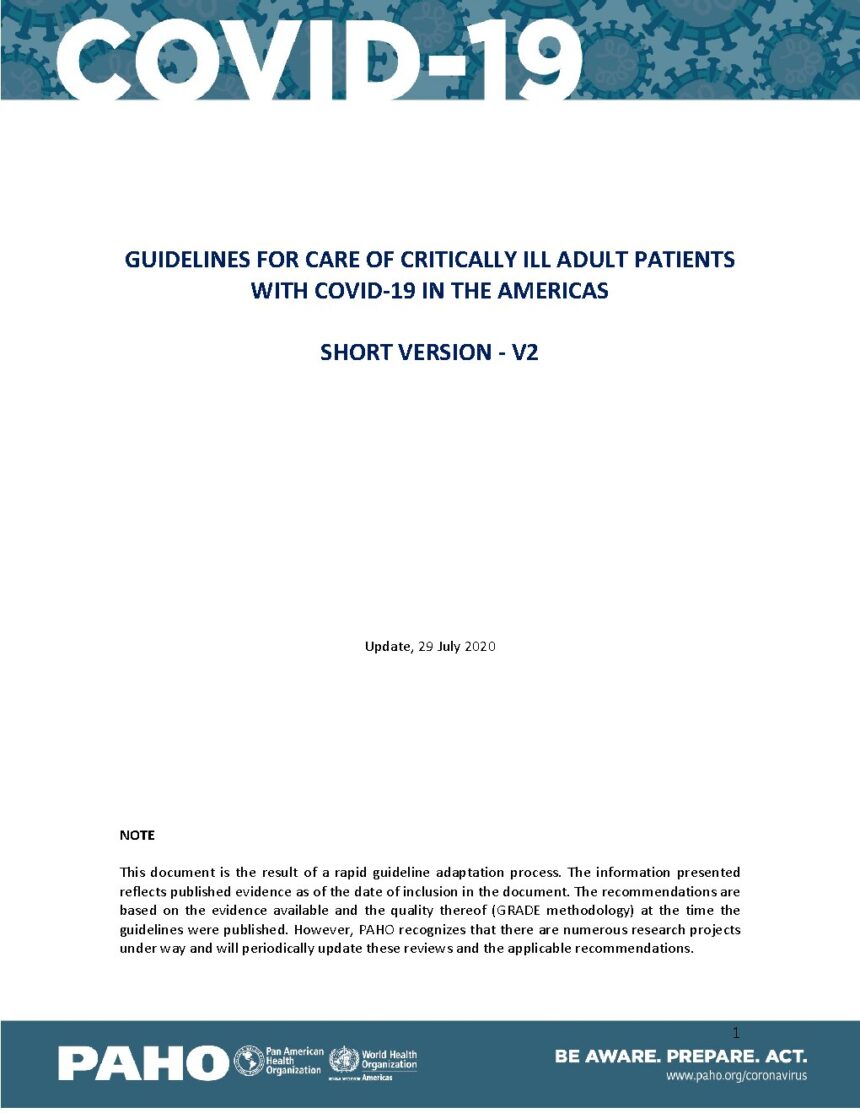
Pan American Health Organization · Version 2, 29 July 2020
Evidence-based ICU management protocols for severe COVID-19 using GRADE methodology, for intensive care physicians and emergency medicine staff.
- Issuer
- Pan American Health Organization
- Edition
- Version 2, 29 July 2020
- Audience
- Emergency medicine physicians, intensivists, pulmonologists, anaesthesiologists, infectious disease specialists, respiratory therapists, physical therapists, ICU nurses, pharmaceutical chemists, and health system decision-makers
- Evidence
- GRADE-rated recommendations from systematic literature review; multidisciplinary expert panel consensus
- Reviewed
- 21 Oct 2026 · GMJ
What this guideline says
GMJ summary
These rapid-adaptation clinical practice guidelines provide 44 evidence-based recommendations for the intensive care management of critically ill adults with COVID-19. Developed by PAHO using GRADE methodology, they cover triage, infection control, respiratory support (mechanical ventilation, prone positioning, oxygen therapy), haemodynamic support, pharmacological treatment, thromboprophylaxis, complication prevention, early rehabilitation, and ICU discharge criteria.
Key clinical recommendations include: low tidal volume ventilation (4–8 mL/kg predicted body weight) with plateau pressures <30 cmH₂O for ARDS; prone ventilation for 12–16 hours in moderate-to-severe ARDS; conservative fluid strategy; norepinephrine as first-line vasopressor targeting MAP 60–65 mmHg; low-dose corticosteroids for mechanically ventilated patients receiving supplemental oxygen; and prophylactic low molecular weight heparin (1 mg/kg enoxaparin daily for ≥7 days in high-risk patients). The guideline strongly recommends against hydroxychloroquine, lopinavir/ritonavir, remdesivir, ivermectin, convalescent plasma, and tocilizumab outside clinical trials.
This is a ‘living guideline’ subject to continuous evidence updates, reflecting the rapidly evolving COVID-19 knowledge base as of July 2020. All recommendations indicate strength (strong/conditional) and evidence quality (high/moderate/low/very low) using GRADE criteria.
Key points
For clinicians — doses and thresholds as stated in the guideline
- For mechanically ventilated COVID-19 patients with ARDS: use tidal volumes 4–8 mL/kg predicted body weight and maintain plateau pressures <30 cmH₂O (strong recommendation, moderate evidence)
- Prone ventilation for 12–16 hours is suggested for moderate-to-severe ARDS (conditional recommendation, moderate evidence)
- Target SpO₂ 94% initially in acute hypoxemic respiratory failure; maintain SpO₂ ≤96% once oxygen therapy established (strong recommendation, moderate evidence)
- Norepinephrine is first-line vasopressor, titrated to MAP 60–65 mmHg; add vasopressin if target not achieved (conditional recommendation, low to moderate evidence)
- Administer low-dose corticosteroids to critically ill patients receiving oxygen or mechanical ventilation (strong recommendation, moderate evidence)
- Prophylactic enoxaparin 1 mg/kg daily for ≥7 days in high-risk patients (elevated CRP, fibrinogen, D-dimer) without contraindications (strong recommendation, very low evidence)
- Do NOT use hydroxychloroquine, lopinavir/ritonavir, remdesivir, ivermectin, tocilizumab, or convalescent plasma outside clinical trials (conditional recommendation, low evidence)
- Use conservative fluid strategy (250–500 mL crystalloid boluses) rather than liberal fluid administration for shock resuscitation (conditional/strong recommendations, low evidence)
GRADE Evidence Quality and Recommendation Strength Interpretation
Table extracted from the guideline
| Category | Level | Meaning |
|---|---|---|
| Evidence Quality | High | Further research very unlikely to change confidence in estimate of effect |
| Evidence Quality | Moderate | Further research likely to have important impact on confidence and may change estimate |
| Evidence Quality | Low | Further research very likely to have important impact and likely to change estimate |
| Evidence Quality | Very low | Any estimate of effect is very uncertain |
| Recommendation Strength | Strong (RECOMMENDED) | Should be used; new evidence unlikely to change recommendation |
| Recommendation Strength | Conditional (SUGGESTED) | Could be used; new evidence may change recommendation |
Source: Pan American Health Organization, Guidelines for care of critically ill adult patients with COVID-19 in the Americas. Reproduced in summary form.
What changed in this edition
Versus the previous edition
- Version 2 update dated 29 July 2020 represents a rapid guideline adaptation with continuous updating process (living guideline)
- Prioritization process selected questions needing update and new questions included in this version
- Particular attention given to potential pharmacological treatments: antivirals, immunomodulators, convalescent plasma, and antibiotics
- Updated evidence profiles using systematic literature search as of July 2020
From the guideline
Verbatim
“For critically ill patients with COVID 19 receiving supplemental oxygen or ventilation, we recommended low-dose of corticosteroids to reduce mortality and progression to invasive mechanical ventilation”
Editor’s perspective
Why this matters for Georgia and the region
Prof. Giorgi Pkhakadze, MD, MPH, PhD
Editor-in-Chief, Georgian Medical Journal · Chair, Public Health Institute of Georgia · WHO consultant, health and migration
As Georgia's COVID-19 response evolved through 2020–2021, our ICU capacity expanded from fewer than 200 ventilators nationwide to over 500, yet regional disparities remain stark. This PAHO guideline's strength lies in its GRADE-rated, resource-stratified recommendations that acknowledge different healthcare capacities across the Americas—a reality Georgian intensivists understand well. I would emphasize to colleagues the evidence-based rejection of hydroxychloroquine and ivermectin, which consumed significant resources and clinical attention during early pandemic waves, and the strong evidence for simple interventions: lung-protective ventilation parameters, prone positioning, and thromboprophylaxis with locally available enoxaparin at 1 mg/kg daily for high-risk patients. The critical implementation challenge for Georgia is ensuring adherence to conservative fluid strategies and avoiding ventilator disconnection—practices that require sustained training and cultural change in ICU teams accustomed to different protocols, alongside reliable supply chains for low molecular weight heparin and corticosteroids.
ORCID 0000-0001-7609-4515 · Perspective written for the GMJ Guidelines Library, 21 Oct 2026
Applicability
Georgia and the South Caucasus
These guidelines are directly applicable to Georgian ICUs managing severe COVID-19 cases, though resource limitations require adaptation. Georgia’s critical care infrastructure varies significantly between Tbilisi tertiary centres and regional facilities; many recommendations assume availability of mechanical ventilators, video laryngoscopes, ECMO, and continuous laboratory monitoring that may not be universally accessible. National COVID-19 protocols should specify which recommendations are feasible at each healthcare level, establish telemedicine consultation networks linking peripheral hospitals to tertiary ICUs, and prioritize procurement of essential equipment (mechanical ventilators with closed-circuit systems, N-95 respirators, low molecular weight heparin). The strong recommendation against unproven therapies is particularly relevant given global medication shortages and misinformation. Georgian critical care training programmes should incorporate prone positioning techniques, lung-protective ventilation strategies, and conservative fluid management protocols outlined in this guideline.
Questions this guideline answers
Quick answers
What oxygen saturation target should I aim for in severe COVID-19?
Initially provide supplemental oxygen immediately to achieve SpO₂ ≥94%. Once the patient is receiving oxygen therapy, maintain SpO₂ at no higher than 96% to avoid potential oxygen toxicity (strong recommendation, moderate evidence).
Should I use hydroxychloroquine or ivermectin for critically ill COVID-19 patients?
No. The guideline recommends against hydroxychloroquine (with or without azithromycin), ivermectin, and other antiparasitics outside clinical trials (conditional recommendation, low evidence). Clinical trials for hydroxychloroquine are explicitly not recommended.
What ventilation settings should I use for COVID-19 ARDS?
Use low tidal volume ventilation: 4–8 mL/kg predicted body weight with plateau pressures <30 cmH₂O. Use conservative PEEP strategy to prevent barotrauma. For moderate-to-severe ARDS, prone positioning for 12–16 hours is suggested (strong recommendation for low tidal volume, conditional for proning; moderate evidence).
What thromboprophylaxis should critically ill COVID-19 patients receive?
Administer prophylactic low molecular weight heparin (enoxaparin 1 mg/kg daily for ≥7 days) to patients without contraindications, especially those with elevated C-reactive protein, fibrinogen, and D-dimer. Use mechanical prophylaxis (intermittent pneumatic compression) if anticoagulation is contraindicated (strong recommendation, very low evidence).
Related on GMJ
Interconnected resources
Dictionary of Public Health
Drugs A–Z
GMJ News coverage
- UK flu and COVID-19 surveillance data to May 2027 shows continued monitoring amid seasonal trendsOct 2026
- Community Health Workers Boost COVID-19 Testing Among Formerly Incarcerated PeopleAug 2026
- Cambridge researchers identify three distinct severe pneumonia subtypes, opening path to personalised treatmentSep 2026
- Sepsis AI Algorithms Fail When Trained on Future Data, Study Reveals Critical FlawsJul 2026
Quality & accreditation
Other guidelines on this topic
- Adapting the First Level of Care in the Context of the COVID-19 Pandemic: Interventions, Modalities, and Scope
- Safety of COVID-19 Patients and Use of Medicines without Scientific Evidence of Their Benefit
- Summary on Advances in the Development of Vaccines against COVID-19, 3 April 2020
- COVID-19 Recommendations: Prehospital Emergency Medical Services (EMS)
- Ongoing Living Update of Potential COVID-19 Therapeutics: summary of rapid systematic reviews
- Issuer
- Pan American Health Organization
- Type
- Procedures, manuals, guidelines
- Edition
- Version 2, 29 July 2020
- Replaces
- Version 1 (date not specified in document)
- Status
- Current
- Published
- 2020-01-01
- Languages
- Spanish (original), English (this version)
- Scope
- Management of critically ill adult COVID-19 patients in intensive care units; excludes nutrition and some complications
- Audience
- Emergency medicine physicians, intensivists, pulmonologists, anaesthesiologists, infectious disease specialists, respiratory therapists, physical therapists, ICU nurses, pharmaceutical chemists, and health system decision-makers
- Licence
- CC BY-NC-SA 3.0 IGO
- Evidence
- GRADE-rated recommendations from systematic literature review; multidisciplinary expert panel consensus
- Next review
- Continuous updating process (living guideline)
- Record history
- Created 21 Oct 2026 · updated 21 Oct 2026 · next check Apr 2027
Pan American Health Organization. Guidelines for care of critically ill adult patients with COVID-19 in the Americas. Short version, v.2. Washington, D.C.: PAHO; 2020. 22 p. (PAHO/IMS/EIH/COVID-19/20-0013). Available from: https://iris.paho.org/handle/10665.2/52614GMJ Guidelines Library records are original summaries written by the GMJ editorial team from the issuer’s published document and reviewed by a physician. They do not replace the full guideline. The document is the copyright of its issuer and is linked, not hosted. Spotted an error or a newer edition? Tell the Guidelines Desk.
Was this article helpful?