Pan American Health Organization · 2020
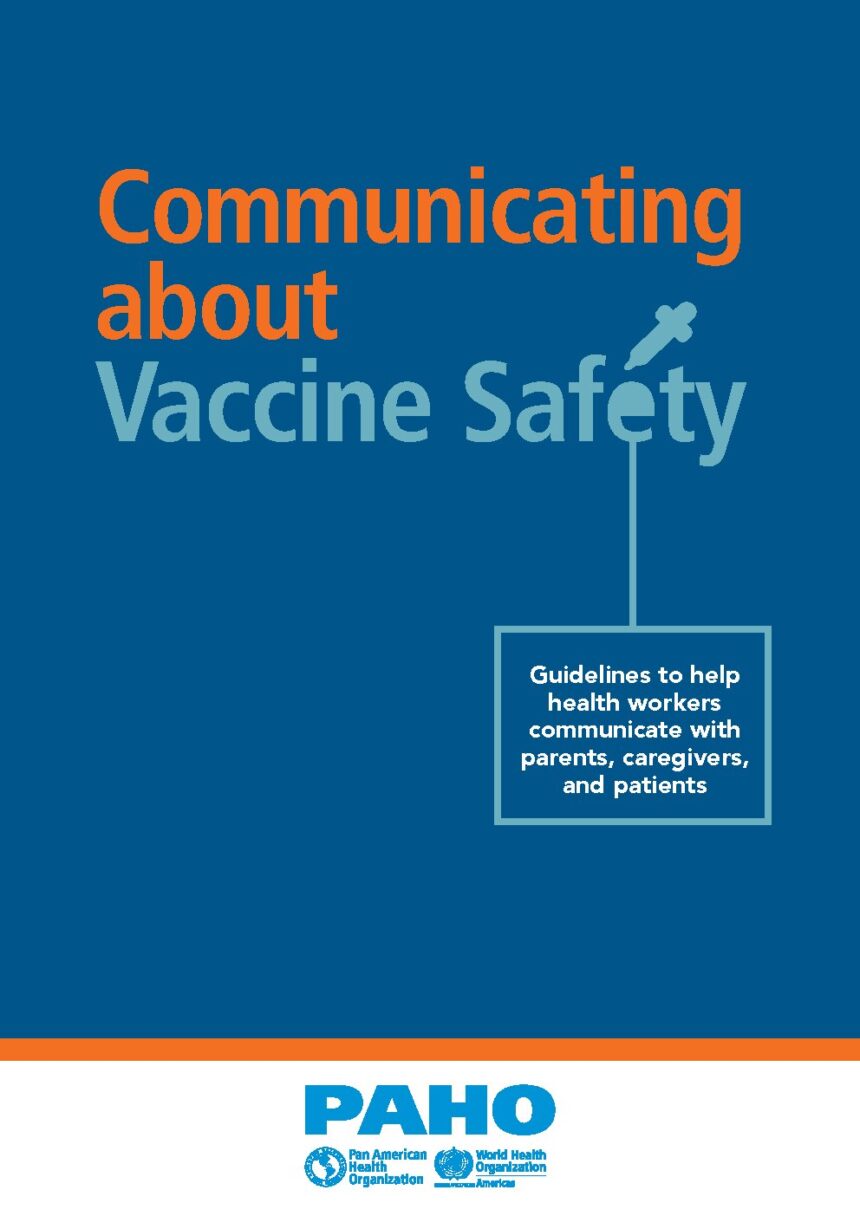
Evidence-based interpersonal communication strategies for health workers to address vaccine hesitancy and build trust in immunization programmes
- Issuer
- Pan American Health Organization
- Edition
- 2020
- Audience
- Health workers administering vaccines, primary care providers, public health professionals, immunization programme managers
- Evidence
- Evidence-based communication techniques from psychology and behavioural science literature; expert consensus recommendations
- Reviewed
- 21 Oct 2026 · GMJ
What this guideline says
GMJ summary
These guidelines from the Pan American Health Organization provide comprehensive, evidence-based communication tools for health workers to support effective dialogue about vaccination with parents, caregivers, and patients. The document emphasizes that simply providing information about vaccine quality, safety, and efficacy is insufficient to change vaccination behaviour; instead, health workers must understand the complex determinants of vaccine hesitancy – including confidence, convenience, and complacency – and employ two-way, empathetic communication that acknowledges concerns while focusing on evidence.
The guidelines address communication across the vaccine hesitancy spectrum, from active demand to outright rejection, presenting practical strategies including the presumptive approach (presuming parents will vaccinate), pain mitigation techniques (breastfeeding, holding, distraction), and methods for debunking misinformation without reinforcing false beliefs. Special attention is given to frequently asked questions about influenza, HPV, measles-mumps-rubella, and COVID-19 vaccines, along with guidance on communicating about adverse events supposedly attributable to vaccination or immunization (ESAVIs) and addressing vaccine hesitancy among health workers themselves.
The central message is that health workers, as the most trusted source of vaccine information, must move beyond one-way information delivery to respectful, personalized dialogue that bridges the risk perception gap between technical evidence and individual emotional concerns, using communication techniques that respect cognitive biases while systematically replacing misinformation with evidence about both individual and collective benefits of vaccination.
Key points
For clinicians — doses and thresholds as stated in the guideline
- High vaccination coverage of 95% or more is needed to control measles, one of the most contagious diseases known
- Use presumptive approach (presuming vaccination acceptance) for most parents; participatory approach for those with visible hesitancy
- Implement pain mitigation during vaccination: breastfeeding (strongly recommended), holding children (not lying supine), distraction techniques for children under 14, and sugar solutions (20-50%, e.g. 1 teaspoon sugar in 10 ml water) when breastfeeding not possible
- When debunking misinformation, issue a warning before mentioning the myth, focus primarily on evidence rather than repeating false claims, and replace misinformation with concrete facts
- Address vaccine hesitancy using the 3C model: Confidence (in vaccine effectiveness, safety, and delivery system), Convenience (physical and psychological accessibility), and Complacency (perception of disease risk)
- Health workers should wait at least 15 minutes after vaccination to monitor for anaphylaxis, though severe allergic reactions are very rare
- Flu vaccine effectiveness is typically 40-60% and prevents hospitalizations and severe disease even when not completely protective; during 2017-2018 US season prevented 7 million cases, 109,000 hospitalizations, and 8,000 deaths
- HPV vaccine has been administered in over 300 million doses worldwide with confirmed safety; vaccination at young age (preadolescence) protects before exposure to virus that causes 90% of anal cancers, 70% of vulvar/vaginal cancers, and 60% of penile cancers
Differences in clinical presentation of the common cold and influenza
Table extracted from the guideline
| Signs and symptoms | Common cold | Influenza |
|---|---|---|
| Symptom onset | Gradual | Sudden |
| Fever | Rare | Common, lasting 3-4 days |
| Muscle aches | Mild | Common, often severe |
| Chills | Rare | Common |
| Fatigue, weakness | Sometimes | Common |
| Sneezing | Common | Sometimes |
| Difficulty breathing | Mild to moderate | Can be severe |
| Cough | Mild to moderate | Can be severe |
| Stuffy nose | Common | Sometimes |
| Sore throat | Common | Sometimes |
| Headache | Rare | Common |
Source: Pan American Health Organization, Communicating about Vaccine Safety: Guidelines to help health workers communicate with parents, caregivers, and patients. Reproduced in summary form.
From the guideline
Verbatim
“Studies have shown that health personnel, as they interact with individuals regarding the decision to vaccinate, constitute the most reliable source of information.”
Editor’s perspective
Why this matters for Georgia and the region
Prof. Giorgi Pkhakadze, MD, MPH, PhD
Editor-in-Chief, Georgian Medical Journal · Chair, Public Health Institute of Georgia · WHO consultant, health and migration
As a WHO consultant who has worked on Georgia's immunization programme expansion, including rotavirus vaccine introduction in 2013, I recognize that these PAHO guidelines address a critical gap in our health workforce training. We have invested heavily in cold chain infrastructure and vaccine supply, but communication skills remain underdeveloped; many Georgian providers still use directive rather than dialogic approaches. The recommendation I would stress most is the pain mitigation protocol—particularly breastfeeding during vaccination and proper holding techniques—because these are zero-cost interventions that immediately improve the vaccination experience and can be implemented in every rural ambulatory without additional resources. The main implementation caveat for our context is that the presumptive communication model, while evidence-based, may initially feel uncomfortable to providers trained in the Soviet tradition of detailed explanation and consent; we will need structured role-play training, not just didactic sessions, to shift this deeply rooted practice pattern. The social media guidance is valuable for urban Tbilisi and Yerevan, but for mountain villages in Tusheti or Svaneti where internet remains sparse, we must adapt these principles to face-to-face community dialogue and trust-building through continuous presence of the same feldshers.
ORCID 0000-0001-7609-4515 · Perspective written for the GMJ Guidelines Library, 21 Oct 2026
Applicability
Georgia and the South Caucasus
For Georgia and the South Caucasus, these communication guidelines are directly applicable to strengthening routine immunization programmes and addressing pockets of vaccine hesitancy that threaten disease control. Georgia has achieved measles elimination status but faces periodic outbreaks requiring the 95% coverage threshold specified in this document. The region’s health systems have introduced HPV vaccination in some countries and conduct annual influenza campaigns, contexts where the specific communication strategies for these vaccines (chapters 6-7) are immediately relevant. National programmes should adapt the ESAVI communication protocols (chapter 8) to local pharmacovigilance systems, ensure health worker training incorporates the presumptive/participatory communication models, and consider that in post-Soviet health systems where paternalistic communication traditions persist, the shift to two-way empathetic dialogue may require deliberate culture change among providers. The emphasis on social media communication is pertinent given high internet penetration in urban Caucasus populations (85% in the Chilean example cited), though rural/remote areas may require different channels.
Questions this guideline answers
Quick answers
Why should we use a presumptive approach when talking about vaccines?
A presumptive approach (e.g., 'Today we are going to give your child the pentavalent vaccine') is recommended for parents who seem to accept vaccines or are only slightly hesitant, as studies show it is more effective than asking permission. However, for parents with visible hesitancy, a participatory approach ('What do you think about vaccines?') may be more appropriate. The key is to assess each individual and personalize the communication strategy.
How can I debunk the myth that vaccines cause autism without reinforcing it?
Use three steps: (1) Focus on evidence first ('We are going to review the evidence confirming vaccine safety'), (2) Issue a clear warning before mentioning the myth ('Many studies have ruled out this false information'), and (3) Replace with concrete facts ('The measles vaccine protects against serious complications including pneumonia, encephalitis, and death, and hundreds of well-designed studies confirm no association with autism'). Never lead with or repeat the false claim.
What pain mitigation techniques should I use during vaccination?
For infants, breastfeeding during and after vaccination is strongly recommended as it lowers heart rate and reduces crying. If breastfeeding is not possible, a sugar solution (20-50%, such as 1 teaspoon sugar in 10 ml drinking water) is effective. All children should be held by parents (not lying down alone, which increases anxiety), and children under 14 benefit from distraction techniques (toys, videos, conversation). When giving multiple vaccines, administer in order of painfulness, ending with the most painful. Do not use topical anesthetics systematically.
How should I communicate if an adverse event supposedly attributable to vaccination (ESAVI) occurs?
Recognize the public's concerns and anxiety, explain that surveillance systems exist to monitor all adverse events, emphasize that serious side effects are very rare, and clarify that adverse events occurring after vaccination do not necessarily mean the vaccine caused them. During investigation, use phrases like 'We are very concerned and a team of experts is investigating the cause. This vaccine has undergone all quality and safety studies and has been used for decades successfully.' Never get ahead of investigation conclusions or discredit official messages.
Related on GMJ
Interconnected resources
Dictionary of Public Health
GMJ News coverage
Quality & accreditation
- ASF Hospital — Standard 20 — Supporting the Care Workforce
- ASF Laboratory — Standard 3 — Personnel & Competence
- ASF PHC — Standard 4 — Acute & Same-Day Care · Primary Health Clinic
- ASF PHC — Standard 7 — Governance & Staffing · Primary Health Clinic
- ASF Hospital — Standard 7 — Governance & Management
- ASF Hospital — Standard 5 — Safety & Emergency Preparedness
- ASF Hospital — Standard 4 — Care & Treatment
Other guidelines on this topic
- Template and operational guidance for the ethics review and oversight of COVID-19-related research
- Recommendations for Preparing Disinfecting Solution in Health Establishments, 9 April 2020
- The Immunization Program in the Context of the COVID-19 Pandemic
- Immunization throughout the Life Course at the Primary Care Level in the Context of the COVID-19 Pandemic
- Safety of COVID-19 Patients and Use of Medicines without Scientific Evidence of Their Benefit
- Issuer
- Pan American Health Organization
- Type
- Procedures, manuals, guidelines
- Edition
- 2020
- Status
- Current
- Published
- 2020-01-01
- Languages
- English (also available in Spanish and Portuguese)
- Scope
- Communication strategies for health workers to address vaccine hesitancy and improve vaccination acceptance
- Audience
- Health workers administering vaccines, primary care providers, public health professionals, immunization programme managers
- Licence
- CC BY-NC-SA 3.0 IGO
- ISBN
- 978-92-75-12282-2
- Evidence
- Evidence-based communication techniques from psychology and behavioural science literature; expert consensus recommendations
- Record history
- Created 21 Oct 2026 · updated 21 Oct 2026 · next check Apr 2027
Pan American Health Organization. Communicating about Vaccine Safety: Guidelines to help health workers communicate with parents, caregivers, and patients. Washington, D.C.: PAHO; 2020. 63 p. License: CC BY-NC-SA 3.0 IGO.GMJ Guidelines Library records are original summaries written by the GMJ editorial team from the issuer’s published document and reviewed by a physician. They do not replace the full guideline. The document is the copyright of its issuer and is linked, not hosted. Spotted an error or a newer edition? Tell the Guidelines Desk.
Was this article helpful?