Pan American Health Organization · Version 2
Guidance for maintaining routine immunization services and VPD surveillance during the COVID-19 pandemic for national immunization programmes.
- Issuer
- Pan American Health Organization
- Edition
- Version 2
- Audience
- National immunization programme managers, public health officials, clinicians providing vaccination services
- Evidence
- Expert consensus aligned with WHO SAGE recommendations
- Reviewed
- 21 Oct 2026 · GMJ
What this guideline says
GMJ summary
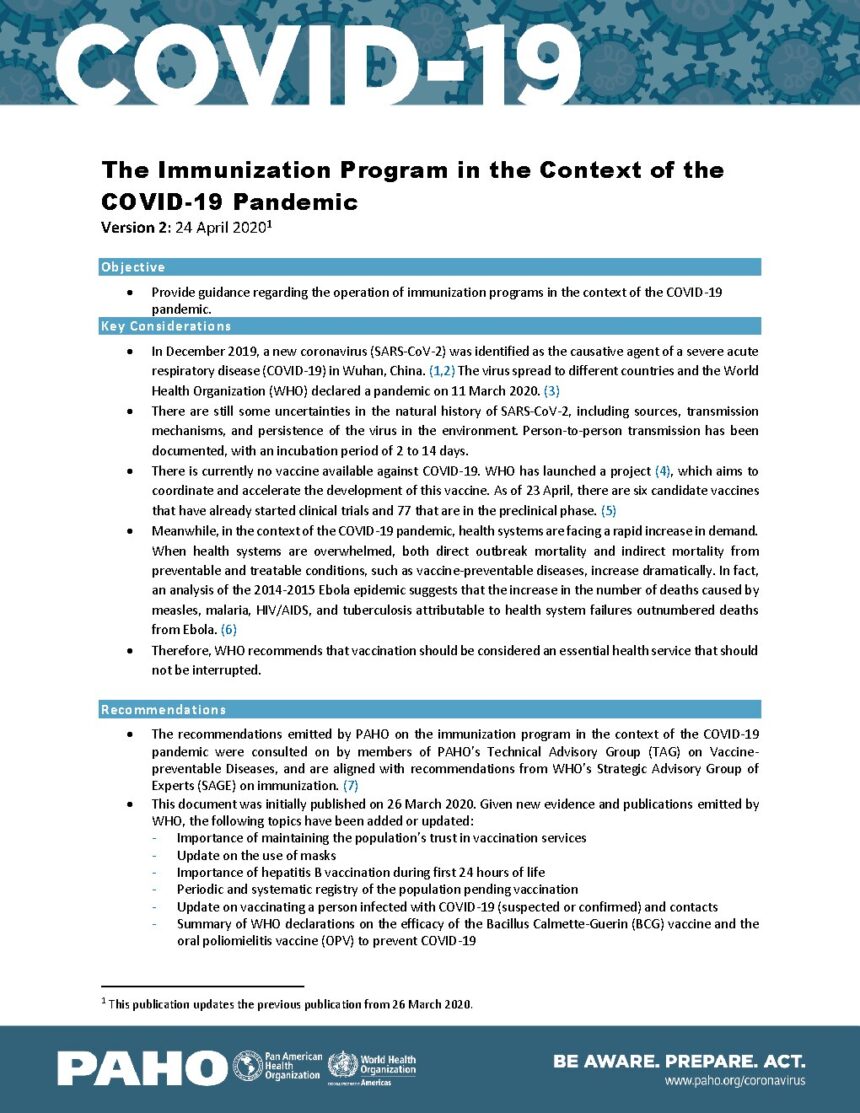
This guidance from the Pan American Health Organization, published in its second version on 24 April 2020, provides comprehensive recommendations for maintaining immunization programmes during the COVID-19 pandemic. The document addresses the critical tension between controlling SARS-CoV-2 transmission and preventing deaths from vaccine-preventable diseases (VPDs), noting that during the 2014–2015 Ebola epidemic, deaths from measles, malaria, HIV/AIDS and tuberculosis attributable to health system failures outnumbered deaths from Ebola itself.
The guidance establishes three operational scenarios based on health system capacity and SARS-CoV-2 transmission risk. In the first scenario, where health system capacity is intact, vaccination should continue through fixed posts, mobile posts and coverage extension activities with strict infection prevention and control measures. In the second scenario, where only limited services are available, vaccination should be prioritized for vulnerable populations at highest risk of VPD morbidity and mortality (older adults, people with chronic diseases, health personnel, pregnant women, children under 5 years, communities with active outbreaks). In the third scenario, where vaccination cannot be performed safely and SARS-CoV-2 transmission risk is high, vaccination activities should be suspended until conditions improve.
The document prioritizes influenza vaccination for health personnel, older adults, people with chronic diseases and pregnant women, and measles vaccination including a zero-dose strategy for children aged 6–11 months in municipalities with active outbreaks. It recommends temporarily suspending mass vaccination campaigns but maintaining essential surveillance for VPDs with global mandates (measles, rubella, neonatal tetanus, polio) and epidemic potential (influenza, meningococcus, yellow fever, diphtheria). Special emphasis is placed on hepatitis B vaccination within the first 24 hours of life to reduce vertical transmission risk, maintaining vaccination services for newborns at institutional births, and establishing systematic registries of populations pending vaccination.
Key points
For clinicians — doses and thresholds as stated in the guideline
- Hepatitis B vaccination must be administered within the first 24 hours of life to reduce the risk of vertical transmission, even during the pandemic
- Apply zero-dose measles strategy for children aged 6–11 months in municipalities with active outbreaks
- Prioritize influenza vaccination for health personnel, older adults, people with chronic diseases and pregnant women
- Defer vaccination of persons with suspected or confirmed COVID-19 until symptoms resolve, preferably after two consecutive negative tests (conducted with 24 hours difference); if laboratory confirmation not feasible, postpone for 14 days after symptom resolution
- Isolate contacts for 14 days; vaccinate if asymptomatic after 14 days, or prior to discharge if hospitalized
- Temporarily suspend mass vaccination campaigns due to SARS-CoV-2 transmission risk; assess risk-benefit if VPD outbreak occurs
- Maintain VPD surveillance for diseases with global mandates (measles, rubella, neonatal tetanus, polio) and epidemic potential (influenza, meningococcus, yellow fever, diphtheria)
- Maintain systematic registry of populations pending vaccination, including newborns who have not received corresponding doses, for catch-up once conditions permit
Vaccination scenarios during COVID-19 pandemic
Table extracted from the guideline
| Scenario | Recommendation |
|---|---|
| 1. If the capacity of the health system is intact and the provision of essential health services continues | Vaccination should be conducted through fixed posts, mobile posts, and coverage extension activities, guaranteeing fulfillment of the recommended measures for infection prevention and control and safe vaccination. The population should be informed on the continuation of vaccination services, and the importance of attending scheduled vaccination appointments. |
| 2. When only limited service provision is available | Prioritize vaccination of vulnerable populations with the highest risk of morbidity and mortality from VPDs (for example, older adults, people with chronic diseases, health personnel, pregnant women, children under 5 years of age, communities with active outbreaks of measles, diphtheria, yellow fever). |
| 3. If vaccination cannot be performed safely, and the risk of SARS-CoV-2 transmission increases | Suspend vaccination activities until the risk of SARS-CoV-2 transmission has been reduced and the capacity of the health system has recovered sufficiently to resume these activities. |
Source: Pan American Health Organization, The Immunization Program in the Context of the COVID-19 Pandemic. Reproduced in summary form.
What changed in this edition
Versus the previous edition
- Importance of maintaining the population's trust in vaccination services added
- Update on the use of masks added
- Importance of hepatitis B vaccination during first 24 hours of life added
- Periodic and systematic registry of the population pending vaccination added
- Update on vaccinating a person infected with COVID-19 (suspected or confirmed) and contacts added
- Summary of WHO declarations on the efficacy of the Bacillus Calmette-Guerin (BCG) vaccine and the oral poliomyelitis vaccine (OPV) to prevent COVID-19 added
From the guideline
Verbatim
“Vaccination should be considered an essential health service that should not be interrupted.”
Editor’s perspective
Why this matters for Georgia and the region
Prof. Giorgi Pkhakadze, MD, MPH, PhD
Editor-in-Chief, Georgian Medical Journal · Chair, Public Health Institute of Georgia · WHO consultant, health and migration
As someone who has worked with WHO on health systems strengthening, I recognise this guidance as essential reading for Georgia's national immunization programme and our regional partners. The document's central insight—that during the Ebola epidemic, health system failures caused more deaths from vaccine-preventable diseases than from Ebola itself—should fundamentally reshape how we approach pandemic preparedness in the South Caucasus. I would particularly stress to Georgian clinicians the non-negotiable recommendation to administer hepatitis B vaccine within 24 hours of birth, even during pandemic conditions, given our national commitment to viral hepatitis elimination and the irreversible consequences of delayed birth dose. The practical challenge for Georgia and neighbouring countries will be maintaining the systematic registries of children with missed doses and ensuring adequate cold chain capacity for catch-up vaccination once pandemic conditions ease, particularly in rural and mountainous areas where service delivery is already challenging.
ORCID 0000-0001-7609-4515 · Perspective written for the GMJ Guidelines Library, 21 Oct 2026
Applicability
Georgia and the South Caucasus
This guidance remains highly relevant for Georgia and the South Caucasus region as countries prepare for potential future pandemic responses and evaluate their immunization programme resilience. Georgia’s national immunization programme, which has achieved high coverage rates for routine vaccines and successfully introduced multiple new vaccines over the past decade, would benefit from integrating these scenario-based decision frameworks into pandemic preparedness planning. The emphasis on maintaining hepatitis B birth dose coverage and VPD surveillance is particularly pertinent given Georgia’s hepatitis C elimination programme and regional measles elimination commitments. National programmes in Armenia, Azerbaijan and Georgia should work with their NITAGs to adapt these recommendations to local contexts, ensuring that pandemic preparedness plans explicitly address vaccine supply chain resilience, cold chain capacity expansion, alternative service delivery models and catch-up vaccination strategies for children who miss doses during emergencies.
Questions this guideline answers
Quick answers
Should we vaccinate a person with confirmed COVID-19?
There are no medical contraindications to vaccinating a person with COVID-19. However, to minimize transmission risk, defer vaccination until symptoms resolve, preferably after two consecutive negative COVID-19 tests (24 hours apart). If laboratory confirmation is not feasible, postpone vaccination for 14 days after symptoms resolve. If the person is hospitalized, vaccinate according to the national schedule before discharge with appropriate infection prevention and control measures.
Should we continue routine immunization during the COVID-19 pandemic?
Yes, vaccination should be considered an essential health service that should not be interrupted. The decision depends on health system capacity, SARS-CoV-2 transmission context, and VPD burden. If health system capacity is intact, continue vaccination through fixed posts, mobile posts and coverage extension activities with strict infection prevention measures. If capacity is limited, prioritize vulnerable populations at highest VPD risk.
Should we conduct mass vaccination campaigns during COVID-19?
It is recommended to temporarily suspend mass vaccination campaigns due to the risk of strengthening SARS-CoV-2 transmission in the community and health establishments. If a VPD outbreak occurs, evaluate the risk-benefit of outbreak response vaccination considering the health system's ability to safely carry out the activity. Continue micro-planning and postpone implementation until conditions permit.
Do BCG or oral polio vaccines protect against COVID-19?
No. There is no evidence that BCG or OPV vaccines protect against SARS-CoV-2 infection. WHO does not recommend BCG or OPV for COVID-19 prevention. WHO continues to recommend neonatal BCG vaccination in countries with high tuberculosis incidence and OPV administration to prevent polio as part of global eradication efforts.
Related on GMJ
Interconnected resources
Dictionary of Public Health
Conditions A–Z
GMJ News coverage
- UK flu and COVID-19 surveillance data to May 2027 shows continued monitoring amid seasonal trendsOct 2026
- Community Health Workers Boost COVID-19 Testing Among Formerly Incarcerated PeopleAug 2026
- The Pennsylvania Measles Deaths Are a Failure of Will, Not EpidemiologyOct 2026
- Bangladesh's Measles Crisis: How a Vaccination Success Turned Into 120,000 CasesOct 2026
Quality & accreditation
- ASF PHC — Standard 4 — Acute & Same-Day Care · Primary Health Clinic
- ASF PHC — Standard 7 — Governance & Staffing · Primary Health Clinic
- ASF Hospital — Standard 5 — Safety & Emergency Preparedness
- ASF Hospital — Standard 11 — Critical Care
- ASF Medical Transport — Standard 6 — Emergency Response During Transport
Other guidelines on this topic
- Rapid Assessment of service delivery for NCDs during the COVID-19 pandemic in the Americas
- Checklist for the Management of Human Resources for Health in Response to COVID-19
- Infection prevention and control practices for care of patients in nontraditional settings with focus to the novel coronavirus (COVID-19)
- Immunization throughout the Life Course at the Primary Care Level in the Context of the COVID-19 Pandemic
- Post-authorization Surveillance of Medical Products during a Pandemic Emergency
- Issuer
- Pan American Health Organization
- Type
- Procedures, manuals, guidelines
- Edition
- Version 2
- Replaces
- Version 1, 26 March 2020
- Status
- Current
- Published
- 2020-01-01
- Scope
- Global guidance for immunization programmes during COVID-19 pandemic
- Audience
- National immunization programme managers, public health officials, clinicians providing vaccination services
- Licence
- CC BY-NC-SA 3.0 IGO
- Evidence
- Expert consensus aligned with WHO SAGE recommendations
- Record history
- Created 21 Oct 2026 · updated 21 Oct 2026 · next check Apr 2027
Pan American Health Organization. The Immunization Program in the Context of the COVID-19 Pandemic. Version 2: 24 April 2020. Washington, D.C.: PAHO; 2020. PAHO/FPL/IM/COVID-19/20-0008. Available from: https://iris.paho.org/handle/10665.2/52056GMJ Guidelines Library records are original summaries written by the GMJ editorial team from the issuer’s published document and reviewed by a physician. They do not replace the full guideline. The document is the copyright of its issuer and is linked, not hosted. Spotted an error or a newer edition? Tell the Guidelines Desk.
Was this article helpful?