Updated 13/09/2026
Photo: physician, by Yuya Tamai (Flickr), cropped for layout · Licensed CC BY 2.0 · Source
Plain-language summary of research published in the Georgian Medical Journal. Written for the general public by the GMJ News editorial team.
Every major code of medical ethics recognises patient advocacy as a core physician duty — yet surveys consistently show doctors who believe in that duty often don’t act on it. A commentary in the Georgian Medical Journal maps exactly what stands in the way, with particular attention to Georgia and similar transitional health systems.

Six Barriers, Reinforcing Each Other
The commentary identifies six categories of constraint on physician advocacy: time and workload, fear of retribution, inadequate training, systemic complexity, cultural and hierarchical impediments, and ethical role conflicts. Critically, these don’t operate in isolation — they act simultaneously at the individual, institutional, and systemic level, reinforcing one another rather than existing as separate, independently fixable problems.
Attention to Transitional Health Systems
The analysis pays particular attention to employment vulnerabilities, hierarchical professional cultures, and resource constraints that characterise healthcare systems in transition — conditions where speaking up on a patient’s behalf can carry real professional risk in a way it might not in a more established system with stronger institutional protections.
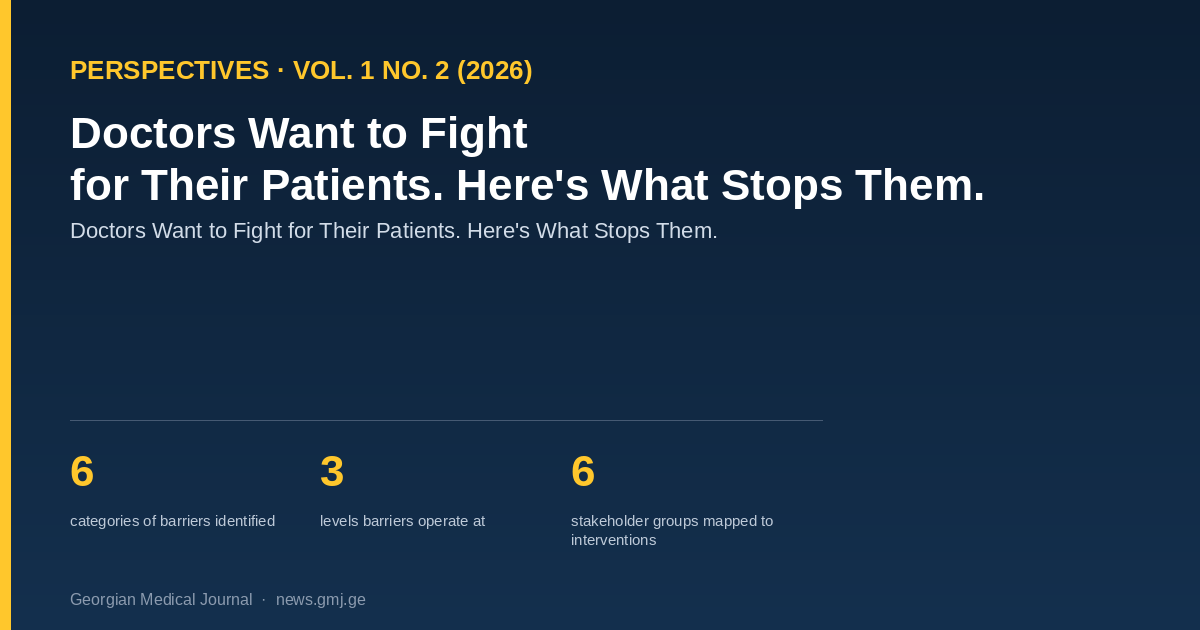
At a glance — the headline figures.

A framework showing how individual, institutional, and systemic determinants shape physician advocacy capacity and downstream patient, system, and profession-level outcomes. Figure from the commentary. Source: Georgian Medical Journal, Vol. 1 No. 2 (2026), DOI: 10.66636/gmj.v1.i2.a6.
The commentary’s central claim is a reframing: effective patient advocacy is not the moral achievement of unusually courageous individual doctors, but a structural property of well-designed healthcare systems. Fixing it, the authors argue, requires coordinated action across physician development, institutional culture, professional society leadership, and health policy reform together — not just asking individual doctors to be braver.
🗺️ Find certified Georgian healthcare providers: sheniekimi.ge — Georgia Health Map · 998 clinics · 6,600+ doctors · 2,296 pharmacies
Read the Original Research
Original article: Doctors Want to Fight for Their Patients. Here’s What Stops Them.
Published in: Georgian Medical Journal, Vol. 1 No. 2 (2026)
DOI: 10.66636/gmj.v1.i2.a6
📄 Read the full article at gmj.ge →
Georgian Medical Journal (GMJ) · ISSN 3088-4322 · gmj.ge · Open Access CC BY 4.0 · Published by the Public Health Institute of Georgia (PHIG). This summary is an independent editorial product of GMJ News; for clinical decisions, consult the original peer-reviewed article and a qualified professional.
Was this article helpful?
Disclaimer. This article is health journalism intended for general information and education. It is not medical advice and is not a substitute for professional diagnosis or treatment. Always consult a qualified healthcare provider about your individual circumstances. Full disclaimer →
Related Coverage




Editorial standards. This article was produced under the GMJ News editorial process, with oversight by the GMJ Editorial Board. Our editorial process. Spotted an error? Contact the editorial team.