Updated 13/09/2026
Photo: iPhone Home Screen, by freestocks.org · Public domain / CC0 · Source
Plain-language summary of research published in the Georgian Medical Journal. Written for the general public by the GMJ News editorial team.
Generative AI chatbots fabricate medical citations in an estimated 28–47% of queries — and Georgian speakers face a compounded risk, since commercial AI tools offer poor localisation and no evidence-based Georgian-language symptom triage tool existed before now. A study in the Georgian Medical Journal documents SheniEkimi: a non-commercial, fully auditable alternative built specifically to close that gap.

Built to Be Audited, Not Just Used
Unlike a general-purpose chatbot, SheniEkimi is anchored exclusively in named international clinical guidelines and externally validated clinical decision rules (CDRs) — meaning every triage recommendation traces back to a specific, citable source, not a language model’s best guess. The team built a 16-body-system framework adapted from WHO’s IMAI/IMCI programme and ICD-11, then selected 150 clinical scenarios that met four strict inclusion criteria: assessable without in-hospital diagnostics, backed by an evidence-based threshold from a guideline or validated CDR, mappable to ICD-11, and common enough in primary care to matter.
What’s Actually Under the Hood
Twenty-nine clinical decision rules meeting quality criteria — peer-reviewed derivation, external validation, explicit thresholds, primary-care applicability — were implemented with full multi-question weighted scoring. Sources span 39 international guidelines, from WHO and NICE to AHA/ACC, ESC, and specialty consortia. The tool itself runs as a single-file WordPress plugin with a bilingual Georgian/English interface, full offline capability, and no collection or transmission of identifiable personal data.
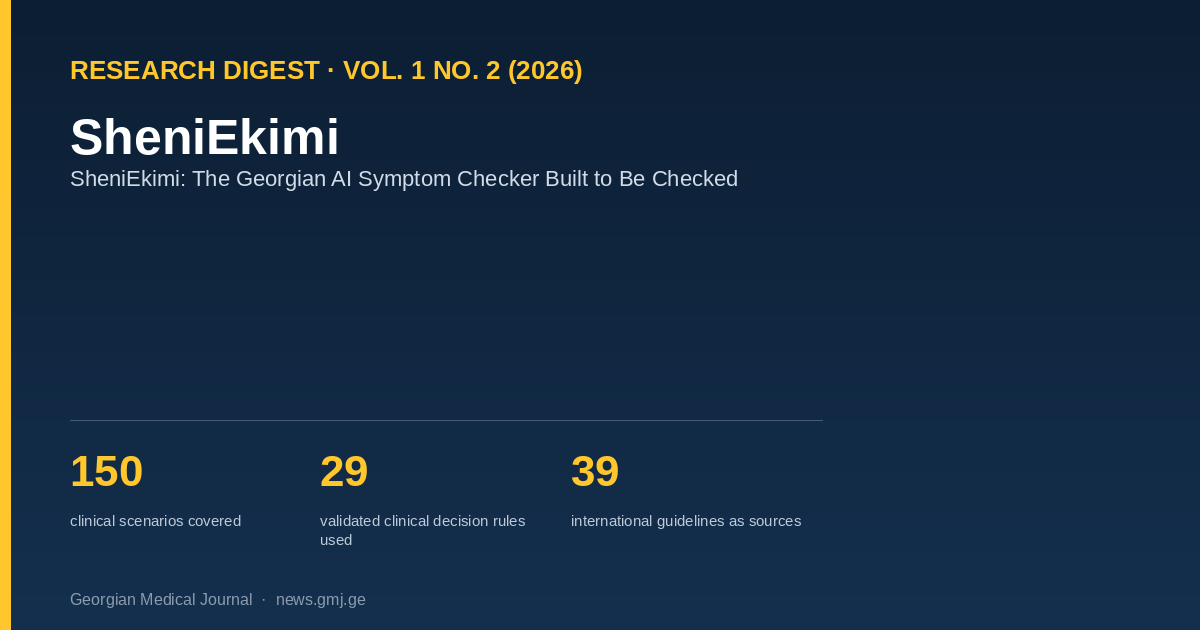
At a glance — the headline figures.
Of the 150 scenarios, 46% route to emergency dispatch, 50% to same-day primary care, and 4% to safe home self-care — a triage distribution the team validated deterministically, confirming every clinical decision rule’s scoring chain produces valid output across its full range. The whole methodology, source code, and scenario registry are published under CC BY 4.0, meaning SheniEkimi isn’t just a tool for Georgian speakers — it’s offered as a reusable template for any other regional or minority-language digital health initiative facing the same localisation gap.
🗺️ Find certified Georgian healthcare providers: sheniekimi.ge — Georgia Health Map · 998 clinics · 6,600+ doctors · 2,296 pharmacies
Read the Original Research
Original article: SheniEkimi: The Georgian AI Symptom Checker Built to Be Checked
Published in: Georgian Medical Journal, Vol. 1 No. 2 (2026)
DOI: 10.66636/gmj.v1.i2.a113
📄 Read the full article at gmj.ge →
Georgian Medical Journal (GMJ) · ISSN 3088-4322 · gmj.ge · Open Access CC BY 4.0 · Published by the Public Health Institute of Georgia (PHIG). This summary is an independent editorial product of GMJ News; for clinical decisions, consult the original peer-reviewed article and a qualified professional.
Was this article helpful?
Disclaimer. This article is health journalism intended for general information and education. It is not medical advice and is not a substitute for professional diagnosis or treatment. Always consult a qualified healthcare provider about your individual circumstances. Full disclaimer →
Related Coverage




Editorial standards. This article was produced under the GMJ News editorial process, with oversight by the GMJ Editorial Board. Our editorial process. Spotted an error? Contact the editorial team.