By using this site, you agree to the Privacy Policy and Terms of Use.
Accept
GMJ NewsGMJ NewsGMJ News
  • Latest News
    • GMJ Briefs
  • Podcast & Media
    • Podcast Episodes
    • GMJ Audio
    • GMJ Videos
  • Research Digest
    • New Studies
    • Georgian Research
    • Data & Numbers
  • Policy & Systems
    • Health Policy
    • Quality & Safety
    • Migration & Health
    • Global Health
  • Practice
    • Clinical Updates
    • Case Discussions
    • Pharmacy & Prescribing
    • Ingredients A-Z
  • Perspectives
    • Editorial
    • Explainers
    • Voices
    • Letters
  • Health Topics
  • GMJ Articles
    • Vol. 1 Issue 2 (2026)
    • Vol. 1 Issue 1 (2026)
    • Pre-Launch Articles (2025)
  • Read the Journal →
  • About GMJ News
Notification Show More
Font ResizerAa
GMJ NewsGMJ News
Font ResizerAa
  • Latest News
    • GMJ Briefs
  • Podcast & Media
    • Podcast Episodes
    • GMJ Audio
    • GMJ Videos
  • Research Digest
    • New Studies
    • Georgian Research
    • Data & Numbers
  • Policy & Systems
    • Health Policy
    • Quality & Safety
    • Migration & Health
    • Global Health
  • Practice
    • Clinical Updates
    • Case Discussions
    • Pharmacy & Prescribing
    • Ingredients A-Z
  • Perspectives
    • Editorial
    • Explainers
    • Voices
    • Letters
  • Health Topics
  • GMJ Articles
    • Vol. 1 Issue 2 (2026)
    • Vol. 1 Issue 1 (2026)
    • Pre-Launch Articles (2025)
  • Read the Journal →
  • About GMJ News
Follow US
GMJ News > GMJ Briefs > By the Numbers: The Staggering Scale of Your Gut Microbiome

By the Numbers: The Staggering Scale of Your Gut Microbiome

GMJ
Last updated: 10/07/2026 06:43
By
Prof. Giorgi Pkhakadze
Share
1 Min Read
Scientific illustration of diverse gut microorganisms including bacteria, viruses and fungi
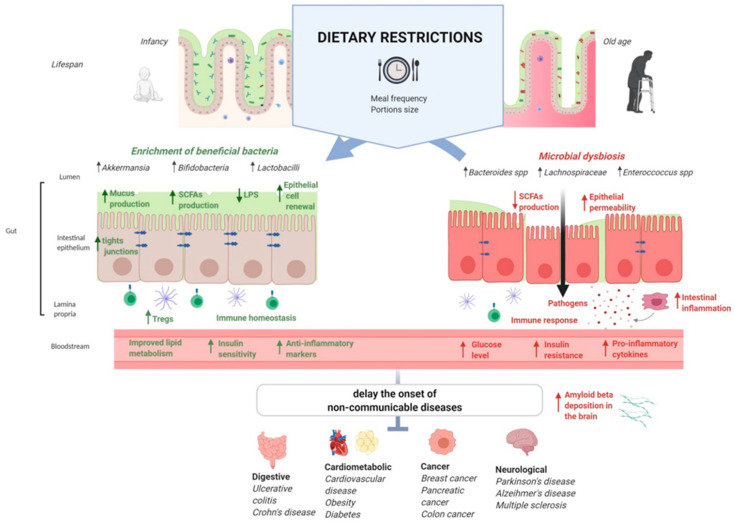
The human gut harbors 100 trillion microorganisms that perform essential functions for digestion, immunity, and overall health. This complex microbial ecosystem influences everything from nutrient metabolism to mental health through intricate host-microbe interactions. — Microorganisms-08-01140-g001 The possible role of gut microbiota in the interplay between dietary restrictions, gut barrier functions, health benefits, and non-communicable diseases.jpg by 1UOC di Nutrizione Clinica, Dipartimento di Scienze mediche e chirurgiche, Fondazione Policlinico Universitario A. Gemelli IRCCS, Largo A. Gemelli 8, 00168 Rome, Italy 2Scuola di Specializzazione in Scienza dell’Alimentazione, Università di Roma Tor Vergata, Via Montpellier 1, 00133 Rome, Italy; moc.liamg@inotnic.ocram 3UOSD di Nutrizione Avanzata in Oncologia, Dipartimento di Scienze mediche e chirurgiche, Fondazione Policlinico Universitario A. Gemelli IRCCS, Largo A. Gemelli 8, 00168 Rome, Italy; moc.liamg@1luoar.eniluap (P.R.); ti.ttacinu@elem.anitsircairam (M.C.M.) 4UOC di Medicina Interna e Gastroenterologia, Dipartimento di Scienze mediche e chirurgiche, Fondazione Policlinico Universitario A. Gemelli IRCCS, Largo A. Gemelli 8, 00168 Rome, Italy; ti.liamtoh@orinai.aculnaig (G.I.); moc.liamg@aizercul.azretal (L.L.); ti.orebil@sirolosutepol (L.R.L.); moc.liamg@inaiznop.acsecnarf (F.R.P.); ti.ttacinu@inirrabsag.oinotna (A.G.) 5Department of Medicine and Ageing Sciences, Faculty of Medicine and Surgery,“G. d’Annunzio” University of Chieti-Pescara, Via dei Vestini 31, 66100 Chieti, Italy 6Center for Advanced Studies and Technology (CAST), “G. d’Annunzio” University of Chieti-Pescara, Via dei Vestini 31, 66100 Chieti, Italy 7Dipartimento di Medicina e Chirurgia traslazionale, Facoltà di Medicina e Chirurgia, Università Cattolica Del Sacro Cuore, Largo F. Vito 1, 00168 Rome, Italy / CC BY-SA 4.0 via Wikimedia Commons (CC BY-SA 4.0)
SHARE
1 min read|140 words

A striking revelation from microbiome research challenges our understanding of human biology: your gut contains approximately 100 trillion microorganisms—outnumbering your own human cells by a ratio of 10 to 1. This mind-bending statistic underscores the sheer scale of the microbial ecosystem residing within our digestive tracts. Research published in the Proceedings of the National Academy of Sciences documents bacterial concentrations reaching up to 10^12 cells per gram of intestinal content, making the gut one of the densest microbial habitats on Earth. The composition of this ecosystem is remarkably consistent across healthy individuals, with the bacterial phyla Firmicutes and Bacteroidetes comprising approximately 90 percent of gut bacterial communities. The National Institutes of Health Human Microbiome Project has identified over 1,000 distinct bacterial species in healthy human guts. These numbers illustrate not merely curiosity-inducing biology, but fundamental evidence of how profoundly microorganisms shape human health and physiology.

Was this article helpful?

GMJ Brief · Key Finding

📰 Read the full article: The Human Gut Microbiome: Trillions of Microorganisms Shape Health and Disease →

Share This Article
Facebook LinkedIn Bluesky Copy Link Print
GMJ
ByProf. Giorgi Pkhakadze
Follow:
Prof. Giorgi Pkhakadze, MD, MPH, PhD, is Editor-in-Chief of the Georgian Medical Journal and Chair of the Public Health Institute of Georgia (PHIG). He is Professor and Head of the Department of Social and Behavioural Sciences at David Tvildiani Medical University, and Secretary/Treasurer of the UEMS Section of Public Health. ORCID: 0000-0001-7609-4515.


Submit Your Paper →

Georgia's peer-reviewed open-access medical journal. No APC until January 2027.
Submit Manuscript →
Early immune markers could identify which TB-infected people will develop active disease

Research at the Francis Crick Institute suggests that specific immune markers may…

Air pollution drives school absences and health symptoms in Delhi and Dhaka youth, new study shows

A new study of 814 young people in Delhi and Dhaka finds…

Novel Prime-and-Pull Vaccine Strategy Shows Promise Against Genital Herpes in Preclinical Models

Yale researchers developed a novel prime-and-pull vaccine that prevented genital herpes infection…

Submit Your Paper to GMJ

No APC until January 2027.
Submit Manuscript →

You Might Also Like

Diagram showing hematopoietic stem cell differentiation into various blood cell types

What You Need to Know About Your Blood Cell Production and Health

By
Prof. Giorgi Pkhakadze
27/06/2026
Illustration of microglia immune cells in brain tissue with amyloid-beta plaques

What Patients Should Know: OLE Targets Neuroinflammation in Emerging Alzheimer’s Therapy

By
Prof. Giorgi Pkhakadze
14/08/2026
Digital representation of lung transplant technology and ex vivo perfusion systems

Hundreds of Donor Lungs Analyzed to Predict Transplant Success

By
Prof. Giorgi Pkhakadze
24/06/2026
Medical professional reviewing cancer detection test results and data charts

What the SUMMIT Trial Teaches Us About Next-Generation Cancer Screening

By
Prof. Giorgi Pkhakadze
14/07/2026
Facebook Twitter Youtube Instagram
Company
  • Privacy Policy
  • Contact US
  • GMJ Journal
  • Submit Manuscript
  • Editorial Team
  • Register at GMJ
  • Terms of Use

Subscribe to GMJ News — Click here

Join Community
© 2026 Georgian Medical Journal (GMJ). Published by the Public Health Institute of Georgia (PHIG). All rights reserved.
Welcome Back!

Sign in to your account

Username or Email Address
Password

Lost your password?

Not a member? Sign Up