By using this site, you agree to the Privacy Policy and Terms of Use.
Accept
GMJ NewsGMJ NewsGMJ News
  • Latest News
    • GMJ Briefs
  • Podcast & Media
    • Podcast Episodes
    • GMJ Audio
    • GMJ Videos
  • Research Digest
    • New Studies
    • Georgian Research
    • Data & Numbers
  • Policy & Systems
    • Health Policy
    • Quality & Safety
    • Migration & Health
    • Global Health
  • Practice
    • Clinical Updates
    • Case Discussions
    • Pharmacy & Prescribing
    • Ingredients A-Z
  • Perspectives
    • Editorial
    • Explainers
    • Voices
    • Letters
  • GMJ Articles
    • Vol. 1 Issue 2 (2026)
    • Vol. 1 Issue 1 (2026)
    • Pre-Launch Articles (2025)
  • Read the Journal →
  • About GMJ News
Notification Show More
Font ResizerAa
GMJ NewsGMJ News
Font ResizerAa
  • Latest News
    • GMJ Briefs
  • Podcast & Media
    • Podcast Episodes
    • GMJ Audio
    • GMJ Videos
  • Research Digest
    • New Studies
    • Georgian Research
    • Data & Numbers
  • Policy & Systems
    • Health Policy
    • Quality & Safety
    • Migration & Health
    • Global Health
  • Practice
    • Clinical Updates
    • Case Discussions
    • Pharmacy & Prescribing
    • Ingredients A-Z
  • Perspectives
    • Editorial
    • Explainers
    • Voices
    • Letters
  • GMJ Articles
    • Vol. 1 Issue 2 (2026)
    • Vol. 1 Issue 1 (2026)
    • Pre-Launch Articles (2025)
  • Read the Journal →
  • About GMJ News
Follow US
GMJ News > GMJ Briefs > Revolutionary AI System Identifies Osteoporosis Risk Hidden in Routine Chest X-rays

Revolutionary AI System Identifies Osteoporosis Risk Hidden in Routine Chest X-rays

GMJ
Last updated: 07/06/2026 16:00
By
Prof. Giorgi Pkhakadze
Share
1 Min Read
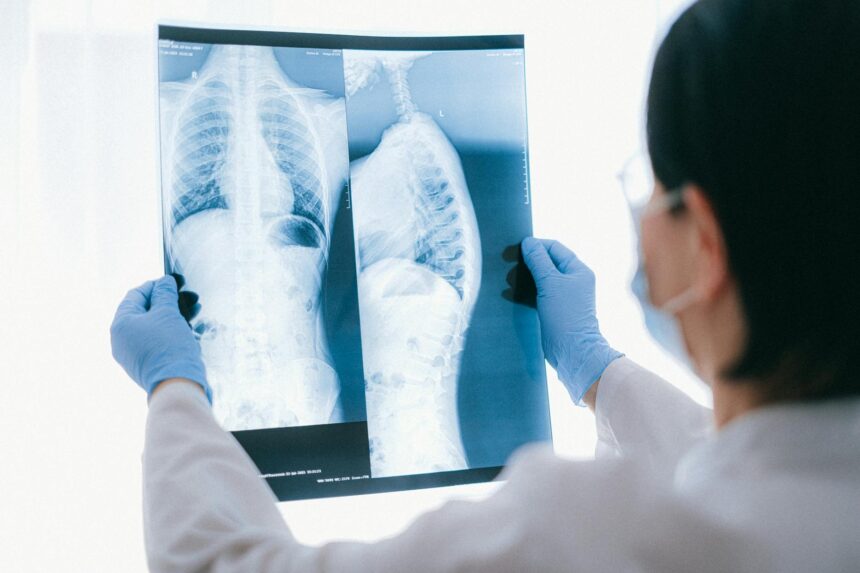
Medical professional reviewing chest X-ray with AI analysis highlighting bone density patterns
New AI technology can detect early bone loss from routine chest X-rays, potentially identifying millions of at-risk patients who fall outside current osteoporosis screening guidelines. The approach could transform preventive care for younger adults, men, and other underserved populations. — Photo: Anna Shvets / Pexels
SHARE
1 min read|120 words

A groundbreaking artificial intelligence system is reshaping osteoporosis detection by identifying bone loss from chest X-rays performed for unrelated clinical reasons. This innovation addresses a significant public health challenge: millions of at-risk patients remain undiagnosed until suffering a fracture.

Current screening guidelines create substantial gaps in care, excluding approximately 85% of men under 70, 78% of women under 50, and 65% of normal-weight adults from routine osteoporosis assessment. The new AI technology enables opportunistic screening within existing imaging workflows, requiring no additional appointments or procedures.

With 50 million Americans affected by osteoporosis or low bone density, early detection through this technology could prevent countless fractures and improve quality of life across diverse populations traditionally overlooked by conventional screening protocols.

Read the full article on GMJ Newsroom.

Submit Your Paper
GMJ_Submit_Banner

Was this article helpful?

GMJ Brief · Announcement

📰 Read the full article: AI Tool Detects Silent Bone Loss from Routine Chest X-rays Before Fractures Strike →

Related reference
  • Osteoporosis · Condition
Share This Article
Facebook LinkedIn Bluesky Copy Link Print
GMJ
ByProf. Giorgi Pkhakadze
Follow:
Prof. Giorgi Pkhakadze, MD, MPH, PhD, is Editor-in-Chief of the Georgian Medical Journal and Chair of the Public Health Institute of Georgia (PHIG). He is Professor and Head of the Department of Social and Behavioural Sciences at David Tvildiani Medical University, and Secretary/Treasurer of the UEMS Section of Public Health. ORCID: 0000-0001-7609-4515.

Submit Your Paper →

Georgia's peer-reviewed open-access medical journal. No APC until January 2027.
Submit Manuscript →
Light roast coffee retains highest chlorogenic acid levels, study shows

Light roast coffee preserves 8.0 mg/g of chlorogenic acids compared to 4.35…

Zinc depletion in athletes: why the standard RDA falls short during training

The human body stores only ~2 grams of zinc with no physiological…

How Your Body Switches Between Two Operating Systems: The Autonomic Nervous System Explained

Your body operates two competing nervous systems that constantly switch control. The…

Submit Your Paper to GMJ

No APC until January 2027.
Submit Manuscript →

You Might Also Like

Medical ultrasound equipment used for intestinal imaging in Crohn's disease monitoring

Post-Surgical Crohn’s Recurrence Rates High, Yet Ultrasound Monitoring Remains Underutilized

By
Prof. Giorgi Pkhakadze
13/06/2026
Medical pills and regulatory documents representing UK medicine approvals

UK Regulatory Agency Approves Record 47 New Medicines, Prioritizing Neurological Advances

By
Prof. Giorgi Pkhakadze
15/06/2026
Medical illustration showing teclistamab bispecific antibody mechanism in multiple myeloma treatment

What Clinicians Need to Know: Teclistamab’s Earlier-Line Role in Myeloma Care

By
Prof. Giorgi Pkhakadze
09/07/2026
Scientific researchers working on longevity interventions in laboratory setting

What Readers Should Know About the XPRIZE Healthspan Longevity Competition

By
Prof. Giorgi Pkhakadze
29/06/2026
Facebook Twitter Youtube Instagram
Company
  • Privacy Policy
  • Contact US
  • GMJ Journal
  • Submit Manuscript
  • Editorial Team
  • Register at GMJ
  • Terms of Use

Subscribe to GMJ News — Click here

Join Community
© 2026 Georgian Medical Journal (GMJ). Published by the Public Health Institute of Georgia (PHIG). All rights reserved.
Welcome Back!

Sign in to your account

Username or Email Address
Password

Lost your password?

Not a member? Sign Up