Updated 13/09/2026
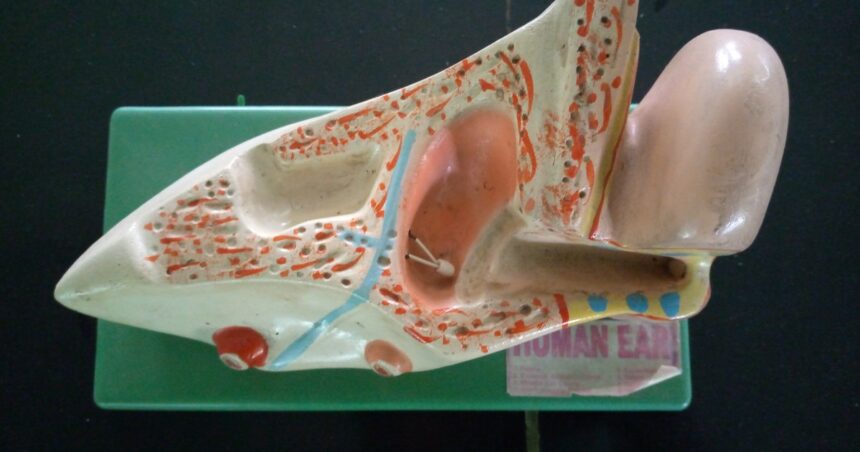
Photo: Cross section of human ear, by Jeremyida002 (Wikimedia), cropped for layout · Licensed CC BY-SA 4.0 · Source
Plain-language summary of research published in the Georgian Medical Journal. Written for the general public by the GMJ News editorial team.
Vestibular dysfunction — the medical term for chronic balance problems rooted in the inner ear — is increasingly suspected of contributing to cognitive impairment, not just dizziness. An exploratory case-control study in the Georgian Medical Journal investigates a specific genetic link behind that connection: a polymorphism in the BACE1 gene, already known for its central role in Alzheimer’s disease biology.

Why the Inner Ear Might Matter for the Brain
BACE1 (β-site amyloid precursor protein cleaving enzyme 1) plays a central role in amyloid-β metabolism and synaptic regulation — the same biological pathway implicated in Alzheimer’s disease. Increasing evidence suggests vestibular dysfunction contributes to cognitive impairment by disrupting hippocampal-dependent processes, but whether BACE1 genetic variation specifically shapes that vestibular-cognitive vulnerability had remained unexplored before this study.
The Study Groups
This exploratory case-control study included 108 participants aged 25 to 80, split into three groups: vestibular system dysfunction (VSD, n=45), Alzheimer’s disease (AD, n=21), and healthy controls (n=42). Cognitive performance was assessed with standardised neuropsychological instruments, and every participant was genotyped for the rs638405 polymorphism using TaqMan real-time PCR assays.

At a glance — the headline figures.
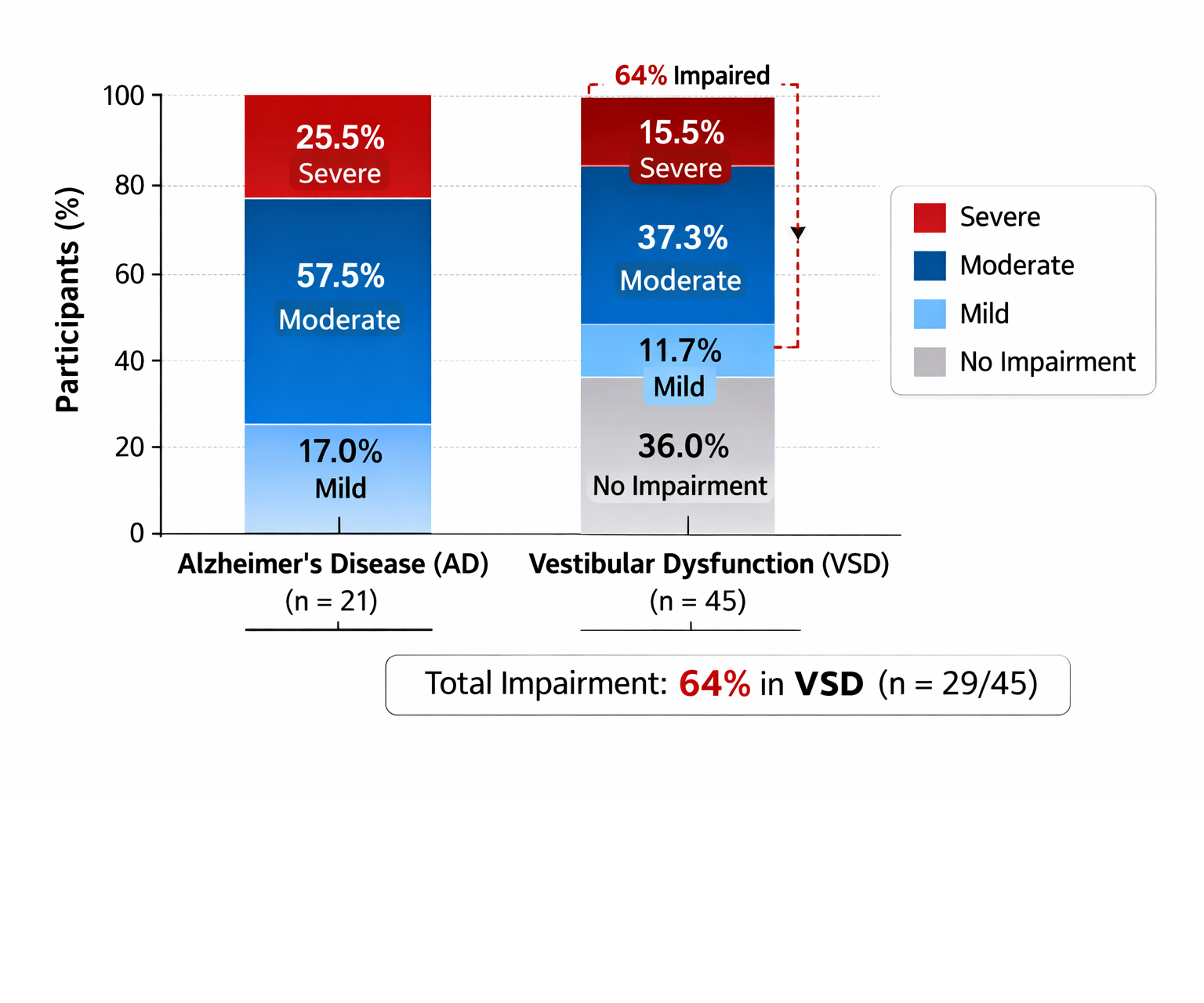
Cognitive impairment severity among participants with Alzheimer’s disease versus vestibular system dysfunction — 64% of the VSD group showed some degree of impairment. Figure from the study. Source: Georgian Medical Journal, Vol. 1 No. 1 (2026), DOI: 10.5281/zenodo.19120293.
The GG genotype of rs638405 was notably more common in the vestibular dysfunction group than in healthy controls — 24.4% versus 7.1% (p=0.045, odds ratio 4.51) — a genuine, though only marginally significant, signal given the modest sample size. No significant association turned up between this polymorphism and Alzheimer’s disease directly. Cognitively, 64% of patients with vestibular dysfunction showed some degree of cognitive impairment, a striking figure for a condition usually framed purely in terms of balance and dizziness.
The authors are explicit about the limits here: with a modest sample size, a borderline p-value, and no correction for multiple comparisons, this is an exploratory, preliminary genetic signal — not a confirmed mechanism. What it does support is the broader concept of a vestibular–cognitive axis: balance problems may be more than a fall-risk issue, potentially serving as an early, physically-measurable marker worth tracking for cognitive vulnerability, pending confirmation in larger, multi-centre studies with fuller genetic profiling.
🗺️ Find certified Georgian healthcare providers: sheniekimi.ge — Georgia Health Map · 998 clinics · 6,600+ doctors · 2,296 pharmacies
Read the Original Research
Original article: Balance Problems and the Vulnerable Mind: A Gene Study Links the Inner Ear to Cognition
Published in: Georgian Medical Journal, Vol. 1 No. 1 (2026)
DOI: 10.5281/zenodo.19120293
📄 Read the full article at gmj.ge →
Georgian Medical Journal (GMJ) · ISSN 3088-4322 · gmj.ge · Open Access CC BY 4.0 · Published by the Public Health Institute of Georgia (PHIG). This summary is an independent editorial product of GMJ News; for clinical decisions, consult the original peer-reviewed article and a qualified professional.
Was this article helpful?
100% of readers found this helpful (1 votes)
Disclaimer. This article is health journalism intended for general information and education. It is not medical advice and is not a substitute for professional diagnosis or treatment. Always consult a qualified healthcare provider about your individual circumstances. Full disclaimer →
Related Coverage



Editorial standards. This article was produced under the GMJ News editorial process, with oversight by the GMJ Editorial Board. Our editorial process. Spotted an error? Contact the editorial team.