Pan American Health Organization · Interim recommendations, 7 April 2020
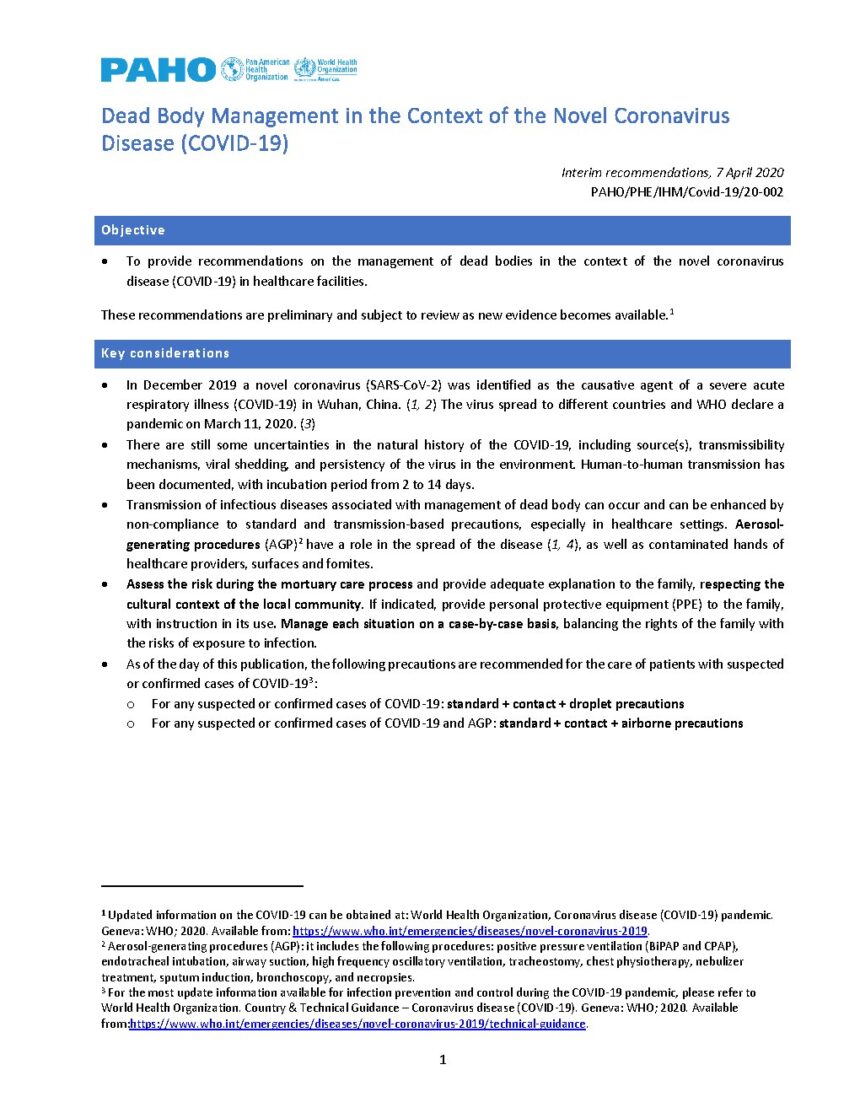
Interim recommendations for safe handling of deceased persons with suspected or confirmed COVID-19 in healthcare facilities.
- Issuer
- Pan American Health Organization
- Edition
- Interim recommendations, 7 April 2020
- Audience
- Mortuary staff, funeral directors, infection prevention and control teams, healthcare workers performing autopsies
- Evidence
- Expert consensus based on evidence from coronavirus persistence studies and infection control principles
- Reviewed
- 19 Oct 2026 · GMJ
What this guideline says
GMJ summary
This interim guidance from the Pan American Health Organization provides detailed procedures for the safe management of deceased persons with suspected or confirmed COVID-19. The document addresses packing and transfer, mortuary care, burial practices, and autopsy procedures, with emphasis on appropriate infection prevention and control measures throughout the mortuary care process.
Key precautions include standard plus contact and droplet precautions for all COVID-19 cases, with airborne precautions added for aerosol-generating procedures. The guidance emphasises that body bags are not necessary, embalming is not recommended, and both burial and cremation are acceptable. Environmental surfaces should be disinfected with 0.1% sodium hypochlorite (1000 ppm) or 62–71% ethanol, which significantly reduces coronavirus infectivity within 1 minute exposure time.
For autopsies, the document requires adequately ventilated rooms (at least 160 L/s/person natural ventilation or negative pressure with at least 12 air changes per hour), appropriate PPE including N95 respirators, and minimisation of aerosol-generating procedures such as use of power saws. The guidance balances infection control with respect for cultural practices and family rights to view the deceased.
Key points
For clinicians — doses and thresholds as stated in the guideline
- Apply standard + contact + droplet precautions for all suspected or confirmed COVID-19 cases; add airborne precautions for aerosol-generating procedures
- Disinfect environmental surfaces with 0.1% sodium hypochlorite (1000 ppm) or 62–71% ethanol with at least 10 minutes contact time for chlorine solutions
- Body bags are not necessary; wrap the body in cloth or tissue and transfer to mortuary as soon as possible
- Perform autopsies only in adequately ventilated rooms: at least 160 L/s/person natural ventilation or negative pressure rooms with at least 12 air changes per hour
- For autopsies of COVID-19 cases, wear scrub suit, N95 mask, long-sleeved fluid-resistant gown, double gloves or autopsy gloves, face shield or goggles, and boots
- Embalming is not recommended; both burial and cremation are acceptable for COVID-19 decedents
- Minimise aerosol-generating procedures during autopsy: avoid power saws when possible, use vacuum shrouds for oscillating saws, avoid high-pressure water sprays
- Family may view the body following standard precautions and hand hygiene, with clear instructions not to touch or kiss the body
Use of personal protective equipment according to procedure related to mortuary management of COVID-19
Table extracted from the guideline
| Procedure | Hand hygiene | Gloves | Surgical Mask | Respirator (N-95 or similar) | Long sleeved impermeable gown | Facial protection |
|---|---|---|---|---|---|---|
| Managing the body inside the isolation room | ✓ | ✓ | ✓ | ✓ | ✓ | |
| Removal of the body from the isolation room or similar area | ✓ | ✓ | ✓ | ✓ | ✓ | |
| Mortuary care | ✓ | ✓ | ✓ | ✓ | ✓ | |
| Necropsies | ✓ | ✓ | ✓ | ✓ |
Source: Pan American Health Organization, Dead Body Management in the Context of COVID-19. Reproduced in summary form.
From the guideline
Verbatim
“Surface disinfection with 0.1% sodium hypochlorite or 62–71% ethanol significantly reduces coronavirus infectivity on surfaces within 1 min exposure time.”
Editor’s perspective
Why this matters for Georgia and the region
Prof. Giorgi Pkhakadze, MD, MPH, PhD
Editor-in-Chief, Georgian Medical Journal · Chair, Public Health Institute of Georgia · WHO consultant, health and migration
As someone who has advised WHO on health system responses to complex humanitarian and infectious disease challenges, I recognise this PAHO guidance addresses a critical gap that emerged early in the COVID-19 pandemic when fear and misinformation led to unsafe practices and denial of dignified death rituals. For Georgian healthcare facilities, I would particularly stress the ventilation requirements for autopsy rooms—12 air changes per hour for negative pressure systems or 160 litres per second per person for natural ventilation—as many of our older medical facilities may require infrastructure assessment and upgrading to meet these standards. The evidence that 0.1% sodium hypochlorite with 10-minute contact time effectively inactivates coronavirus on surfaces provides a practical, low-cost disinfection protocol that our facilities can implement immediately. One realistic implementation challenge in Georgia and the wider Caucasus region will be balancing the recommended precautions against family viewing (no touching or kissing) with deeply rooted Orthodox Christian and Muslim mourning traditions that involve close physical contact with the deceased; healthcare facilities will need culturally sensitive communication strategies and possibly designated family liaison staff to navigate these difficult conversations with grieving relatives whilst maintaining infection control standards.
ORCID 0000-0001-7609-4515 · Perspective written for the GMJ Guidelines Library, 19 Oct 2026
Applicability
Georgia and the South Caucasus
This guidance remains highly applicable for healthcare facilities in Georgia and the South Caucasus region managing COVID-19 deaths and conducting post-mortem procedures. National programmes should ensure availability of appropriate ventilation systems in mortuary and autopsy facilities (160 L/s/person or 12 air changes per hour for negative pressure rooms), adequate stocks of PPE including N95 respirators and face shields, and standardised protocols for preparing 0.1% sodium hypochlorite solutions. Cultural sensitivity is particularly important in Georgia and neighbouring countries where Orthodox Christian, Muslim, and other traditions involve close family contact with the deceased; the guidance provides a framework for balancing infection control with respect for mourning practices. Healthcare facilities should develop specific protocols for family viewing that implement the recommended precautions whilst accommodating local customs.
Questions this guideline answers
Quick answers
Are body bags required for COVID-19 deceased persons?
No, body bags are not necessary. The body should be wrapped in cloth or any other tissue for transfer and removed as soon as possible to the mortuary area, with minimum handling and movement.
What disinfectant concentration should be used for environmental cleaning after handling COVID-19 bodies?
Use 0.1% sodium hypochlorite (1000 ppm) or 62–71% ethanol. If using sodium hypochlorite, wet the surface and allow at least 10 minutes contact time. Chlorine solution should be diluted daily and kept out of sunlight.
Can families view the body of a COVID-19 deceased person?
Yes, families may view the body after removal from the isolation room following standard precautions and hand hygiene. They must receive clear instructions not to touch or kiss the body. PPE may be provided to family members with instruction in its use.
What ventilation is required for COVID-19 autopsies?
Autopsies require at least natural ventilation with 160 L/s/person air flow, or negative pressure rooms with at least 12 air changes per hour with controlled direction of air flow when using mechanical ventilation. Exhaust systems should direct air and aerosols away from healthcare workers.
Related on GMJ
Interconnected resources
Dictionary of Public Health
GMJ News coverage
Quality & accreditation
- ASF Hospital — Standard 5 — Safety & Emergency Preparedness
- ASF Medical Transport — Standard 5 — Infection Prevention & Control
- ASF Laboratory — Standard 7 — Examination: Process & Safety
- ASF Hospital — Standard 11 — Critical Care
- ASF Medical Transport — Standard 6 — Emergency Response During Transport
Other guidelines on this topic
- Ethics guidance on issues raised by the novel coronavirus disease (COVID-19) pandemic
- Technical specifications of medical devices for the case management of COVID-19 in healthcare settings
- Frequently asked questions for the management of health workers in response to COVID-19
- Environmental Public Health Recommendations for Collective Residential Places: Nursing Homes, Orphanages, and Other Collective Residential Places
- Recommendations for Cleaning and Disinfection Public Places: Supermarkets, Markets, Neighborhood Stores, Banks, Public Transport, and Others
- Issuer
- Pan American Health Organization
- Type
- Procedures, manuals, guidelines
- Edition
- Interim recommendations, 7 April 2020
- Status
- Current
- Published
- 2020-01-01
- Scope
- Management of dead bodies with suspected or confirmed COVID-19 in healthcare facilities
- Audience
- Mortuary staff, funeral directors, infection prevention and control teams, healthcare workers performing autopsies
- Licence
- CC BY-NC-SA 3.0 IGO
- ISBN
- PAHO/PHE/IHM/Covid-19/20-002
- Evidence
- Expert consensus based on evidence from coronavirus persistence studies and infection control principles
- Record history
- Created 19 Oct 2026 · updated 19 Oct 2026 · next check Apr 2027
Pan American Health Organization. Dead Body Management in the Context of the Novel Coronavirus Disease (COVID-19). Interim recommendations, 7 April 2020. Washington, D.C.: PAHO; 2020. (PAHO/PHE/IHM/Covid-19/20-002).GMJ Guidelines Library records are original summaries written by the GMJ editorial team from the issuer’s published document and reviewed by a physician. They do not replace the full guideline. The document is the copyright of its issuer and is linked, not hosted. Spotted an error or a newer edition? Tell the Guidelines Desk.
Was this article helpful?