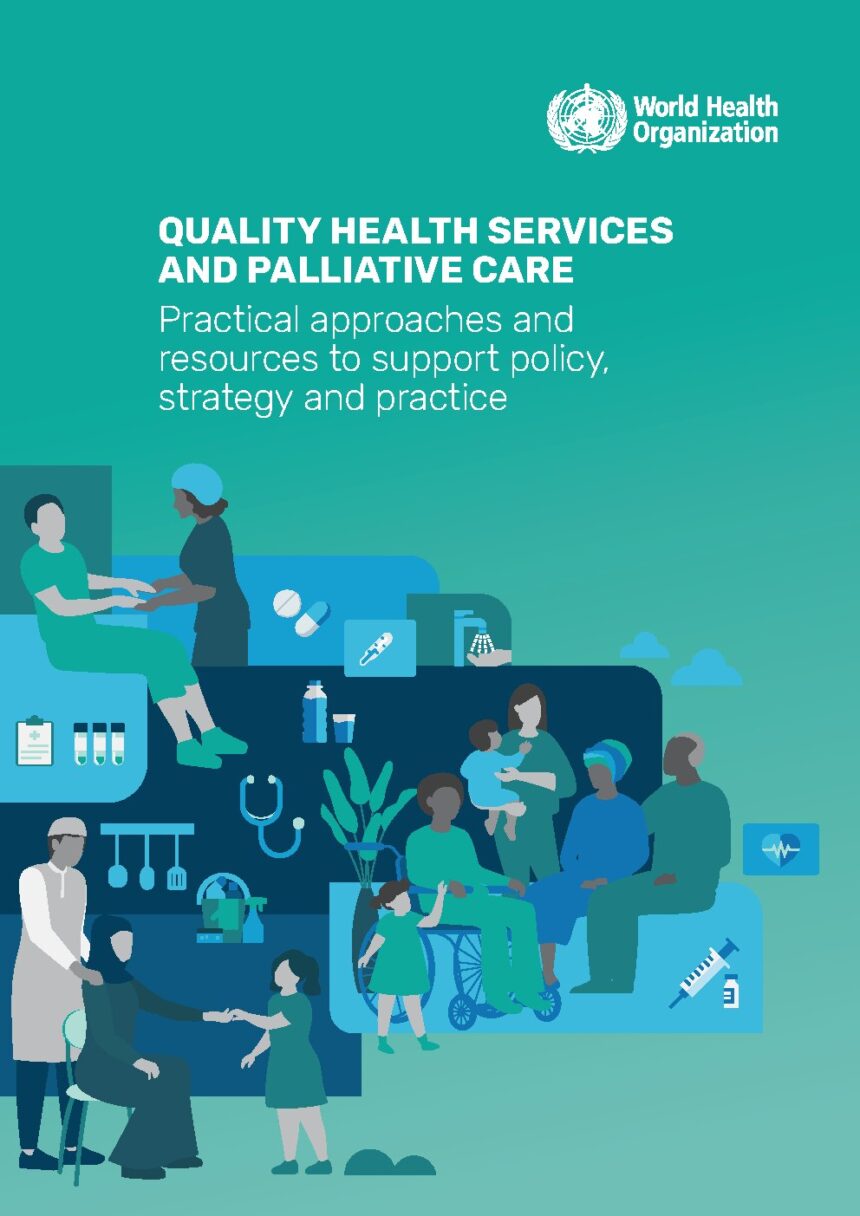
World Health Organization · 1st edition, 2021 · 52 pages
Technical document providing practical approaches for policy-makers and clinicians to integrate quality palliative care into health systems at national, district, and point-of-care levels.
- Issuer
- World Health Organization
- Edition
- 1st edition, 2021
- Audience
- Policy-makers, palliative care service planners, managers, practitioners, health care providers at all levels; particularly relevant for low- and middle-income countries including fragile, conflict-affected and vulnerable settings
- Evidence
- Synthesis of existing WHO guidance and expert consensus; not a normative guideline with graded recommendations but a practical resource adapting recognized research and guidance
- Reviewed
- 23 Oct 2026 · GMJ
What this guideline says
GMJ summary
This WHO technical document establishes a framework for integrating quality considerations into palliative care across all health system levels. It addresses the unmet global need for palliative care—over 56.8 million people annually require palliative care, 78% in low- and middle-income countries, yet only 12% of need is currently met. The document emphasizes that quality palliative care must address all seven domains: effective, safe, people-centred, timely, equitable, integrated, and efficient care.
The framework proposes concrete actions at three levels: national (incorporating quality into policy, aligning with national quality strategy, integrating across the health system, developing measurement systems, and quality assurance); district (commitment to quality, data use for improvement, community engagement); and point-of-care (maintaining home-based care quality, data-driven improvement, integrating quality improvement methods). Special attention is given to opioid access and safety, task-shifting to nurses and community health workers, and measurement challenges specific to palliative care where traditional outcome metrics are inappropriate.
The document positions palliative care as central to achieving universal health coverage through a primary health care approach, requiring integration into essential health services packages, workforce planning, and community engagement to address cultural taboos around death and dying.
Key points
For clinicians — doses and thresholds as stated in the guideline
- Over 56.8 million people annually need palliative care (25.7 million in last year of life), with 78% in low- and middle-income countries; only 12% of global need is currently met
- Quality palliative care must address seven domains: effective, safe, people-centred, timely, equitable, integrated, and efficient
- Palliative care should be integrated early in life-threatening illness alongside curative treatments, not reserved as 'last resort' or end-of-life care only
- National level actions include: incorporating quality into palliative care policy and strategy, aligning with national quality frameworks, integrating palliative care across PHC and all health programmes, developing robust measurement systems, and utilizing quality assurance mechanisms (licensing, registration, standards)
- Task-shifting is recommended: trained nurses can prescribe opioids (as in Uganda's 2004 statute requiring nine months palliative care training and Ministry of Health registration); community health workers and volunteers can deliver home-based care with proper competency-based training and supervision
- District level roles include: committing to quality targets, using data to identify inequalities and variation in care, engaging communities to address misconceptions, and linking national plans to point-of-care implementation
- Point-of-care actions include: implementing evidence-based quality interventions for home care (clinical guidelines, patient assessment tools, safety protocols, adverse event reporting), collecting patient-reported outcome measures and family evaluations, and using quality improvement cycles (e.g., plan-do-study-act)
- Opioid access requires balanced national systems to monitor supply from import/manufacture to patient use, ensuring legal authorization for relevant prescribers while maintaining safe use through education and evidence-based prescribing guidelines
How is quality being considered in the provision of palliative care? Key questions for policy-makers
Table extracted from the guideline
| Quality domain | Key questions |
|---|---|
| Effective | How is the health system facilitating access to evidence-based palliative care through legislation, research, licensing, procurement and medicine supply chains? What quality interventions can improve effectiveness at point of care (guidelines, training, supervision, standards)? |
| Safe | How do we ensure palliative care policy enables essential medicines (morphine, opioid analgesics) to be procured, stored, prescribed and administered safely, without creating access barriers? What is known about key patient safety issues (pressure sores, medication errors)? |
| Person-centred | How does policy and legislation impact ability to construct robust advance care plans consistent with patient values and preferences? Where would most patients prefer to receive care and how can services adapt to meet preferences? |
| Timely | What are rate-limiting steps preventing timely diagnosis and treatment? How do we ensure palliative care and symptom control is incorporated from time of diagnosis across the system? |
| Equitable | Is palliative care viewed as a human right in policy? How do we ensure access without financial hardship? Which populations experience unequal access and how can this be rectified? |
| Integrated | How do we ensure palliative care is integrated at all levels with emphasis on PHC? How can we strengthen referral and information sharing between levels and providers? |
| Efficient | What mechanisms prioritize simple, cost-effective interventions with wide-reaching benefits? How do we coordinate government and nongovernmental providers to maximize resources? |
Source: World Health Organization, Quality health services and palliative care: practical approaches and resources to support policy, strategy and practice. Reproduced in summary form.
From the guideline
Verbatim
“Palliative care is an approach that improves the quality of life of patients (adults and children) and their families who are facing problems associated with life-threatening illness or serious health-related suffering.”
Editor’s perspective
Why this matters for Georgia and the region
Prof. Giorgi Pkhakadze, MD, MPH, PhD
Editor-in-Chief, Georgian Medical Journal · Chair, Public Health Institute of Georgia · WHO consultant, health and migration
As Chair of the Public Health Institute of Georgia, I recognize this framework addresses a critical gap in our universal health coverage programme. Georgia has made significant strides in UHC since 2013, but palliative care integration remains underdeveloped despite growing noncommunicable disease burden in our ageing population. The most immediately actionable recommendation for Georgian clinicians and health managers is establishing task-shifting protocols for nurse-led opioid prescribing in rural areas, following Uganda's model of competency-based training and Ministry registration—this could dramatically expand access given our physician distribution challenges in mountainous regions. However, implementation requires confronting a significant caveat: our current narcotic control legislation prioritizes supply restriction over balanced medical access, and cultural reluctance to discuss death openly limits community engagement. We must simultaneously reform opioid regulations, develop national palliative care standards aligned with existing quality assurance mechanisms under the Healthcare Quality Assurance Service, and invest in public education to address societal taboos—this document provides the evidence-based roadmap, but success depends on political commitment and intersectoral coordination between the Ministries of Health, Internal Affairs (drug control), and Labour and Social Affairs (long-term care).
ORCID 0000-0001-7609-4515 · Perspective written for the GMJ Guidelines Library, 23 Oct 2026
Applicability
Georgia and the South Caucasus
For Georgia and the South Caucasus, this framework is directly applicable to strengthening palliative care within existing universal health coverage programmes. Georgia’s health system reforms since 2013 provide infrastructure for integrating palliative care into the State Healthcare Programmes, but measurement systems and quality assurance mechanisms specific to palliative care require development. The document’s emphasis on primary health care integration aligns with Georgia’s PHC strengthening efforts. National programmes should prioritize: establishing opioid access protocols that balance safety with medical need (currently a barrier in the region); developing competency-based training for task-shifting to nurses in rural areas where physician density is low; creating district-level coordination mechanisms between public, private, and NGO palliative care providers; and addressing cultural attitudes toward death and dying through community engagement. The framework for home-based palliative care is particularly relevant given family-based care traditions in the Caucasus, but requires formal support systems to prevent caregiver burden falling disproportionately on women.
Questions this guideline answers
Quick answers
What is the difference between palliative care and end-of-life care?
Palliative care is an approach that improves quality of life for patients and families facing life-threatening illness through prevention and relief of suffering (physical, psychological, social, spiritual). It includes but is not limited to end-of-life care. It should be integrated early in the course of illness alongside curative treatments, not reserved as a 'last resort.' It continues throughout disease progression and includes bereavement support for families after death.
How can nurses and community health workers safely prescribe opioids for palliative care?
Task-shifting opioid prescribing to trained nurses is feasible with appropriate quality assurance. Uganda's model requires: nine months of palliative care training, registration with the Ministry of Health, standardized competency-based training linked to certification, regular supportive supervision and clinical mentoring, performance assessment against defined competency levels, and clear protocols for safe prescription and administration. Low-cost colour-coding of different morphine concentrations aids safe administration by clinicians, patients, and families.
What quality indicators should be used to measure palliative care at the national level?
WHO recommends indicators covering six components: (i) robust health policies related to palliative care; (ii) use of essential palliative care medicines; (iii) provision within integrated health services; (iv) education and training for providers; (v) empowered people and communities; (vi) palliative care research. These should align with the PHC monitoring framework. Special considerations: outcome measures based on disease recovery or mortality averted are inappropriate for palliative care; patient-reported outcome measures and family post-death evaluation surveys are essential; measurement must capture value of suffering relieved and cost savings from avoiding unnecessary hospitalization.
How should quality be assured for home-based palliative care provided by families and volunteers?
Essential components include: interdisciplinary team approach, timely responsive care, effective pain and symptom management, competency-based training for family and community caregivers covering safe moving/handling, feeding, medication administration, disease education. Support systems needed: respite care, telephone support, clear escalation plans. Quality interventions adaptable to home settings include: clinical guidelines and assessment tools, safety protocols (infection prevention), adverse event reporting, patient self-management tools, and potentially mobile applications enabling caregivers to report patient outcomes to professionals for care prioritization. National standards, licensing, and accreditation mechanisms (as in South Africa's COHSASA hospice accreditation) provide external quality assurance.
Related on GMJ
Interconnected resources
Dictionary of Public Health
Conditions A–Z
GMJ News coverage
- Multi-country study reveals critical gaps in Chagas disease data systems across Bolivia and ParaguayJun 2026
- Pancreatic Cancer Innovation Without Equity: What European Approval of Rasonque Actually RevealsOct 2026
- Amphibian bacterium eliminates colorectal tumors in mice with single dose — potential breakthrough for solid cancersOct 2026
ASF accreditation standards
Other guidelines on this topic
- Caring for those who care: Guide for the development and implementation of occupational health and safety programmes for health workers
- WASH FIT: A practical guide for improving quality of care through water, sanitation and hygiene in health care facilities, Second edition
- Clinical Practice Guideline for Prescribing Opioids for Pain — United States, 2022
- Consolidated telemedicine implementation guide
- Global guidelines for the prevention of surgical site infection, second edition
- Issuer
- World Health Organization
- Type
- Technical document
- Edition
- 1st edition, 2021
- Status
- Current
- Published
- 2021-10-04
- Languages
- English (original); translations not specified
- Scope
- Global, with emphasis on low- and middle-income countries; applicable to all health system levels (national, district, point-of-care) and settings (hospitals, primary care, hospices, long-term care, home-based care)
- Audience
- Policy-makers, palliative care service planners, managers, practitioners, health care providers at all levels; particularly relevant for low- and middle-income countries including fragile, conflict-affected and vulnerable settings
- Pages
- 52
- Licence
- CC BY-NC-SA 3.0 IGO
- ISBN
- 978-92-4-003516-4
- Evidence
- Synthesis of existing WHO guidance and expert consensus; not a normative guideline with graded recommendations but a practical resource adapting recognized research and guidance
- Next review
- Not specified
- Record history
- Created 23 Oct 2026 · updated 23 Oct 2026 · next check Apr 2027
Quality health services and palliative care: practical approaches and resources to support policy, strategy and practice. Geneva: World Health Organization; 2021. Licence: CC BY-NC-SA 3.0 IGO.GMJ Guidelines Library records are original summaries written by the GMJ editorial team from the issuer’s published document and reviewed by a physician. They do not replace the full guideline. The document is the copyright of its issuer and is linked, not hosted. Spotted an error or a newer edition? Tell the Guidelines Desk.
Was this article helpful?