By using this site, you agree to the Privacy Policy and Terms of Use.
Accept
GMJ NewsGMJ NewsGMJ News
  • Latest News
    • GMJ Briefs
  • The Wire
  • Health Topics
  • Podcast & Media
    • GMJ Audio
    • GMJ Videos
    • Podcast & Media
    • Podcast Episodes
  • GMJ Articles
    • Vol. 1 Issue 3 (2026)
    • Public Health Dictionary — Supplement Edition
    • IAP Legacy Series
    • Read Full Journal (gmj.ge) →
    • Pre-Launch Articles (2025)
    • Vol. 1 Issue 1 (2026)
    • Vol. 1 Issue 2 (2026)
  • Perspectives
    • Editorial
    • Explainers
    • Letters
    • Voices
  • Policy & Systems
    • Global Health
    • Health Policy
    • Migration & Health
    • Quality & Safety
    • Work & Health
  • Dictionary
    • Our Story: 20 Years in the Making
    • Browse A–Z
    • About the Project
    • Contribute a Term
  • Practice
    • Case Discussions
    • Clinical Updates
    • Pharmacy & Prescribing
  • Research Digest
    • Data & Numbers
    • Georgian Research
    • New Studies
  • Read the Journal →
Notification Show More
Font ResizerAa
GMJ NewsGMJ News
Font ResizerAa
  • Latest News
  • The Wire
  • Health Topics
  • Podcast & Media
  • GMJ Articles
  • Perspectives
  • Policy & Systems
  • Dictionary
  • Practice
  • Research Digest
  • Read the Journal →
  • Latest News
    • GMJ Briefs
  • The Wire
  • Health Topics
  • Podcast & Media
    • GMJ Audio
    • GMJ Videos
    • Podcast & Media
    • Podcast Episodes
  • GMJ Articles
    • Vol. 1 Issue 3 (2026)
    • Public Health Dictionary — Supplement Edition
    • IAP Legacy Series
    • Read Full Journal (gmj.ge) →
    • Pre-Launch Articles (2025)
    • Vol. 1 Issue 1 (2026)
    • Vol. 1 Issue 2 (2026)
  • Perspectives
    • Editorial
    • Explainers
    • Letters
    • Voices
  • Policy & Systems
    • Global Health
    • Health Policy
    • Migration & Health
    • Quality & Safety
    • Work & Health
  • Dictionary
    • Our Story: 20 Years in the Making
    • Browse A–Z
    • About the Project
    • Contribute a Term
  • Practice
    • Case Discussions
    • Clinical Updates
    • Pharmacy & Prescribing
  • Research Digest
    • Data & Numbers
    • Georgian Research
    • New Studies
  • Read the Journal →
Follow US
GMJ News > Perspectives > Explainers > Why Fat-Soluble Vitamins Need an Oil Carrier: The Science of MCT
Explainers

Why Fat-Soluble Vitamins Need an Oil Carrier: The Science of MCT

GMJ
Last updated: 13/09/2026 21:20
By
GMJ Perspectives Desk
Share
3 Min Read
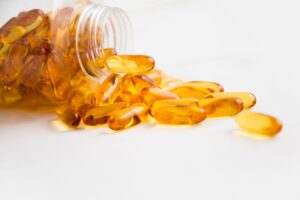
MCT oil used as a carrier for fat-soluble vitamin formulations
SHARE
🎧 Listen to this article5:48 min · 831 words · GMJ Audio

Updated 13/09/2026

Contents
  • Why fat solubility dictates absorption
  • What makes MCT different from other oils
  • Reading the label
  • The bile–micelle pathway, slightly deeper
  • MCT versus long-chain oils versus emulsifiers
  • Softgel engineering: the oxygen problem
  • Practical guidance: making any format work
  • The clinical bottom line
  • Primary sources
4 min read|831 words

Look at a quality vitamin D3 or astaxanthin product and you will usually find a second ingredient doing quiet but essential work: an oil carrier, most often medium-chain triglycerides (MCT). This is not filler. For the four fat-soluble vitamins — A, D, E and K — and for lipophilic compounds such as carotenoids and CoQ10, the carrier determines whether the active ingredient reaches circulation at all.

Why fat solubility dictates absorption

Fat-soluble nutrients cannot dissolve in the watery environment of the gut. Their absorption depends on the fat-digestion pathway: dietary lipids trigger bile release, bile salts emulsify the fats into micelles, and only nutrients incorporated into those micelles are efficiently carried to the intestinal wall for uptake. Taken without fat, a crystalline vitamin D tablet largely passes through unabsorbed — clinical studies have repeatedly shown substantially higher serum responses when fat-soluble vitamins are taken with a fat source, with trials on vitamin D reporting meaningfully greater 25(OH)D increases when supplements accompany a fat-containing meal.

What makes MCT different from other oils

Medium-chain triglycerides — typically caprylic (C8) and capric (C10) acids fractionated from coconut or palm kernel oil — have three formulation advantages. First, built-in solvent function: the active ingredient arrives pre-dissolved in lipid, ready for micelle incorporation without depending on the user remembering to take it with food. Second, oxidative stability: MCTs are fully saturated, so unlike polyunsaturated carriers (sunflower, soybean oil) they do not generate rancidity products during shelf life — particularly important for oxidation-sensitive actives like astaxanthin. Third, digestive simplicity: medium-chain fats are absorbed more readily than long-chain fats, partly independent of bile, which matters for people with reduced fat digestion.

Submit Your Paper
GMJ_Submit_Banner

Reading the label

On ingredient lists, MCT appears as “MCT oil”, “fractionated coconut oil” or “caprylic/capric triglycerides”. Its presence in a fat-soluble vitamin product is a formulation-competence marker: it signals the manufacturer engineered for absorption rather than just for dosage arithmetic. The same logic explains why oil-based softgels and drops generally outperform dry tablets for vitamins D, E, K and A.

The bile–micelle pathway, slightly deeper

Fat digestion is a staged emulsification cascade. Dietary fat entering the duodenum triggers cholecystokinin release; the gallbladder contracts, delivering bile salts — biological detergents with a fat-facing and a water-facing side. Bile salts break fat globules into micro-droplets, pancreatic lipase strips triglycerides into monoglycerides and free fatty acids, and these re-assemble with bile salts into mixed micelles: nanometre-scale ferries whose oily cores dissolve fat-soluble vitamins and carry them across the unstirred water layer to the enterocyte surface. Inside the intestinal cell, the cargo is repackaged into chylomicrons and enters the lymphatic system — bypassing the liver’s first pass entirely, which is a pharmacokinetic peculiarity of fat-soluble nutrients. Every link in this chain — CCK signal, bile flow, lipase, micelle formation — is switched on by one trigger: fat in the meal. No fat, no ferry.

MCT versus long-chain oils versus emulsifiers

Formulators have three carrier strategies. Long-chain triglycerides (olive, sunflower, fish oil) work but bring their own oxidation risk when polyunsaturated, and depend fully on the bile pathway. MCTs dissolve the active equally well, are oxidation-inert (fully saturated), and enjoy partial bile-independent absorption — the pragmatic default. Emulsified/liposomal systems pre-form the micelle industrially, useful for water-dispersible drops and for patients with compromised bile flow, at higher cost and formulation complexity. For standard softgels, MCT wins the stability-absorption-cost triangle, which is why it quietly dominates quality fat-soluble formulations.

Softgel engineering: the oxygen problem

An oil carrier solves absorption but creates a shelf-life duty: oxygen, light and heat degrade both carriers and actives. Competent products respond with opaque or amber gelatin shells (light), nitrogen flushing during filling (headspace oxygen), antioxidant co-formulation — typically a few milligrams of vitamin E protecting the oil, a technical role distinct from a label dose — and saturated carriers like MCT that give peroxides nothing to attack. When comparing two vitamin D or astaxanthin products, shell opacity and carrier identity are quality signals hiding in plain sight.

Practical guidance: making any format work

Oil-based softgel or drops: take any time you like — the fat is built in. Dry tablet or powder formats: take with the fattiest meal of the day; studies on vitamin D show meaningful serum gains simply from co-ingesting fat, with something on the order of a tablespoon of fat-containing food being sufficient — no need for engineered “fat loading.” And the corollary worth repeating to patients on very-low-fat regimens or fat-blocking medication: their fat-soluble vitamin absorption drops with the fat, making oil-based, meal-timed formats — and occasionally clinician-guided monitoring — genuinely relevant rather than pedantic.

The clinical bottom line

Fat-soluble means fat-dependent. An oil carrier such as MCT is the difference between a vitamin that is swallowed and a vitamin that is absorbed — one of the few label details that reflects absorption science directly.

Primary sources

  • NIH Office of Dietary Supplements: Vitamin D — Health Professional Fact Sheet (absorption with dietary fat)
  • Dawson-Hughes B, et al. Dietary fat increases vitamin D-3 absorption. J Acad Nutr Diet. 2015
  • NIH ODS: Vitamin E — Health Professional Fact Sheet

🗺️ Find certified Georgian healthcare providers: sheniekimi.ge — Georgia Health Map · 998 clinics · 6,600+ doctors · 2,296 pharmacies

Was this article helpful?

Disclaimer. This article is health journalism intended for general information and education. It is not medical advice and is not a substitute for professional diagnosis or treatment. Always consult a qualified healthcare provider about your individual circumstances. Full disclaimer →

Related Coverage

A 10-Second Daily Finger Exercise May Support Cognitive Function, New Research SuggestsOct 6, 2026
Why Afternoon Fatigue Strikes After Lunch—and How Nutrition Can HelpOct 5, 2026
L-Arginine's Hidden Role: From Vascular Function to Alzheimer's Protein DynamicsOct 5, 2026
Omega-3 Supplement Oxidation: Separating Controversy from Clinical EvidenceOct 5, 2026
Explore more on this topic:🧭 Supplements & Nutraceuticals hub🧭 Erectile Dysfunction hub
🔥 Most read this week
1Animal Protein’s Muscle-Building Edge Disappears When Measured Over Days, Not Hours
2Animal Protein Produces 47% Larger Muscle Protein Synthesis Spike Than Plant Sources, New Research Shows
3High-Intensity Interval Training Alone Preserves Muscle While Reducing Fat in Older Adults
4Short sleep duration linked to weight gain and reduced activity in six-week study
Related reference
  • Astaxanthin · Ingredient
  • Vitamin D · Ingredient
  • Vitamin A · Ingredient
  • Vitamin E · Ingredient
  • MCT Oil · Ingredient
  • Iron · Ingredient
  • SAMe · Ingredient

Find certified Georgian healthcare providers at sheniekimi.ge/jandacvis-ruka/

PG
Editorial oversight
Prof. Giorgi Pkhakadze, MD, MPH, PhD
Editor-in-Chief, GMJ News
Full profile →  ·  ORCID 0000-0001-7609-4515
Medical disclaimer. This article is health journalism intended for general information. It is not medical advice and is not a substitute for consultation with a qualified healthcare professional. Always seek your physician's advice regarding any medical condition.
Editorial standards. This article was produced under the GMJ News editorial process, with oversight by the GMJ Editorial Board. Our editorial process. Spotted an error? Contact the editorial team.
📬 GMJ Health Digest
Evidence-based medical news, once a week. Free, no spam, unsubscribe anytime.
Share This Article
Facebook Whatsapp Whatsapp LinkedIn Telegram Bluesky Copy Link Print
GMJ
ByGMJ Perspectives Desk
Follow:
GMJ Perspectives Desk is part of GMJ News, the newsroom of the Georgian Medical Journal (gmj.ge), published by the Public Health Institute of Georgia. Every article is editorially reviewed before publication.
Leave a Comment Leave a Comment

Leave a Reply Cancel reply

Your email address will not be published. Required fields are marked *

Submit Your Paper →

Georgia's peer-reviewed open-access medical journal. No APC until January 2027.
Submit Manuscript →
Clare Bannon Elected Chair of BMA General Practitioners Committee England

Dr. Clare Bannon, a general practitioner from Barnsley, has been elected chair…

Medicare Proposes Fresh Cuts to Hospital 340B Drug Discount Program

Medicare has announced a new proposal to reduce payment rates for drugs…

Transgender Sports Bans May Increase Body Scrutiny Risk for All Girls, Experts Warn

State-level policies excluding transgender girls from school sports may create unintended consequences…

Submit Your Paper to GMJ

No APC until January 2027.
Submit Manuscript →

You Might Also Like

Bar chart comparing fish oil bioavailability rates across ethyl ester and triglyceride forms with low and high-fat mealsIllustrative image · Photo by Supplements On Demand on Pexels (Pexels License)
Clinical UpdatesExplainersPerspectivesPractice

Fish Oil Absorption Varies Dramatically by Supplement Form and Meal Composition, Research Shows

By
GMJ Practice Desk
18/07/2026
Diagram showing mitochondrial biogenesis pathway: energy stress signals activate PGC-1α, triggering nuclear gene transcription and mitochondrial DNA replicationIllustrative image · Photo by Mikhail Nilov on Pexels (Pexels License)
ExplainersNew StudiesPerspectivesResearch Digest

How Your Cells Build New Mitochondria: The Science of Energy Production

By
GMJ Perspectives Desk
22/07/2026
Infographic comparing catechin content in matcha versus steeped green tea per servingIllustrative image · Photo by Ivan S on Pexels (Pexels License)
ExplainersNew StudiesPerspectivesResearch Digest

Matcha vs Steeped Green Tea: Why Preparation Chemistry Matters More Than the Leaf

By
GMJ Perspectives Desk
25/07/2026
Diagram showing nutrient absorption at different checkpoints along the gastrointestinal tract, from mouth through colonIllustrative image · Photo by Atlantic Ambience on Pexels (Pexels License)
ExplainersPerspectives

How Your Gut Absorbs Nutrients: A Section-by-Section Guide to Digestive Checkpoints

By
GMJ Perspectives Desk
15/08/2026
Facebook Twitter Youtube Instagram
Company
  • Privacy Policy
  • Accreditation Canada in Georgia
  • GMJ Journal
  • Submit Manuscript
  • Editorial Team
  • Register at GMJ

Subscribe to GMJ News — Click here

Join Community
© 2026 Georgian Medical Journal (GMJ). Published by the Public Health Institute of Georgia (PHIG). All rights reserved.
Welcome Back!

Sign in to your account

Username or Email Address
Password

Lost your password?