Updated 13/09/2026
Photo: Healthcare professional experiencing back pain while working at a desk during a busy day, by nenadstojkovicart (Flickr), cropped for layout · Licensed CC BY 2.0 · Source
Plain-language summary of research published in the Georgian Medical Journal. Written for the general public by the GMJ News editorial team.
Scoliosis affects roughly 2–3% of adolescents worldwide, and while genetics plays a role in who develops it, a new survey in the Georgian Medical Journal asks a more everyday question: what are Georgian students actually doing with their bodies day to day, and how much of it lines up with what we know encourages spinal strain?

Why Posture in Youth Matters for Spinal Health
Lifestyle factors and postural habits during the formative years may influence both whether spinal deformities develop and how they progress once they do — but the paper’s authors note that evidence on postural awareness and health behaviour specifically in student populations has remained limited. That gap matters because habits formed in adolescence and early adulthood tend to be the ones that are hardest to unlearn later.
The Survey
The team distributed a structured, ten-item, self-administered online questionnaire (via Google Forms) to university and school students across Georgia between November 2025 and May 2026, covering preferred resting posture, physical activity participation, history of scoliosis diagnosis, current postural complaints, and how often respondents consciously monitor their own posture. In total, 104 respondents aged 17 to 28 completed it.

At a glance — the study’s headline figures.
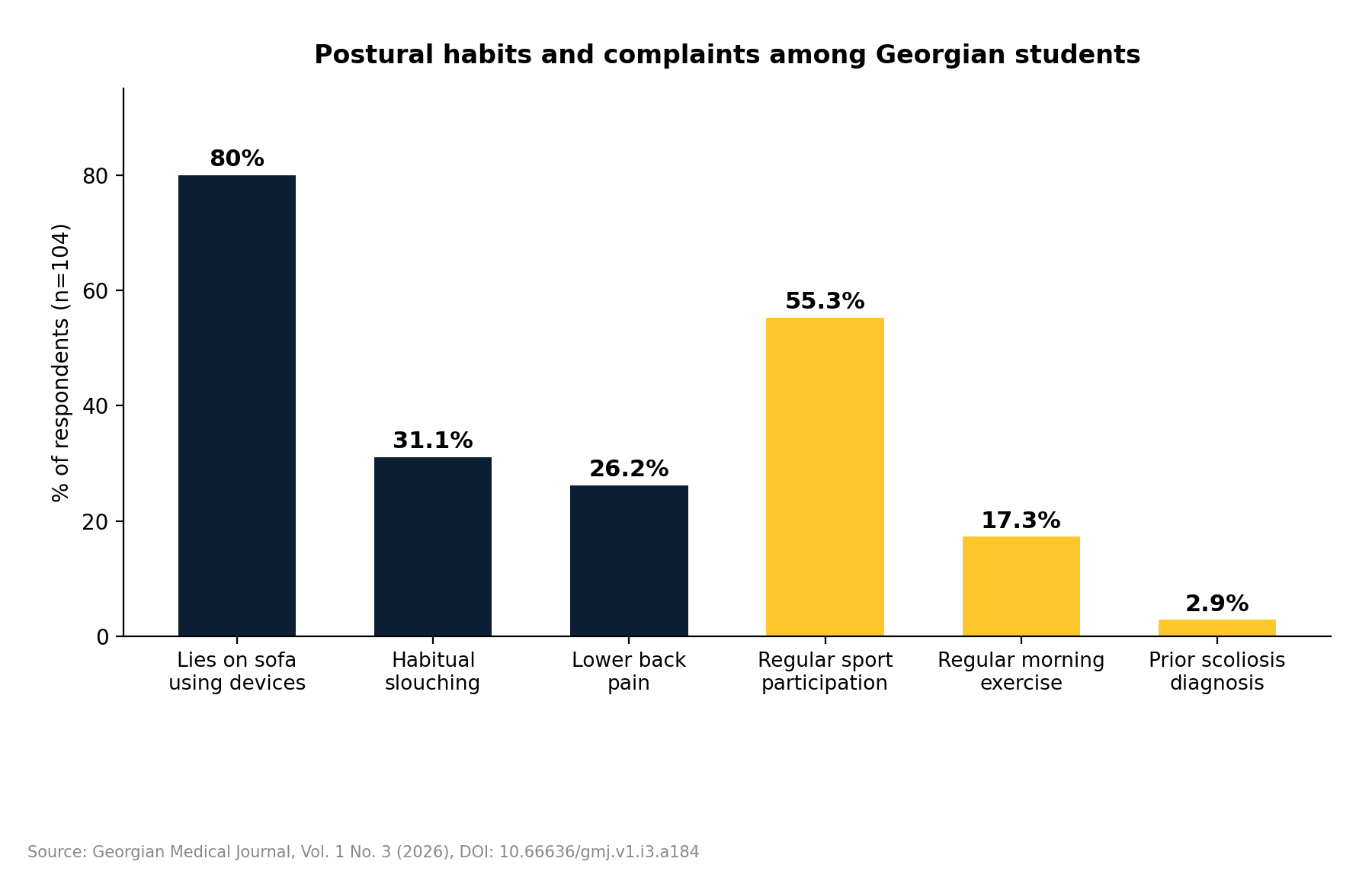
Behaviours associated with spinal loading were common; protective habits like regular morning exercise were not. Source: Georgian Medical Journal, Vol. 1 No. 3 (2026), DOI: 10.66636/gmj.v1.i3.a184.
The headline figure is stark: 80% of respondents reported habitually lying on a sofa while using electronic devices — a posture the paper flags as associated with increased spinal loading. Only 17.3% exercised regularly in the morning, though a more encouraging 55.3% did participate in some form of sport. On the complaint side, 31.1% reported habitual slouching and 26.2% reported lower back pain — common enough that they can’t be dismissed as outliers. Meanwhile 2.9% already carried a scoliosis diagnosis, and a further 14.4% said they simply didn’t know their own status.
The authors frame this as descriptive groundwork rather than a final verdict: a self-reported, cross-sectional survey can document associations and prevalence, not prove that any one habit causes spinal deformity. But as a first look at what Georgian students are actually doing with their spines every day — and how many don’t even know their own scoliosis status — it’s a concrete starting point for postural-health education aimed at exactly this age group.
🗺️ Find certified Georgian healthcare providers: sheniekimi.ge — Georgia Health Map · 998 clinics · 6,600+ doctors · 2,296 pharmacies
Read the Original Research
Original article: Scoliosis Risk in Students: Postural Habits and Lifestyle Under the Microscope
Published in: Georgian Medical Journal, Vol. 1 No. 3 (2026)
DOI: 10.66636/gmj.v1.i3.a184
📄 Read the full article at gmj.ge →
Georgian Medical Journal (GMJ) · ISSN 3088-4322 · gmj.ge · Open Access CC BY 4.0 · Published by the Public Health Institute of Georgia (PHIG). This summary is an independent editorial product of GMJ News; for clinical decisions, consult the original peer-reviewed article and a qualified professional.
Was this article helpful?
Disclaimer. This article is health journalism intended for general information and education. It is not medical advice and is not a substitute for professional diagnosis or treatment. Always consult a qualified healthcare provider about your individual circumstances. Full disclaimer →
Related Coverage

Editorial standards. This article was produced under the GMJ News editorial process, with oversight by the GMJ Editorial Board. Our editorial process. Spotted an error? Contact the editorial team.