Updated 13/09/2026
🟠 Moderate Evidence
There is no universally “best” squat variation. Rather, the safest and most effective squat depends on an individual’s postural alignment and structural constraints, according to evidence-based biomechanics analysis. Exercise prescription that adapts movement to individual anatomy—rather than forcing anatomy to match a standardised movement—reduces injury risk and improves load management through the spine, hips, knees, and ankles.
Key takeaways
- Squat safety and effectiveness depend on individual postural alignment and anatomical constraints, not universal “best practices”
- Most squat-related discomfort stems from load-path and alignment mismatches, not strength deficits
- Exercise variation selection should follow a framework: upright posture → traditional squats; forward collapse → front-loaded variants; ankle stiffness → heel elevation; spinal instability → box squats
- Personalised exercise adaptation reduces compensatory movement patterns and minimises spinal and joint stress
Squat Variation Selection by Postural Presentation
Biomechanical framework for matching squat variant to individual alignment constraints

Source: Biomechanics framework | Georgian Medical Journal News
Load-Path Alignment: The Core Principle
The fundamental objective of exercise variation selection is to maintain load stacked over the skeletal system whilst minimising compensatory movement patterns. When postural alignment changes, the trajectory of force through the spine, hips, knees, and ankles changes proportionally. This alters injury risk and mechanical efficiency.
Most difficulties reported during squat performance—instability, discomfort, or inconsistent depth—are not indicators of strength deficiency. Rather, they reflect a mismatch between exercise variant and the individual’s structural presentation. Evidence from biomechanics literature demonstrates that accommodating posture-specific constraints significantly reduces compensatory stress on passive spinal structures.
Postural Subgroups and Recommended Variations
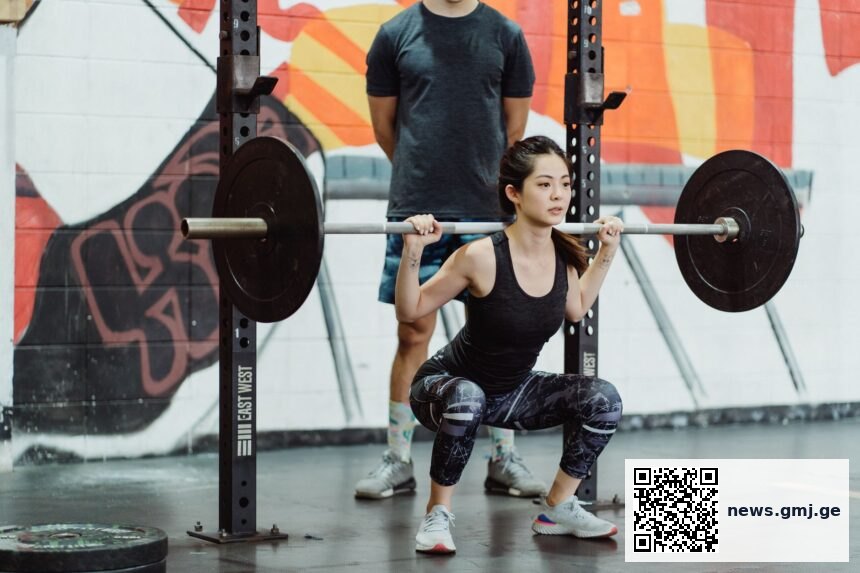
Upright, well-aligned posture: Individuals with neutral spine position, stable shoulders, and symmetrical hip mobility typically tolerate traditional back squats with minimal modification. Force distribution remains optimally stacked through the vertebral column and hip–knee–ankle axes.
Rounded shoulders or forward postural collapse: Forward thoracic rounding increases anterior shear on lumbar discs and shifts load anteriorly. Front-loaded squat variants (dumbbell goblet, barbell front squat) naturally reinforce upright posture by requiring spinal extension for balance. This proprioceptive feedback reduces compensatory trunk flexion.
Ankle mobility limitation: Restricted dorsiflexion forces excessive forward trunk lean to achieve adequate depth. Heel elevation or use of squat-specific footwear reduces dorsiflexion demand whilst preserving movement depth, preventing cascade compressive forces on the lumbar spine.
Lumbar instability (swayback, rib flare, or excessive lordosis): Variations that emphasise rib-cage stacking over the pelvis—such as paused repetitions or box squats with strict neutral alignment—reduce lumbar extension stress. These variants allow progressive stabilisation adaptation without end-range spinal loading.
Shoulder or upper-limb mobility constraints: Safety-bar squats, goblet holds, and machine variants reduce upper-extremity joint demand whilst permitting lower-body training stimulus. This framework protects injury-prone or post-surgical shoulders from excessive loading.
Exercise adaptation to individual postural constraints reduces compensatory movement patterns and lumbar spine stress more effectively than standardised programming. The goal is always the same: keep the load stacked over the skeleton whilst minimising compensations.
— Biomechanics framework analysis, Georgian Medical Journal News
Clinical Implications for Rehabilitation and Training
Physical therapists and strength coaches increasingly recognise that programming should prioritise individual biomechanical assessment over prescriptive “best practices.” A growing body of evidence supports the principle that personalised exercise modification enhances both safety and long-term adherence.
For patients with existing back pain, knee pain, or hip dysfunction, this framework offers a practical diagnostic tool. Discomfort during squat performance signals load-path misalignment rather than exercise unsuitability. Systematic variant adjustment—rather than movement abandonment—often resolves pain and restores function.
Strength training adherence improves when exercise feels stable and pain-free. By matching squat variant to postural presentation, individuals experience immediate proprioceptive feedback that reinforces correct positioning. This builds confidence and consistency, essential drivers of long-term training compliance. Evidence from adherence research confirms that comfort during movement directly predicts sustained participation in resistance programmes.
What this means
Frequently asked questions
Why do some people struggle with traditional squats whilst others excel?
Individual postural architecture varies. Ankle mobility, hip structure, spinal curve, and shoulder position all determine which squat variant aligns load optimally through the skeleton. A person who “struggles” with traditional squats may perform excellently with a front squat or box squat, because that variant matches their structural constraints. Difficulty reflects variant-anatomy mismatch, not inherent incapacity.
Is squat discomfort always a sign of injury risk?
Not necessarily injury, but always a signal of load-path misalignment. Discomfort prompts variant adjustment and postural screening. If pain persists across all variations, clinical evaluation for underlying pathology is warranted. However, acute discomfort during an ill-fitting variant is reversible through exercise modification.
Should I use the same squat variant indefinitely?
No. Postural presentation changes with training adaptation, age, and injury history. Periodically reassess ankle mobility, thoracic extension, and spinal stability. As constraints improve, progression to more technically complex variants (e.g., front squat → back squat) may become appropriate. Variant evolution reflects advancing postural capacity.
The principle of personalised biomechanical adaptation applies broadly to strength training: good programming adapts the exercise to the body, not the body to the exercise. As researchers and clinicians increasingly adopt data-driven assessment frameworks, the myth of the universal “best” exercise continues to fade. Individual anatomy, not ideology, should guide exercise selection. See the Clinical Updates section for more guidance on evidence-based exercise prescription, or explore related patient education resources.
Source: Personalised Squat Biomechanics: Individual Posture and Exercise Variant Selection
🗺️ Find certified Georgian healthcare providers: sheniekimi.ge — Georgia Health Map · 998 clinics · 6,600+ doctors · 2,296 pharmacies
Was this article helpful?
Disclaimer. This article is health journalism intended for general information and education. It is not medical advice and is not a substitute for professional diagnosis or treatment. Always consult a qualified healthcare provider about your individual circumstances. Full disclaimer →
Related Coverage




Editorial standards. This article was produced under the GMJ News editorial process, with oversight by the GMJ Editorial Board. Our editorial process. Spotted an error? Contact the editorial team.