Updated 13/09/2026
- Why the form affects absorption at all
- What head-to-head studies show
- When the distinction matters most
- The label-reading shortcut
- Redox chemistry made simple
- The conversion bottleneck: NQO1 and friends
- Formulation is the other half of bioavailability
- Thinking in cost per absorbed milligram
- The clinical bottom line
- Primary sources
Every CoQ10 label choice comes down to two words: ubiquinone or ubiquinol. They are not different compounds — they are the same molecule in two oxidation states, cycling constantly between them inside your mitochondria as electrons are shuttled. Ubiquinone is the oxidised state; ubiquinol is the reduced, electron-carrying, antioxidant-active state. In young healthy blood, over 90% of circulating CoQ10 is present as ubiquinol — the body clearly “prefers” to hold the reduced form.
Why the form affects absorption at all
Both forms are large, fat-soluble molecules with inherently poor absorption from the gut. The body absorbs CoQ10 through the fat pathway (bile, micelles, lymph) and then reduces almost all of it to ubiquinol before releasing it into circulation. The conversion step is the crux: it requires enzymatic capacity that declines with age and in several chronic conditions. Taking ubiquinol supplies the end-state directly, bypassing that conversion.
What head-to-head studies show
Pharmacokinetic comparisons in adults generally find ubiquinol produces higher plasma CoQ10 levels than the same dose of ubiquinone — commonly in the range of 1.5- to 2-fold in crossover studies, with some single-dose studies reporting larger gaps and some formulation-optimised ubiquinone products narrowing them. The most cited crossover work (Langsjoen & Langsjoen, and subsequent Kaneka-supported pharmacokinetic studies) also showed older adults reach clinically targeted plasma levels with substantially lower ubiquinol doses than ubiquinone doses. Two honest caveats: formulation quality (oil-based softgel vs dry powder) can matter as much as form, and both forms end up as the same molecule in tissue — the difference is efficiency of getting there, not destination.

When the distinction matters most
For a healthy 30-year-old, either form taken with a fat-containing meal is adequate. The ubiquinol premium earns its cost where conversion capacity is the bottleneck: adults over roughly 40, statin users, and anyone targeting specific plasma levels on medical advice. In those groups the same milligram number simply goes further as ubiquinol.
The label-reading shortcut
“CoQ10” with no qualifier means ubiquinone. “Ubiquinol” (often with the Kaneka QH trademark) means the reduced form and should be packaged oxygen-protected (opaque softgels), since ubiquinol oxidises back to ubiquinone on air exposure — a stability challenge only competent manufacturers handle well.
Redox chemistry made simple
Strip the nomenclature away and CoQ10 is a rechargeable electron battery. The quinone head-group can hold two electrons (plus two protons): empty = ubiquinone, full = ubiquinol. Inside mitochondria it is charged at Complexes I and II and discharged at Complex III, cycling thousands of times per minute. In blood and membranes outside the respiratory chain, the charged form — ubiquinol — spends its electrons a different way: donating them to neutralise lipid radicals, which is why ubiquinol is ‘the antioxidant form’ and why plasma in healthy young adults runs >90% ubiquinol. The supplement question ‘which form?’ is therefore really ‘do you arrive charged, or does the body charge you after absorption?’
The conversion bottleneck: NQO1 and friends
Absorbed ubiquinone must be enzymatically reduced — chiefly by NAD(P)H-dependent reductases such as NQO1 — before circulating as ubiquinol. This machinery ages: reductase capacity and the NAD(P)H supply that powers it both decline, and common NQO1 polymorphisms (notably the C609T variant, prevalent in several populations) reduce enzyme activity substantially in carriers. The bottleneck concept explains the pharmacokinetic pattern across studies: young subjects show modest between-form differences; older subjects show the widest gaps, precisely the demographic where Hosoe-type ubiquinol dosing achieved target plasma levels at doses ubiquinone matches only with difficulty. Form choice, in other words, is really conversion-capacity insurance.
Formulation is the other half of bioavailability
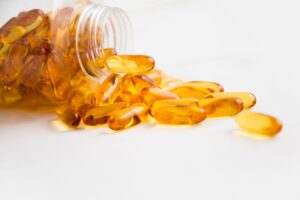
Head-to-head form comparisons hide a second variable: delivery system. Dry ubiquinone powder in a hard capsule is the worst case — crystalline, fat-free, poorly micellised. Oil-suspended softgels multiply absorption; emulsified and ‘solubilisate’ systems multiply it again, with some engineered ubiquinone products approaching ubiquinol-level plasma responses in comparative studies. The hierarchy that emerges from the literature: dry ubiquinone
Thinking in cost per absorbed milligram
Ubiquinol typically costs 1.5–2× more per labelled milligram — and delivers roughly 1.5–2× the plasma response per milligram in the populations that need it. For adults over 40 or on statins, cost per absorbed milligram therefore lands near parity, with ubiquinol adding conversion-independence as the tiebreaker. For healthy under-35s with intact conversion, budget ubiquinone-in-oil with meals is the rational buy. This is one of the few supplement-form debates where the honest answer is a clean age-and-context split rather than a universal winner — and, as everywhere on this page: warfarin users involve their prescriber first.
The clinical bottom line
Same molecule, different starting line: ubiquinol is the pre-activated form with consistently higher bioavailability per milligram, mattering most after 40 and alongside statins. Formulation quality and taking either form with fat remain the other half of the absorption equation. And as with all CoQ10: warfarin users first talk to their physician.
Primary sources
- Zhang Y, et al. Comparative bioavailability of ubiquinol and ubiquinone. 2014/2018 crossover pharmacokinetics
- Hosoe K, et al. Study on safety and bioavailability of ubiquinol (Kaneka QH) after single and 4-week multiple oral administration. Regul Toxicol Pharmacol. 2007
- NIH ODS: Coenzyme Q10 — Health Professional Fact Sheet
🗺️ Find certified Georgian healthcare providers: sheniekimi.ge — Georgia Health Map · 998 clinics · 6,600+ doctors · 2,296 pharmacies
Was this article helpful?
Related Coverage


Editorial standards. This article was produced under the GMJ News editorial process, with oversight by the GMJ Editorial Board. Our editorial process. Spotted an error? Contact the editorial team.