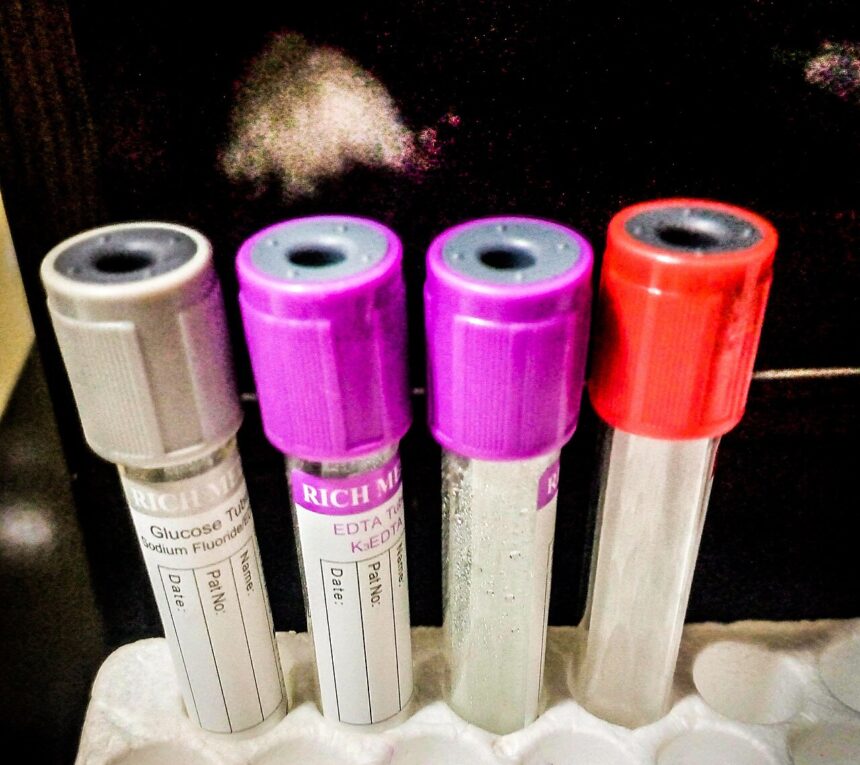
Most nutrient–drug interactions are subtle statistical effects. The vitamin K–warfarin interaction is not: it is the drug’s mechanism of action running in reverse. Warfarin belongs to the class literally named vitamin K antagonists (VKAs) — so any vitamin K entering the body, whether K1 from spinach or K2 from a supplement drop, directly opposes the medication. Understanding this interaction precisely is the difference between safe coexistence and a destabilised INR.
The mechanism: one enzyme, two opposing forces
Clotting factors II, VII, IX and X are manufactured in the liver in an inactive form; a vitamin K–dependent enzyme (gamma-glutamyl carboxylase) must activate them, and each activation cycle oxidises vitamin K, which the enzyme VKORC1 then recycles back to its active form. Warfarin works by blocking VKORC1 — starving the carboxylase of recycled vitamin K, so fewer clotting factors are activated and the blood clots more slowly, measured as a higher INR. Fresh vitamin K arriving from diet or supplements refills exactly the pool warfarin is trying to empty. More vitamin K → more clotting-factor activation → INR falls → clot risk rises. The interaction is not a side effect; it is pharmacology working as designed, in both directions at once.
Why supplements differ from dinner
Anticoagulation clinics have long moved past the outdated advice to “avoid greens.” The modern principle, supported by systematic review of interaction studies (Holbrook 2005) and interaction analyses in VKA-treated cohorts (Violi 2016), is consistency of intake: a patient who eats broadly similar vitamin K amounts week to week can be titrated to a stable warfarin dose around that intake. The clinical problem is change — and this is precisely why supplements deserve special caution. A K2 drop delivers a fixed, concentrated, highly bioavailable dose that starts or stops abruptly; MK-7 additionally has a multi-day half-life, so its effect accumulates to a plateau rather than passing through in hours. Studies show even modest MK-7 doses (as low as 10–45 µg/day) measurably affect coagulation parameters in anticoagulated patients — smaller than the doses in typical supplements. Starting, stopping, or changing a K2 supplement is therefore pharmacologically equivalent to changing the warfarin dose without telling anyone.
The rules, stated plainly
1. On warfarin (or acenocoumarol/phenprocoumon): do not start any vitamin K supplement — K1 or K2, any dose — without your prescribing physician. This is not a soft recommendation; it is the reason the orange warning box exists on every responsible K2 product page. 2. If a physician approves supplementation (some clinics deliberately use low-dose vitamin K to stabilise erratic INRs — a strategy that exists but belongs entirely to the prescriber), it must be taken with strict daily consistency, with INR monitoring after any start, stop or dose change. 3. Never stop an established supplement abruptly before an INR test “to be safe” — the rebound destabilises exactly what it pretends to protect. 4. Tell every clinician who manages your anticoagulation about every supplement, every time.

DOACs are a different story — briefly
Direct oral anticoagulants (apixaban, rivaroxaban, dabigatran, edoxaban) inhibit clotting factors directly, not via vitamin K recycling. Vitamin K intake does not meaningfully interfere with their mechanism, and no dietary vitamin K restriction or consistency rule applies. Patients on DOACs should still inform their physician before adding supplements — general good practice — but the hard VKA rule above is specific to warfarin-class drugs. If you are unsure which class your anticoagulant belongs to, that question alone is worth the phone call.
The clinical bottom line
Warfarin and vitamin K are direct pharmacological opponents at a single enzyme. Diet managed by consistency is routine; supplements are dose changes and belong to the prescriber’s decision, never the shelf’s. On a vitamin K antagonist: no K2 without your physician — and with approval, unwavering daily consistency plus INR checks around any change. On a DOAC: different mechanism, no vitamin K restriction, but disclosure remains good medicine.
Primary sources
- Holbrook AM, Pereira JA, Labiris R, et al. Systematic overview of warfarin and its drug and food interactions. Arch Intern Med. 2005;165(10):1095–1106. doi:10.1001/archinte.165.10.1095
- Violi F, Lip GY, Pignatelli P, Pastori D. Interaction between dietary vitamin K intake and anticoagulation by vitamin K antagonists: is it really true? Medicine (Baltimore). 2016;95(10):e2895. doi:10.1097/MD.0000000000002895
- Theuwissen E, Teunissen KJ, Spronk HM, et al. Effect of low-dose supplements of menaquinone-7 on the stability of oral anticoagulant treatment. Thromb Haemost. 2013;109(6):1105–1111. doi:10.1160/TH12-11-0851
- Shearer MJ, Newman P. Metabolism and cell biology of vitamin K. Thromb Haemost. 2008;100(4):530–547. doi:10.1160/TH08-03-0147
- GMJ: the parallel CoQ10–warfarin interaction — the other supplement with a hard anticoagulation rule
This article is educational information about nutrient–drug interactions, not medical advice. Decisions about anticoagulant therapy and any supplement use alongside it belong exclusively to you and your prescribing physician.
Was this article helpful?
Related Coverage


Editorial standards. This article was produced under the GMJ News editorial process, with oversight by the GMJ Editorial Board. Our editorial process. Spotted an error? Contact the editorial team.