By using this site, you agree to the Privacy Policy and Terms of Use.
Accept
GMJ NewsGMJ NewsGMJ News
  • Latest News
    • GMJ Briefs
  • Podcast & Media
    • Podcast Episodes
    • GMJ Audio
    • GMJ Videos
  • Research Digest
    • New Studies
    • Georgian Research
    • Data & Numbers
  • Policy & Systems
    • Health Policy
    • Quality & Safety
    • Migration & Health
    • Global Health
  • Practice
    • Clinical Updates
    • Case Discussions
    • Pharmacy & Prescribing
    • Ingredients A-Z
  • Perspectives
    • Editorial
    • Explainers
    • Voices
    • Letters
  • Health Topics
  • GMJ Articles
    • Vol. 1 Issue 2 (2026)
    • Vol. 1 Issue 1 (2026)
    • Pre-Launch Articles (2025)
  • Read the Journal →
  • About GMJ News
Notification Show More
Font ResizerAa
GMJ NewsGMJ News
Font ResizerAa
  • Latest News
    • GMJ Briefs
  • Podcast & Media
    • Podcast Episodes
    • GMJ Audio
    • GMJ Videos
  • Research Digest
    • New Studies
    • Georgian Research
    • Data & Numbers
  • Policy & Systems
    • Health Policy
    • Quality & Safety
    • Migration & Health
    • Global Health
  • Practice
    • Clinical Updates
    • Case Discussions
    • Pharmacy & Prescribing
    • Ingredients A-Z
  • Perspectives
    • Editorial
    • Explainers
    • Voices
    • Letters
  • Health Topics
  • GMJ Articles
    • Vol. 1 Issue 2 (2026)
    • Vol. 1 Issue 1 (2026)
    • Pre-Launch Articles (2025)
  • Read the Journal →
  • About GMJ News
Follow US
GMJ News > Policy & Systems > Global Health > Burundi’s first quarter 2026: refugees access care as WHO strengthens health partnerships
Global HealthHealth PolicyMigration & HealthPolicy & Systems

Burundi’s first quarter 2026: refugees access care as WHO strengthens health partnerships

GMJ
Last updated: 12/07/2026 13:29
By
GMJ Policy Desk
Share
7 Min Read
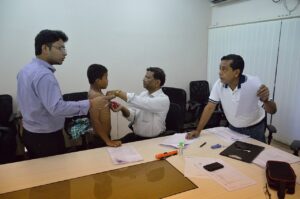
WHO health workers with Congolese refugees in Burundi health facilityIllustrative image · Photo by Baset Alhasan on Pexels (Pexels License)
WHO's first-quarter 2026 report documents that over 65,000 Congolese refugees in Burundi accessed healthcare through a single health post delivering 350 daily consultations. Strategic partnerships with Gavi and national authorities strengthened immunization and emergency preparedness. — Photo by Baset Alhasan on Pexels (Pexels License)
SHARE
4 min read|886 words
✓ Reviewed by GMJ News Editorial Team

The first quarter of 2026 demonstrated measurable progress in Burundi’s public health infrastructure, according to WHO’s Sentinel report covering January to April 2026. Strategic partnerships between the World Health Organization (WHO), Gavi (the Vaccine Alliance), and Burundian health authorities translated into concrete operational gains, particularly in refugee health services and immunization delivery.

Contents
    • Key takeaways
      • Refugee healthcare access in Burundi: service volume and reach
  • WHO leadership engagement strengthens health system strategy
  • Immunization partnerships accelerate vaccine delivery goals
  • Refugee healthcare operations reach operational scale in Busuma
    • What this means
  • Frequently asked questions
    • What is the WHO Sentinel report?
    • Why do refugee health operations matter in Burundi?
    • What is Gavi’s role in Burundi’s immunization programme?

Key takeaways

  • More than 65,000 Congolese refugees in Busuma accessed essential healthcare through a single WHO-supported health post delivering an average of 350 consultations daily
  • WHO Regional Director’s visit to Burundi deepened strategic dialogue on universal health coverage and emergency preparedness in the country
  • Gavi delegation visit strengthened collaboration toward immunization targets, reflecting coordinated international support for vaccination programmes
65,000+
Congolese refugees accessing healthcare through WHO-supported health post in Busuma, Jan–Apr 2026

Refugee healthcare access in Burundi: service volume and reach

Daily consultations and refugee population served through Busuma health post, Q1 2026

65,000+
Refugees served
350
Daily consultations
~91
Days operational (Q1)

Source: WHO Regional Office for Africa, Sentinel Report Jan–Apr 2026 | Georgian Medical Journal News

WHO leadership engagement strengthens health system strategy

The WHO Regional Director for Africa’s visit to Burundi during the first quarter provided high-level engagement on two critical public health priorities: universal health coverage (UHC) and emergency preparedness. According to the WHO Sentinel report, this visit deepened strategic dialogue with Burundian health authorities, signalling international commitment to strengthening the country’s health system resilience.

Submit Your Paper
GMJ_Submit_Banner

Such high-level visits serve dual functions: they reinforce political commitment at the national level and create platforms for technical alignment on health priorities. This engagement is particularly significant given Burundi’s complex humanitarian context, where displacement pressures from neighbouring regions require coordinated health responses.

🎙️ Related Podcast Episodes
🎬 The Architecture of Migration Health: Inside the GMJ Knowledge Hub | Georgian Medical Journal
🎧 #52 | GMJ Podcast | Health and Migration Knowledge Hub — A Global Resource for Evidence-Based Practice · 17m
🎧 #51 | GMJ Podcast | Global Health, Migration, and Health Systems Resilience · 14m
🎧 #50 | GMJ Podcast | Inclusive Health for Refugees and Migrants: WHO Reports Global Progress and Remaining Gaps · 17m
🎧 #32 | GMJ Podcast | Launch of the Georgian Medical Journal — A New International Platform for Medical Science · 5m

Immunization partnerships accelerate vaccine delivery goals

Gavi’s delegation visit to Burundi during Q1 2026 strengthened collaboration toward immunization targets, as documented in the WHO Sentinel report. The Vaccine Alliance works through co-financing and procurement support to expand routine immunization coverage in lower-income countries, and such field visits typically assess progress against coverage targets and identify bottlenecks in vaccine supply chains.

Partnership visits of this nature between international health agencies and national governments are routine mechanisms for accountability and joint planning. The timing of Gavi’s visit during the first quarter suggests coordination with WHO’s broader strategic engagement in the country.

Refugee healthcare operations reach operational scale in Busuma

The most concrete operational outcome documented in the WHO’s humanitarian health response framework was the healthcare access achieved through a single health post in Busuma. According to the WHO Sentinel report, more than 65,000 Congolese refugees accessed essential healthcare services through this facility, which delivered an average of 350 consultations per day during the January–April period.

This operational metric—350 daily consultations—reflects sustained clinical capacity under complex conditions. For comparison, typical health post operations in humanitarian settings range from 100–500 daily visits depending on population density, staff availability, and supply chain reliability. The Busuma figure suggests a functioning facility meeting immediate primary care demand from the refugee population.

More than 65,000 Congolese refugees in Busuma accessed essential healthcare services through a WHO-supported health post delivering an average of 350 consultations per day during January–April 2026.

— WHO Regional Office for Africa, Sentinel Report Jan–Apr 2026

What this means

For patients: Displaced populations in Burundi now have documented access to primary healthcare services, reducing barriers to treatment for communicable diseases, malnutrition, and maternal health complications common in refugee settings. The high consultation volume (350 daily visits) indicates the facility is functional and accessible.
For clinicians: Healthcare workers operating the Busuma health post are delivering primary care at scale within humanitarian constraints. The volume suggests adequate staffing and supply management, though detailed quality metrics (vaccination rates, disease outcomes, referral patterns) are not included in this summary report.
For policymakers: Q1 2026 results demonstrate that coordinated WHO-Gavi-national authority partnerships can translate into measurable healthcare access gains. The refugee healthcare operations model in Busuma provides evidence for scaling humanitarian health responses in displacement-affected regions. Strategic engagement from international health leadership appears to be reinforcing national capacity.

Frequently asked questions

What is the WHO Sentinel report?

The WHO Sentinel is a periodic progress report published by WHO Regional Offices documenting key health achievements, partnerships, and operational outcomes during a defined period. It tracks high-level strategic engagement, field operations, and health system strengthening work. The January–April 2026 Sentinel for Burundi is published on the WHO Regional Office for Africa’s country page.

Why do refugee health operations matter in Burundi?

Burundi hosts significant Congolese refugee populations displaced by regional instability. According to UNHCR data, refugees face heightened risks of communicable disease, malnutrition, and inadequate maternal care. The Busuma health post serves as a critical access point for primary prevention and treatment, reducing disease transmission risk to both refugee and host communities.

What is Gavi’s role in Burundi’s immunization programme?

Gavi, the Vaccine Alliance, is a public–private partnership that co-finances immunization programmes in lower-income countries, provides technical support, and helps secure predictable vaccine supply. Gavi’s presence in Burundi reflects its commitment to strengthen routine immunization coverage and emergency response vaccination campaigns across the region.

The Q1 2026 period reflects Burundi’s commitment to integrating refugee health into national healthcare systems while strengthening core public health functions through international partnerships. Continued tracking of these metrics—refugee service access, immunization coverage, emergency preparedness capacity—will be essential to assess sustainability of gains documented in the first quarter.

Source: WHO Regional Office for Africa: The Sentinel — Burundi (January–April 2026)

Was this article helpful?

Disclaimer. This article is health journalism intended for general information and education. It is not medical advice and is not a substitute for professional diagnosis or treatment. Always consult a qualified healthcare provider about your individual circumstances. Full disclaimer →

Related Coverage
Nigeria's Polio Campaign Reaches 33,000 Settlements, Vaccinating 1.2 Million Children in May 2026Aug 10, 2026
Danish Medicines Agency Launches Cell Therapy Clinical Trial TemplateAug 10, 2026
UK's MHRA Launches Innovation Guidance to Accelerate Medical Device and Drug DevelopmentAug 10, 2026
Rural Healthcare's $50 Billion Question: Can Technology Alone Solve Workforce Shortages?Aug 10, 2026
Explore more on this topic:🧭 HIV/AIDS hub🧭 Vaccines hub🧭 Migration & Health hub
🔥 Most read this week
1Why High-Dose Vitamin B12 Supplements Work Despite Poor Absorption
2Magnesium Form May Not Matter for Cognitive Benefits, New Meta-Analysis Suggests
3Creatine Kidney Damage Myth Debunked by Major Safety Review of 26,000 Participants
4Magnesium Supplements: Marketing Claims vs Scientific Evidence
PG
Editorial oversight
Prof. Giorgi Pkhakadze, MD, MPH, PhD
Editor-in-Chief, GMJ News
Full profile →  ·  ORCID 0000-0001-7609-4515
Medical disclaimer. This article is health journalism intended for general information. It is not medical advice and is not a substitute for consultation with a qualified healthcare professional. Always seek your physician's advice regarding any medical condition.
Editorial standards. This article was produced under the GMJ News editorial process, with oversight by the GMJ Editorial Board. Our editorial process. Spotted an error? Contact the editorial team.
📬 GMJ Health Digest
Evidence-based medical news, once a week. Free, no spam, unsubscribe anytime.
TAGGED:Burundihumanitarian responseimmunizationrefugee healthuniversal-health-coverageWHO
Share This Article
Facebook LinkedIn Bluesky Copy Link Print
GMJ
ByGMJ Policy Desk
Follow:
GMJ Policy Desk is part of GMJ News, the newsroom of the Georgian Medical Journal (gmj.ge), published by the Public Health Institute of Georgia. Every article is editorially reviewed before publication.
Leave a Comment Leave a Comment

Leave a Reply Cancel reply

Your email address will not be published. Required fields are marked *

Submit Your Paper →

Georgia's peer-reviewed open-access medical journal. No APC until January 2027.
Submit Manuscript →
Nigeria’s Polio Campaign Reaches 33,000 Settlements, Vaccinating 1.2 Million Children in May 2026

Nigeria's polio elimination campaign reached 33,000 settlements and vaccinated 1.2 million children…

Danish Medicines Agency Launches Cell Therapy Clinical Trial Template

The Danish Medicines Agency has released a standardized Investigator's Brochure template for…

UK’s MHRA Launches Innovation Guidance to Accelerate Medical Device and Drug Development

The UK's MHRA has published formal guidance for drug and medical device…

Submit Your Paper to GMJ

No APC until January 2027.
Submit Manuscript →

You Might Also Like

Infographic showing wildlife deaths from lead ammunition poisoning with statistics and affected species
Global HealthPolicy & Systems

WOAH Calls for Global Phase-Out of Lead Hunting Ammunition to Protect Wildlife and Human Health

By
GMJ Policy Desk
29/05/2026
NHS healthcare professionals receiving excellence awards for innovative patient care improvementsIllustrative image · Photo by Logan Gutierrez on Unsplash (Unsplash License)
Health PolicyPolicy & Systems

NHS Excellence Awards recognise teams that freed 12,000 hospital beds and accelerated cancer diagnosis

By
GMJ Policy Desk
01/07/2026
Occupational health worker wearing respiratory protective equipment during stone cuttingIllustrative image · Photo by www.kaboompics.com on Pexels (Pexels License)
Clinical UpdatesPolicy & SystemsPracticeQuality & Safety

Engineered quartz surfaces linked to surge in silicosis cases among US workers

By
GMJ Practice Desk
12/07/2026
World Health Assembly meeting hall with Member State representatives discussing budget approval
Health PolicyPolicy & Systems

WHO Assembly Approves $6.83 Billion Budget to Combat Health Emergencies and AMR

By
GMJ Policy Desk
24/05/2026
Facebook Twitter Youtube Instagram
Company
  • Privacy Policy
  • Contact US
  • GMJ Journal
  • Submit Manuscript
  • Editorial Team
  • Register at GMJ
  • Terms of Use

Subscribe to GMJ News — Click here

Join Community
© 2026 Georgian Medical Journal (GMJ). Published by the Public Health Institute of Georgia (PHIG). All rights reserved.
Welcome Back!

Sign in to your account

Username or Email Address
Password

Lost your password?

Not a member? Sign Up