By using this site, you agree to the Privacy Policy and Terms of Use.
Accept
GMJ NewsGMJ NewsGMJ News
  • Latest News
    • GMJ Briefs
  • Podcast & Media
    • Podcast Episodes
    • GMJ Audio
    • GMJ Videos
  • Research Digest
    • New Studies
    • Georgian Research
    • Data & Numbers
  • Policy & Systems
    • Health Policy
    • Quality & Safety
    • Migration & Health
    • Global Health
  • Practice
    • Clinical Updates
    • Case Discussions
    • Pharmacy & Prescribing
    • Ingredients A-Z
  • Perspectives
    • Editorial
    • Explainers
    • Voices
    • Letters
  • GMJ Articles
    • Vol. 1 Issue 2 (2026)
    • Vol. 1 Issue 1 (2026)
    • Pre-Launch Articles (2025)
  • Read the Journal →
  • About GMJ News
Notification Show More
Font ResizerAa
GMJ NewsGMJ News
Font ResizerAa
  • Latest News
    • GMJ Briefs
  • Podcast & Media
    • Podcast Episodes
    • GMJ Audio
    • GMJ Videos
  • Research Digest
    • New Studies
    • Georgian Research
    • Data & Numbers
  • Policy & Systems
    • Health Policy
    • Quality & Safety
    • Migration & Health
    • Global Health
  • Practice
    • Clinical Updates
    • Case Discussions
    • Pharmacy & Prescribing
    • Ingredients A-Z
  • Perspectives
    • Editorial
    • Explainers
    • Voices
    • Letters
  • GMJ Articles
    • Vol. 1 Issue 2 (2026)
    • Vol. 1 Issue 1 (2026)
    • Pre-Launch Articles (2025)
  • Read the Journal →
  • About GMJ News
Follow US
GMJ News > GMJ Briefs > Policy Without Data: The Migrant Health Paradox

Policy Without Data: The Migrant Health Paradox

GMJ
Last updated: 13/07/2026 15:06
By
Prof. Giorgi Pkhakadze
Share
1 Min Read
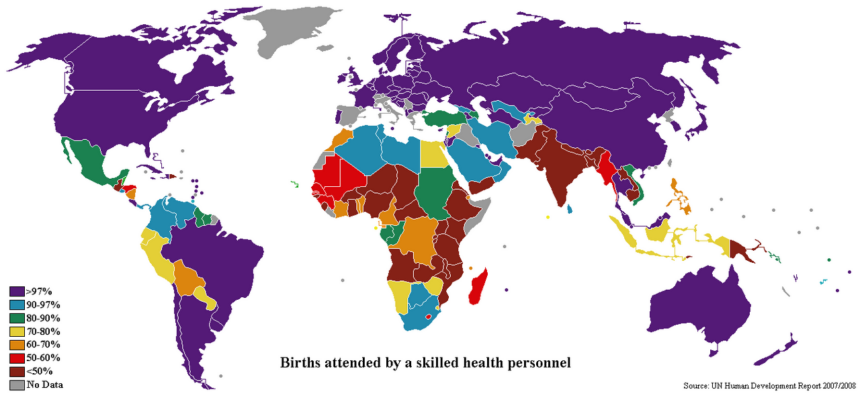
Infographic showing the gap between migration health policies and data collection systems globally
WHO's first global scorecard reveals that while 60+ countries now include migrants in health policies, only 37% collect migration-related health data. Without measurement systems, health policies for over a billion migrants remain unverifiable promises. — Births attended by a skilled health personnel UNHDR 2007-2008.PNG by Sbw01f / CC BY-SA 3.0 via Wikimedia Commons (CC BY-SA 3.0)
SHARE
1 min read|144 words

The World Health Organization’s first global scorecard on migrant health, released in March 2026, exposes a striking disconnect in how the world approaches health for over one billion migrants and refugees. While two-thirds of surveyed countries have now written migrants into their national health policies, implementation remains the critical challenge. The real problem is visibility: only 37% of countries routinely collect migration-related health data, meaning most health systems operate without baseline information on the populations they theoretically serve. This gap between policy and measurement creates a dangerous blind spot. Without disaggregated data, migrants become invisible in the statistics that determine budget allocation, outbreak response priorities, and resource distribution. As the report demonstrates, you cannot effectively manage—or protect—what you cannot count. The WHO’s scorecard provides the first comprehensive baseline, but translating policy into measurable health outcomes remains the defining challenge for global health systems in 2026.

Was this article helpful?

GMJ Brief · Announcement

📰 Read the full article: Health & Migration: policy is moving faster than the data →

Share This Article
Facebook LinkedIn Bluesky Copy Link Print
GMJ
ByProf. Giorgi Pkhakadze
Follow:
Prof. Giorgi Pkhakadze, MD, MPH, PhD, is Editor-in-Chief of the Georgian Medical Journal and Chair of the Public Health Institute of Georgia (PHIG). He is Professor and Head of the Department of Social and Behavioural Sciences at David Tvildiani Medical University, and Secretary/Treasurer of the UEMS Section of Public Health. ORCID: 0000-0001-7609-4515.

Submit Your Paper →

Georgia's peer-reviewed open-access medical journal. No APC until January 2027.
Submit Manuscript →
Why Sunlight Triggers Sneezing in Some People: The Science Behind Photic Sneeze Reflex

Approximately 18–35% of people experience involuntary sneezing when exposed to bright sunlight—a…

Correction issued for MAGE-A4/A8 immunotherapy trial in advanced solid tumours

Nature Medicine has published an author correction to a phase 1 trial…

Jackfruit-derived biomaterial shows promise in reversing severe gum disease damage

A composite biomaterial combining jackfruit latex, pomegranate peel extract, and simvastatin has…

Submit Your Paper to GMJ

No APC until January 2027.
Submit Manuscript →

You Might Also Like

PHEIC Declaration: Ebola Outbreak Cross-Border Transmission DRC-Uganda

By
Prof. Giorgi Pkhakadze
31/05/2026
Global HealthPolicy & Systems

WHO Declares Emergency as Ebola Outbreak Spreads from DR Congo to Uganda

By
Prof. Giorgi Pkhakadze
31/05/2026

PHEIC Declaration: Ebola Outbreak – DRC with Cross-Border Transmission to Uganda

By
Prof. Giorgi Pkhakadze
31/05/2026
Scientific illustration of gut-brain connection and parasitic organisms

Two Billion People Worldwide May Be Affected by Behavior-Altering Parasites

By
Prof. Giorgi Pkhakadze
29/06/2026
Facebook Twitter Youtube Instagram
Company
  • Privacy Policy
  • Contact US
  • GMJ Journal
  • Submit Manuscript
  • Editorial Team
  • Register at GMJ
  • Terms of Use

Subscribe to GMJ News — Click here

Join Community
© 2026 Georgian Medical Journal (GMJ). Published by the Public Health Institute of Georgia (PHIG). All rights reserved.
Welcome Back!

Sign in to your account

Username or Email Address
Password

Lost your password?

Not a member? Sign Up