Updated 13/09/2026
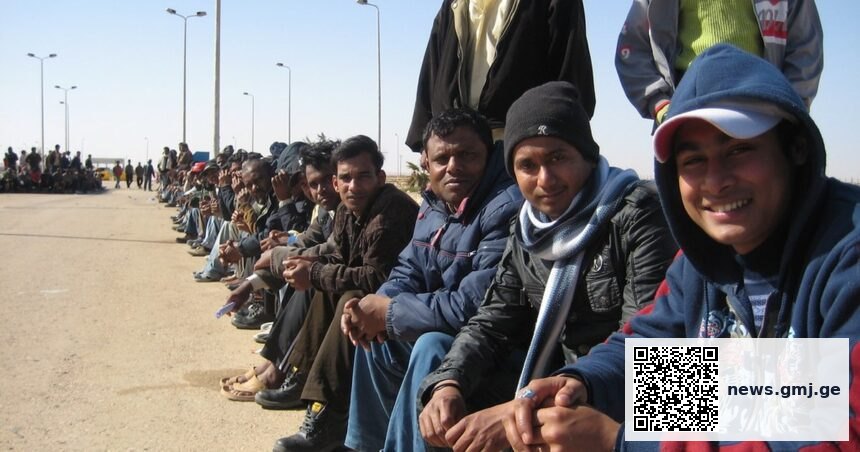
Photo: Patiently waiting for a flight home, by DFID – UK Department for International Development (Flickr), cropped for layout · Licensed CC BY 2.0 · Source
Plain-language summary of research published in the Georgian Medical Journal. Written for the general public by the GMJ News editorial team.
Migrants in transit — people moving through a country rather than settled in it — are among the least institutionally protected populations in modern migration systems. A commentary in the Georgian Medical Journal, responding to a scoping review by Gopinadhan et al., argues this population exposes a structural contradiction sitting at the heart of universal health coverage itself.

The Reviewed Evidence
The original scoping review identifies recurring barriers facing migrants in transit: fragmented continuity of care, administrative exclusion, legal uncertainty, language barriers, and fear that seeking healthcare will trigger immigration enforcement. This commentary situates that evidence in a bigger argument: transit migration isn’t just a humanitarian issue to be addressed with emergency aid, but a genuine governance test for how universal health coverage is designed.
The Structural Contradiction
Healthcare systems promise universality as a founding principle, yet remain organised almost entirely around stable, territorial entitlement — citizenship, residence, registration. Migrants in transit, by definition, don’t fit that model at all: they’re present, but not settled; in need, but administratively invisible to the systems meant to serve everyone.

At a glance — the headline figures.
The commentary is explicit that this isn’t a solved problem — it discusses what the reviewed study contributes and what remains genuinely unresolved. For Georgia and the South Caucasus specifically, a region positioned along active migration routes, the piece argues these questions are becoming increasingly, not decreasingly, relevant to how the region’s own health systems are designed.
🗺️ Find certified Georgian healthcare providers: sheniekimi.ge — Georgia Health Map · 998 clinics · 6,600+ doctors · 2,296 pharmacies
Read the Original Research
Original article: The People Nobody Covers: Migrants in Transit and the Test of Universal Health Coverage
Published in: Georgian Medical Journal, Vol. 1 No. 2 (2026)
DOI: 10.66636/gmj.v1.i2.a124
📄 Read the full article at gmj.ge →
Georgian Medical Journal (GMJ) · ISSN 3088-4322 · gmj.ge · Open Access CC BY 4.0 · Published by the Public Health Institute of Georgia (PHIG). This summary is an independent editorial product of GMJ News; for clinical decisions, consult the original peer-reviewed article and a qualified professional.
Was this article helpful?
Disclaimer. This article is health journalism intended for general information and education. It is not medical advice and is not a substitute for professional diagnosis or treatment. Always consult a qualified healthcare provider about your individual circumstances. Full disclaimer →
Related Coverage




Editorial standards. This article was produced under the GMJ News editorial process, with oversight by the GMJ Editorial Board. Our editorial process. Spotted an error? Contact the editorial team.