Updated 13/09/2026
Photo: Orange fluorescence due to the Cutibacterium acnes on my face, when shining a 365 nm UV li, by MaximilianParadiz (Flickr), cropped for layout · Licensed CC BY 2.0 · Source
Plain-language summary of research published in the Georgian Medical Journal. Written for the general public by the GMJ News editorial team.
Acne vulgaris is usually explained through the pilosebaceous unit — androgens, clogged follicles, bacteria, inflammation. A systematised review in the Georgian Medical Journal makes the case that this picture is incomplete: a growing body of evidence links acne severity to systemic metabolic disturbances, not just what’s happening locally in the skin.

Beyond the Follicle
The traditional model treats acne as driven by androgen activity, follicular hyperkeratinisation, sebaceous gland dysfunction, microbial imbalance, and inflammation. What the review adds is a second, systemic layer: insulin resistance, insulin-like growth factor-1 (IGF-1) signalling, adiposity, dyslipidaemia, and hyperandrogenic states have all emerged as potentially relevant modifiers of how severe and persistent acne becomes — meaning what’s happening in a patient’s broader metabolism may shape what shows up on their skin.
What the Review Set Out to Do
This is a systematised review with narrative synthesis, aiming to critically evaluate the current evidence linking acne severity across multiple domains of metabolic dysfunction — insulin resistance, IGF-1 signalling, obesity-related pathways, lipid abnormalities, and endocrine dysregulation — and to assess how clinically relevant these links actually are for everyday dermatology practice, not just as a research curiosity.

At a glance — the headline figures.
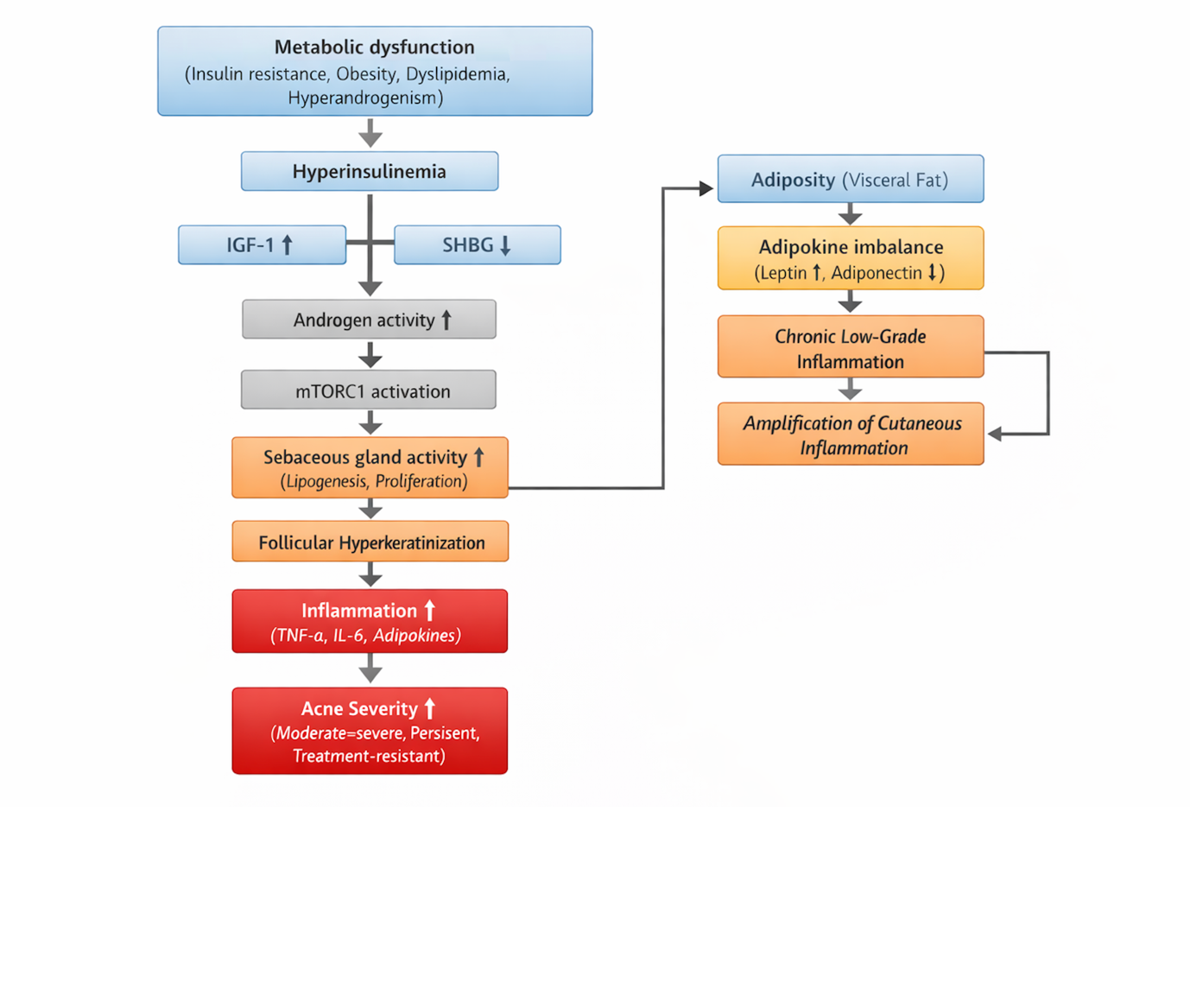
The proposed metabolic dysfunction pathway connecting insulin resistance, IGF-1, adiposity, and inflammation to acne severity. Figure from the review. Source: Georgian Medical Journal, Vol. 1 No. 1 (2026), DOI: 10.5281/zenodo.19135373.
The practical implication is a shift in how persistent or severe acne might eventually be worked up: not only as a dermatological problem to be treated topically or with antibiotics, but potentially as a visible signal of underlying metabolic dysfunction — insulin resistance or dyslipidaemia — that a dermatologist might be the first clinician positioned to notice. The review frames this as an emerging clinical lens rather than a settled protocol, but one dermatology is increasingly being asked to take seriously.
🗺️ Find certified Georgian healthcare providers: sheniekimi.ge — Georgia Health Map · 998 clinics · 6,600+ doctors · 2,296 pharmacies
Read the Original Research
Original article: Acne Isn’t Just Skin Deep: The Metabolic Connection Doctors Are Learning to See
Published in: Georgian Medical Journal, Vol. 1 No. 1 (2026)
DOI: 10.5281/zenodo.19135373
📄 Read the full article at gmj.ge →
Georgian Medical Journal (GMJ) · ISSN 3088-4322 · gmj.ge · Open Access CC BY 4.0 · Published by the Public Health Institute of Georgia (PHIG). This summary is an independent editorial product of GMJ News; for clinical decisions, consult the original peer-reviewed article and a qualified professional.
Was this article helpful?
Disclaimer. This article is health journalism intended for general information and education. It is not medical advice and is not a substitute for professional diagnosis or treatment. Always consult a qualified healthcare provider about your individual circumstances. Full disclaimer →
Related Coverage




Editorial standards. This article was produced under the GMJ News editorial process, with oversight by the GMJ Editorial Board. Our editorial process. Spotted an error? Contact the editorial team.