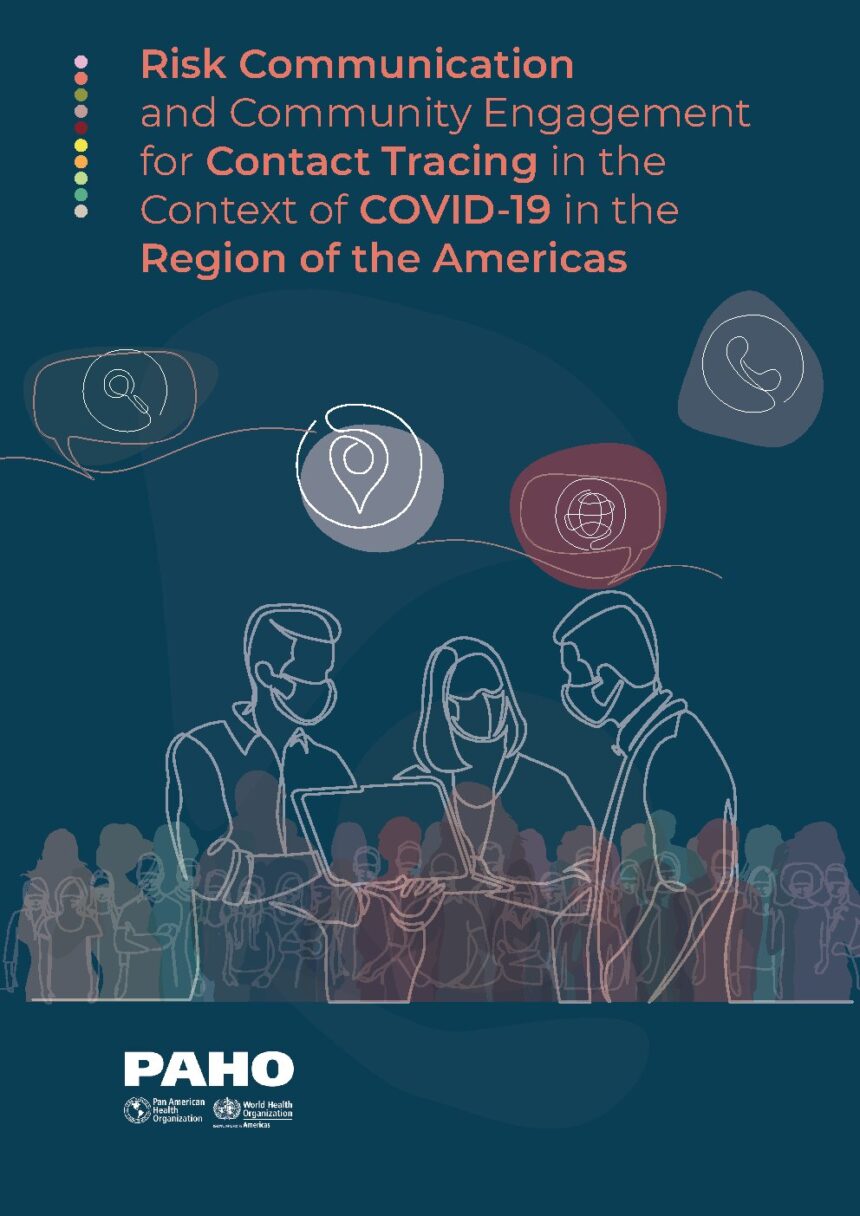
Pan American Health Organization · 2023
A practical guide for health communicators and contact tracing coordinators on building trust, raising awareness, and engaging communities in COVID-19 contact tracing.
- Issuer
- Pan American Health Organization
- Edition
- 2023
- Audience
- Risk communication staff, community engagement workers, health promotion staff, contact tracing coordinators in health ministries and health sector organizations
- Evidence
- Expert guidance based on WHO contact tracing methodology and risk communication principles
- Reviewed
- 17 Oct 2026 · GMJ
What this guideline says
GMJ summary
This PAHO guide addresses one of the greatest challenges in controlling COVID-19 transmission: communicating effectively to encourage community participation in contact tracing. It provides recommendations and tools for informing audiences and raising awareness of the importance of contact tracing and community involvement in the process.
The guide emphasizes that contact tracing is essential for preventing COVID-19 propagation by enabling quarantine of exposed contacts and isolation of positive cases. Success depends on community trust, which is built through contextualized, frank, and transparent communication that involves community leaders and promotes understanding of health risks.
Two main communication tools are presented: public risk communication campaigns to educate populations and build trust in contact tracing activities, and participatory communication strategies designed to encourage community members to actively participate in the contact tracing process. The guide includes practical materials such as poster templates, video scripts, radio soap opera scripts, and social media content.
Key points
For clinicians — doses and thresholds as stated in the guideline
- Contact tracing involves quarantine for up to 14 days for exposed contacts and isolation for at least 10 days from symptom onset plus 3 additional days without symptoms (minimum 13 days total) for confirmed cases
- A contact is defined as: face-to-face contact within 1 meter for more than 15 minutes, direct physical contact, or providing direct care without appropriate PPE
- Exposure period is 2 days before to 10 days after symptom onset (or positive test for asymptomatic cases)
- Contact tracing uses phone contact (voice), SMS/messaging platforms, home visits, or geolocation technologies/applications
- Community engagement is critical: recruit contact tracers from the community who have cultural, linguistic, and social understanding
- Risk communication campaigns should target specific age groups (18–24, 25–34, 35–49, 50–64, 65+ years) with tailored messages and platforms
- Communication must be two-way, empathetic, non-punitive, and avoid stigmatizing language
- Physical distancing of at least 1 meter must be maintained along with mask use, hand hygiene, and respiratory etiquette
Identifying contacts in different settings
Table extracted from the guideline
| Setting | Ways to identify contacts |
|---|---|
| Closed settings (long-term facilities, prisons, shelters, hostels, households, gyms, meeting rooms) | Direct interview with SARS-CoV-2 case caregiver; list of residents, visitors, and staff during relevant timeframe; sign-in sheets; membership lists; interviews with coordinator/manager |
| Healthcare settings | Direct interview with case caregiver; list of residents, visitors, and staff; sign-in sheets; membership lists; interviews with facility coordinator/manager |
| Public or shared transport | Allocated seating records; airline passenger manifests (passengers within 2 rows of case); for non-allocated seating, media release requesting self-identification with date, time, location details |
| Other well-defined settings and gatherings (places of worship, schools, private events, restaurants) | Local risk assessment; communication with focal points (faith leaders); guest registration and booking lists; media release for self-identification; school risk assessment with high-risk contact lists; family interviews |
Source: Pan American Health Organization, Risk Communication and Community Engagement for Contact Tracing in the Context of COVID-19 in the Region of the Americas. Reproduced in summary form.
From the guideline
Verbatim
“Contact tracing is essential for preventing the disease's propagation, since it makes it possible to quarantine people who have had contact with positive cases, and isolate those who have symptoms and have tested positive for COVID-19.”
Editor’s perspective
Why this matters for Georgia and the region
Prof. Giorgi Pkhakadze, MD, MPH, PhD
Editor-in-Chief, Georgian Medical Journal · Chair, Public Health Institute of Georgia · WHO consultant, health and migration
As someone who has worked with WHO on health systems in migration contexts, I see this PAHO guide as immediately applicable to Georgia's ongoing need for robust outbreak response infrastructure beyond COVID-19. The emphasis on community-based contact tracers is particularly relevant for our context: Georgia's successful hepatitis C elimination programme and expanded immunization coverage demonstrate that community trust can be built, but sustaining it requires the kind of systematic, culturally sensitive communication this guide describes. I would stress to Georgian colleagues the principle that contact tracing must never be associated with punitive measures or security concerns—in our region where historical experiences with state surveillance create understandable hesitancy, health authorities must invest heavily in transparent, empathetic communication that explicitly protects privacy. The practical challenge for Georgia will be adapting these primarily Spanish-language materials and urban-focused social media strategies to reach rural Georgian, Azeri-speaking Kvemo Kartli, and Armenian-speaking Samtskhe-Javakheti populations where radio, community leaders, and direct engagement remain more effective than digital platforms.
ORCID 0000-0001-7609-4515 · Perspective written for the GMJ Guidelines Library, 17 Oct 2026
Applicability
Georgia and the South Caucasus
This guide is highly relevant for Georgia and the South Caucasus as the region continues managing COVID-19 transmission and prepares for future respiratory pathogen outbreaks. Georgian public health programmes would need to adapt the communication strategies to account for: significant internal migration and seasonal labor migration to neighboring countries; linguistic diversity including Georgian, Azeri, Armenian, and Russian-speaking populations; disparities between urban Tbilisi and rural regions in digital connectivity and health service access; and the strong role of family networks and religious institutions in community trust. National contact tracing programmes should prioritize engagement with internally displaced persons from occupied territories and ethnic minority communities where trust in government health services may be lower, requiring partnership with community leaders and culturally adapted messaging in multiple languages.
Questions this guideline answers
Quick answers
What defines a close contact for COVID-19 contact tracing?
A contact is a person who had face-to-face contact within 1 meter for more than 15 minutes, direct physical contact, or provided direct care without appropriate PPE to a probable or confirmed COVID-19 case during their infectious period (2 days before to 10 days after symptom onset, plus at least 3 additional symptom-free days).
How long should contacts quarantine and cases isolate?
Contacts should quarantine for 14 days (recommended) in a designated facility or at home. Confirmed cases should isolate for at least 10 days from symptom onset plus 3 additional days without symptoms (minimum 13 days total). Asymptomatic cases isolate 10 days from positive test.
What are the essential principles for engaging communities in contact tracing?
The 11 WHO principles include: learning community circumstances; engaging trustworthy community entities; gaining community acceptance; working with community solutions; creating a community workforce; committing to frank two-way communication; listening and responding to feedback; considering technology carefully; avoiding criminalization; discouraging stigma; and coordinating with all response actors.
What communication channels are most effective for contact tracing campaigns?
Effectiveness depends on the target audience. Urban adults 25–34 may use Facebook and Instagram; rural populations may respond better to community radio and vehicle-mounted loudspeakers. A combination of platforms (social media, official websites, press, influencers, printed materials, SMS) maximizes population exposure while respecting physical distancing.
Related on GMJ
Interconnected resources
Dictionary of Public Health
GMJ News coverage
- UK flu and COVID-19 surveillance data to May 2027 shows continued monitoring amid seasonal trendsOct 2026
- Community Health Workers Boost COVID-19 Testing Among Formerly Incarcerated PeopleAug 2026
- Mobile Health Tools Strengthen Tuberculosis Contact Tracing in Low-Resource SettingsJul 2026
- UK Regulator Streamlines Drug Label Changes Via Self-Certification ModelSep 2026
Quality & accreditation
- ASF PHC — Standard 4 — Acute & Same-Day Care · Primary Health Clinic
- ASF PHC — Standard 7 — Governance & Staffing · Primary Health Clinic
- ASF Hospital — Standard 5 — Safety & Emergency Preparedness
- ASF Hospital — Standard 11 — Critical Care
- ASF Medical Transport — Standard 6 — Emergency Response During Transport
Other guidelines on this topic
- Guidance for Developing Status Profiles on Communicable Diseases to Further Progress toward Their Elimination in the Region of the Americas
- Manual for Stratifying Malaria Risk and the Elimination of Foci
- Essential care package to address mental health and stigma for persons with neglected tropical diseases
- Malaria case management: Plasmodium vivax malaria – A field guide
- Root cause analysis of a yellow fever outbreak: user manual and questionnaire
- Issuer
- Pan American Health Organization
- Type
- Procedures, manuals, guidelines
- Edition
- 2023
- Status
- Current
- Published
- 2023-01-01
- Languages
- Spanish (original), English translation available
- Scope
- COVID-19 contact tracing in the Americas
- Audience
- Risk communication staff, community engagement workers, health promotion staff, contact tracing coordinators in health ministries and health sector organizations
- Licence
- CC BY-NC-SA 3.0 IGO
- Evidence
- Expert guidance based on WHO contact tracing methodology and risk communication principles
- Record history
- Created 17 Oct 2026 · updated 17 Oct 2026 · next check Apr 2027
Pan American Health Organization. Risk Communication and Community Engagement for Contact Tracing in the Context of COVID-19 in the Region of the Americas. Washington, D.C.: PAHO; 2023.GMJ Guidelines Library records are original summaries written by the GMJ editorial team from the issuer’s published document and reviewed by a physician. They do not replace the full guideline. The document is the copyright of its issuer and is linked, not hosted. Spotted an error or a newer edition? Tell the Guidelines Desk.
Was this article helpful?