World Health Organization · 1st edition, 2025 · 82 pages
A competency-based IPC curriculum framework for pre-service health science students to prevent healthcare-associated infections and antimicrobial resistance.
- Issuer
- World Health Organization
- Edition
- 1st edition, 2025
- Audience
- Educators and curriculum developers in healthcare educational institutions; policy makers responsible for pre-service health science education
- Evidence
- Expert consensus through WHO Global IPC Network education sub-working group; evidence review of peer-reviewed literature, existing curricula, and WHO technical documents
- Reviewed
- 17 Oct 2026 · GMJ
What this guideline says
GMJ summary
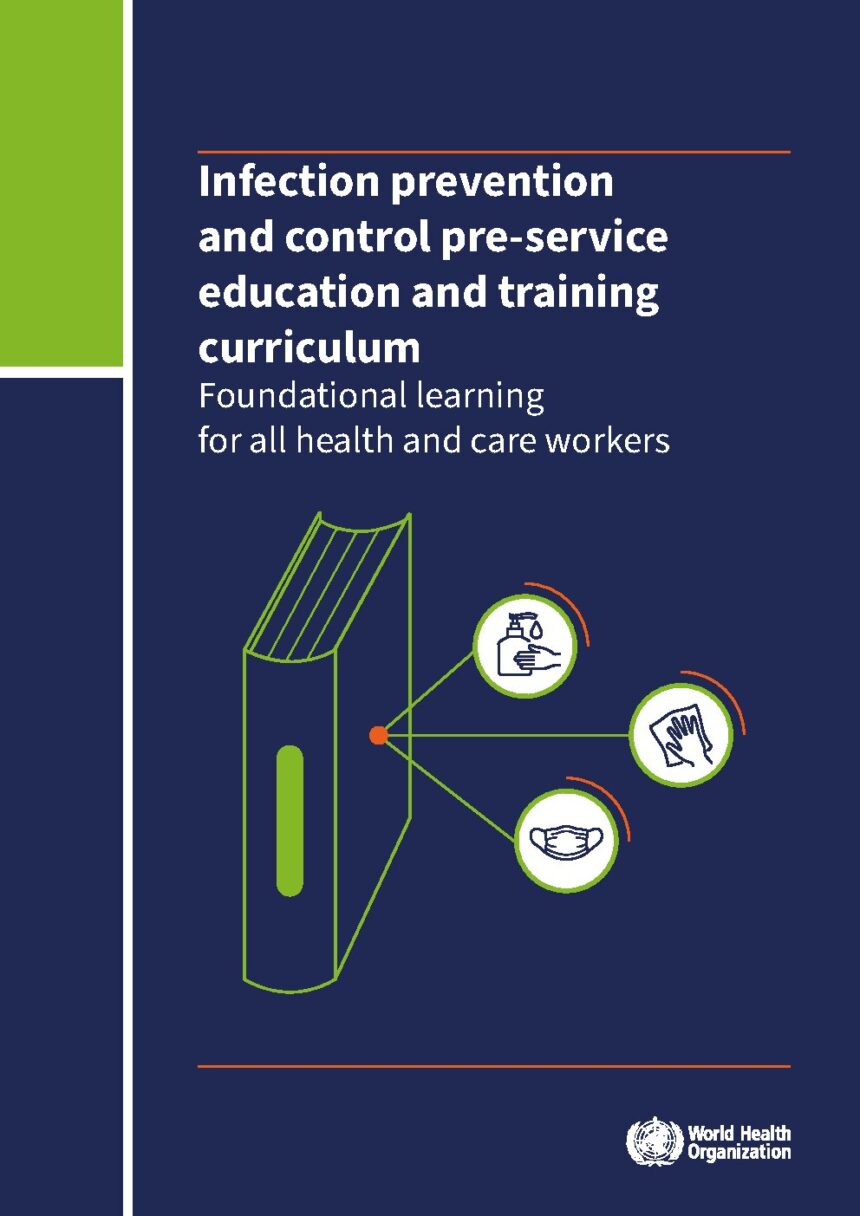
This WHO curriculum provides a comprehensive framework for integrating infection prevention and control (IPC) education into pre-service training programmes for all health and care workers. Responding to the 2022 World Health Assembly resolution on a global IPC strategy, it delivers foundational content applicable to nursing, medicine, midwifery, dentistry, public health, and allied health professions, with targeted modules to follow progressively.
The foundational curriculum covers eight core areas: general microbiology concepts, healthcare-associated infections (HAI) and antimicrobial resistance (AMR), the chain of transmission, IPC principles, standard precautions (including hand hygiene, PPE, environmental cleaning, waste management, aseptic technique, injection safety, and reusable equipment management), transmission-based precautions, AMR prevention concepts, and occupational health for healthcare workers including vaccination and post-exposure management.
Designed for curriculum developers and educators in healthcare educational institutions, the guide emphasizes competency-based learning with clearly defined learning outcomes for knowledge, skills, and attitudes. It promotes flexible, adaptable implementation aligned with national IPC policies and local contexts, using diverse teaching strategies including lectures, simulation, work-based learning, and problem-based approaches. Assessment methods incorporate both formative and summative evaluation using the Kirkpatrick Model to measure training effectiveness from immediate reaction through to long-term patient outcomes.
Key points
For clinicians — doses and thresholds as stated in the guideline
- All pre-service health science students must complete foundational IPC content covering microbiology, HAI/AMR, chain of transmission, standard precautions, transmission-based precautions, and occupational health (estimated 8.45 academic hours total)
- Hand hygiene must be performed according to WHO 'My 5 Moments' using alcohol-based handrub or soap and water with correct technique for minimum 20-40 seconds depending on method
- Standard precautions must be applied for all patients at all times: risk assessment, hand hygiene, respiratory etiquette, appropriate PPE selection, environmental cleaning, safe waste disposal, aseptic technique, safe injection practices, and proper reusable equipment management
- Transmission-based precautions (contact, droplet, airborne) must be added to standard precautions for patients known or suspected to be infected/colonized with transmissible pathogens, including appropriate patient placement, signage, and PPE
- Respirators (N95 or equivalent) require fit testing and seal checks before each use for airborne precautions; medical masks are insufficient for airborne transmission
- Environmental cleaning must follow 'one wipe, one direction, one surface' principle, working from clean to dirty areas, with immediate cleaning and disinfection of blood/body fluid spills
- All healthcare workers must receive vaccination according to institutional requirements (including hepatitis B, seasonal influenza, and others per local policy) and follow post-exposure protocols for blood/body fluid exposures
- Aseptic technique is mandatory for all invasive device insertion and maintenance, wound care, and procedures entering body cavities to prevent contamination
WHO Minimum Requirements for IPC Training and Education (Core Component 3)
Table extracted from the guideline
| Level | Primary Care | Secondary Care | Tertiary Care |
|---|---|---|---|
| Training requirement | IPC training for all clinical practitioners and cleaners upon hire | IPC training for all front-line clinical staff and cleaners upon hire | IPC training for all front-line clinical staff and cleaners upon hire AND annually |
| Content | Education and training on facility IPC guidelines/SOPs upon employment | Education and training on facility IPC guidelines/SOPs upon employment | Education and training on facility IPC guidelines/SOPs upon employment and annually |
| IPC personnel | All IPC link persons and IPC officers at district level need specific IPC training | All IPC staff need specific IPC training | All IPC staff need specific IPC training either online or through courses |
Source: World Health Organization, Infection Prevention and Control Pre-Service Education and Training Curriculum: Foundational Learning for All Health and Care Workers. Reproduced in summary form.
From the guideline
Verbatim
“IPC is a proven and cost-effective approach to prevent the transmission of infectious hazards, but applying it requires programmatic, institutional, financial and knowledge support.”
Editor’s perspective
Why this matters for Georgia and the region
Prof. Giorgi Pkhakadze, MD, MPH, PhD
Editor-in-Chief, Georgian Medical Journal · Chair, Public Health Institute of Georgia · WHO consultant, health and migration
As Chair of Georgia's Public Health Institute and having worked with WHO on health system strengthening, I recognize this curriculum addresses a critical weakness in our regional medical education systems. The 2019 WHO survey showing IPC education scoring lowest among core components globally reflects what we see in Georgian, Armenian, and Azerbaijani medical schools—fragmented IPC teaching without systematic competency assessment. The curriculum's emphasis on competency-based learning with defined outcomes for knowledge, skills, and attitudes aligns perfectly with Georgia's ongoing shift toward outcomes-based medical education that began with our 2019 medical education reforms. I would particularly stress to South Caucasus educators the foundational 8.45 academic hours covering standard precautions and hand hygiene as immediately implementable within existing programmes. However, realistic implementation will require addressing resource constraints: many Georgian clinical training sites lack adequate hand hygiene infrastructure (alcohol-based handrub availability remains below 60% in regional facilities per our 2023 assessments), simulation equipment for practicing aseptic technique and PPE use is limited outside Tbilisi, and we need Georgian-language adaptations of the WHO teaching materials. The curriculum's flexible, adaptable design is essential—our institutions should prioritize high-impact, low-resource content like hand hygiene and respiratory etiquette before expanding to resource-intensive modules requiring simulation labs. Most importantly, this must integrate with our existing antimicrobial resistance national action plan and the infection control standards already required for healthcare facility accreditation under our 2018 quality and safety law.
ORCID 0000-0001-7609-4515 · Perspective written for the GMJ Guidelines Library, 17 Oct 2026
Applicability
Georgia and the South Caucasus
For Georgia and the South Caucasus, this curriculum addresses critical gaps identified in the 2019 WHO facility-level survey where IPC education and training scored lowest globally among IPC core components. Georgian medical, nursing, and public health schools can use this framework to systematically integrate IPC competencies into existing programmes, supporting the country’s antimicrobial resistance national action plan and healthcare quality improvement initiatives. National IPC programmes in Georgia, Armenia, and Azerbaijan should adapt the foundational content to align with existing pre-service education standards, considering resource constraints in clinical training sites and the need for Georgian-language teaching materials. The curriculum’s flexible design allows phased implementation, starting with high-priority topics like hand hygiene and standard precautions before expanding to more complex competencies, while the competency-based approach aligns well with ongoing medical education reforms across the region toward outcomes-based learning.
Questions this guideline answers
Quick answers
What is the minimum IPC training time required for pre-service students?
The foundational curriculum requires an estimated 8.45 academic hours covering all core topics: 120 minutes each for microbiology and HAI/AMR, 60 minutes for hand hygiene and PPE, 120 minutes for transmission-based precautions, and shorter modules for other standard precautions components. This represents minimum foundational content; discipline-specific targeted modules will require additional time.
How should standard precautions and transmission-based precautions be differentiated in teaching?
Standard precautions are the minimum IPC practices used for ALL patients at ALL times in ALL settings, assuming all blood and body fluids are potentially infectious. Transmission-based precautions are ADDITIONAL measures applied alongside standard precautions for patients known or suspected to be infected/colonized with specific transmissible pathogens, determined by transmission route (contact, droplet, or airborne).
What assessment methods should be used to evaluate IPC competencies?
Knowledge should be assessed through quizzes, MCQs, case studies, and essays. Skills require direct observation in clinical or simulation settings using checklists for procedures like hand hygiene, PPE donning/doffing, and aseptic technique. Attitudes are assessed through observation of patient/colleague interactions and reflective practices. The Kirkpatrick Model should guide programme evaluation across four levels: reaction, learning, behaviour change, and organizational results including HAI/AMR reduction.
How does this curriculum align with national IPC minimum requirements?
The curriculum supports WHO IPC Core Component 3 minimum requirements: national IPC training policy and curriculum for all HCWs, approved national curriculum aligned with guidelines, and monitoring systems. It provides the foundational content needed for the national curriculum, ensuring all clinical practitioners receive IPC education upon employment as required at primary, secondary, and tertiary care levels, with annual refresher training at tertiary facilities.
Related on GMJ
Interconnected resources
GMJ News coverage
- UK Hospital Superbug Infections Show Mixed Trends in Latest Government DataJun 2026
- Overuse of 'Just in Case' Antibiotics Accelerates Antimicrobial Resistance Crisis, Researchers WarnSep 2026
- WHO Adopts New Decade-Long Strategy to Combat Antimicrobial Resistance Through 2036Aug 2026
- Heat stress risk from PPE requires urgent clinical vigilance, UK health officials warnOct 2026
Quality & accreditation
- ASF Laboratory — Standard 1 — Governance & Document Control
- ASF Laboratory — Standard 6 — Pre-Examination: Specimen Pathway
- ASF Laboratory — Standard 7 — Examination: Process & Safety
- ASF Laboratory — Standard 8 — Post-Examination: Reporting & Critical Values
- ASF Hospital — Standard 20 — Supporting the Care Workforce
- ASF Laboratory — Standard 3 — Personnel & Competence
- ASF Hospital — Standard 5 — Safety & Emergency Preparedness
- ASF Medical Transport — Standard 5 — Infection Prevention & Control
Other guidelines on this topic
- Development and implementation of national action plans for infection prevention and control: practical guide
- Framework and toolkit for infection prevention and control outbreak preparedness, readiness and response: implementation manual
- Guidance on Indoor Environmental Quality in Health Care Facilities
- Respiratory Protection Program for Healthcare Workers
- Strengthening clinical diagnostic stewardship in the Western Pacific Region: a practical manual
- Issuer
- World Health Organization
- Type
- Handbook
- Edition
- 1st edition, 2025
- Status
- Current
- Published
- 2025-05-04
- Languages
- English
- Scope
- Pre-service education for all health and care workers including nursing, medicine, midwifery, dentistry, public health, and allied health professions
- Audience
- Educators and curriculum developers in healthcare educational institutions; policy makers responsible for pre-service health science education
- Pages
- 82
- Licence
- CC BY-NC-SA 3.0 IGO
- ISBN
- 978-92-4-010996-4
- Evidence
- Expert consensus through WHO Global IPC Network education sub-working group; evidence review of peer-reviewed literature, existing curricula, and WHO technical documents
- Record history
- Created 17 Oct 2026 · updated 17 Oct 2026 · next check Apr 2027
World Health Organization. Infection prevention and control pre-service education and training curriculum: foundational content for all health and care workers. Geneva: World Health Organization; 2025. Licence: CC BY-NC-SA 3.0 IGO.GMJ Guidelines Library records are original summaries written by the GMJ editorial team from the issuer’s published document and reviewed by a physician. They do not replace the full guideline. The document is the copyright of its issuer and is linked, not hosted. Spotted an error or a newer edition? Tell the Guidelines Desk.
Was this article helpful?