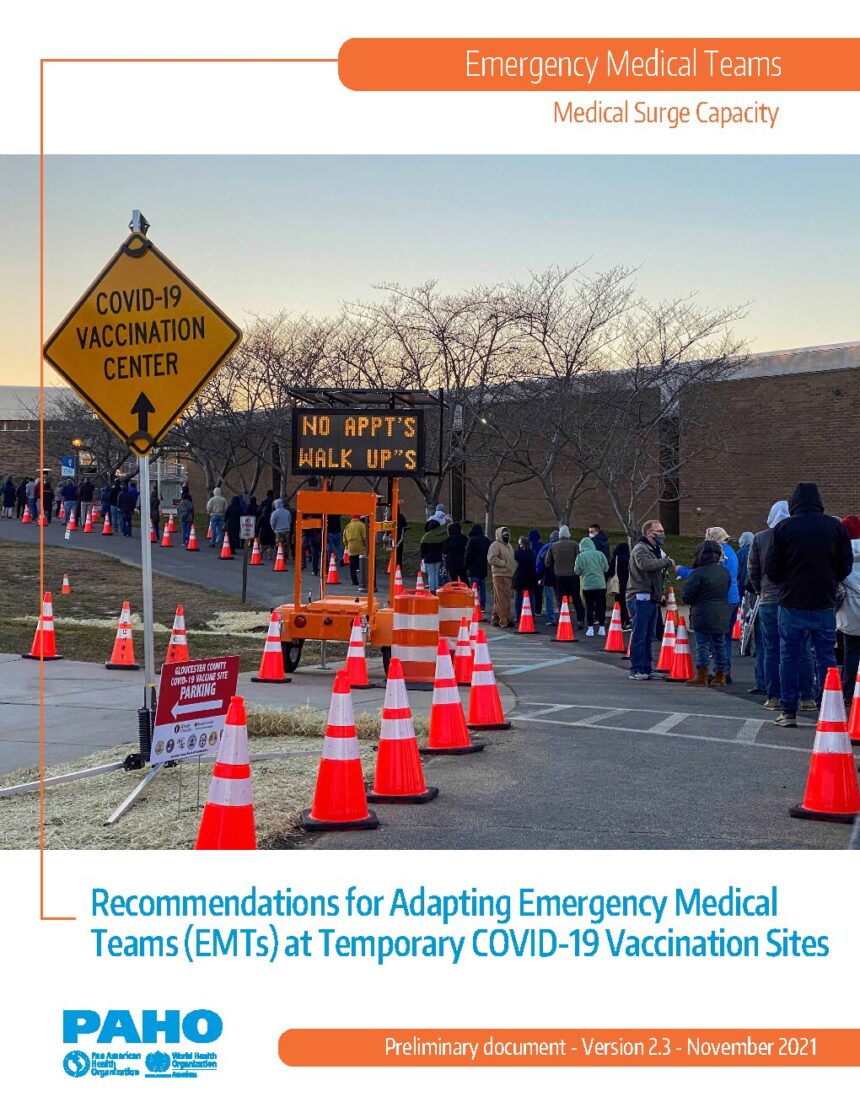
Pan American Health Organization · Version 2.3, November 2021
Operational guide for emergency medical teams establishing safe, temporary COVID-19 vaccination sites in remote and underresourced areas.
- Issuer
- Pan American Health Organization
- Edition
- Version 2.3, November 2021
- Audience
- Emergency medical teams, public health authorities, vaccination programme managers
- Evidence
- Expert consensus and operational field experience
- Reviewed
- 18 Oct 2026 · GMJ
What this guideline says
GMJ summary
This preliminary operational guide provides recommendations for emergency medical teams (EMTs) to establish and operate temporary COVID-19 vaccination sites in coordination with national and local health authorities. It addresses the unique challenges of mass vaccination campaigns, particularly in remote or resource-limited settings, using the 5S methodology: Systems, Structure, Staff, Stuff (equipment/supplies), and Operational Support.
The document defines three EMT vaccination scenarios based on location, vaccine type, and flow of people to be vaccinated. Low flows are defined as fewer than 1,500 people per day; high flows as greater than 1,500 people per day (requiring at least six vaccination stations, with each vaccinator handling 200–300 people daily). The guide emphasizes maintaining cold chain integrity with specific storage temperatures for different vaccines: -90°C to -60°C for Pfizer-BioNTech (use within 6 hours of dilution), -25°C to -15°C for Moderna (use within 6 hours of opening), and +2°C to +8°C for most other vaccines including AstraZeneca (discard 6 hours after opening), Sinovac (discard 8 hours after opening), and Sinopharm (use immediately after opening).
Key operational requirements include unidirectional patient flow through eight steps (waiting, identity verification, vital signs, data collection, vaccination, observation for at least 15 minutes, and exit), mandatory adverse event following immunization (AEFI) reporting through national systems, shock room capacity for at least two patients, and comprehensive waste management for sharps and infectious materials. All staff must be trained in vaccine preparation, administration, AEFI identification, and cold chain management, with vaccination preferably in the deltoid at a 90° angle without gloves.
Key points
For clinicians — doses and thresholds as stated in the guideline
- Low vaccination flows: <1,500 people per day; high flows: >1,500 people per day requiring ≥6 vaccination stations at 200–300 people per vaccinator daily
- Pfizer-BioNTech storage: -90°C to -60°C until expiry or +2°C to +8°C for 31 days; use within 6 hours of dilution at +2°C to +8°C
- Moderna storage: -25°C to -15°C until expiry or +2°C to +8°C for 31 days; use within 6 hours of opening vial
- AstraZeneca/Covishield storage: +2°C to +8°C until expiry; discard 6 hours after opening at +2°C to +8°C
- Sinovac CoronaVac storage: +2°C to +8°C until expiry; discard multidose vial 8 hours after opening
- All vaccinated persons must wait at least 15 minutes for observation to detect adverse events following immunization (AEFI)
- Shock room must accommodate at least two patients simultaneously for AEFI management, with anaphylaxis treatment resources readily available
- Maintain 1.5 meters (6 feet) physical distancing throughout all waiting areas and unidirectional flow from entry through vaccination to exit
COVID-19 Vaccine Storage Temperatures
Table extracted from the guideline
| Vaccine Name | Storage Temperature | In Transit/In Use |
|---|---|---|
| Pfizer-BioNTech Comirnaty | -90°C to -60°C until expiry (up to 6 months) OR +2°C to +8°C for 31 days | Use within 6 hours of dilution, stored at +2°C to +8°C; at <30°C maximum 2 hours |
| Moderna COVID-19 | -25°C to -15°C until expiry OR +2°C to +8°C for 31 days | Use within 6 hours of opening vial at +2°C to +8°C; +8°C to +25°C up to 12 hours |
| AstraZeneca / Covishield | +2°C to +8°C until expiry | Discard 6 hours after opening, stored between +2°C and +8°C |
| Sinovac CoronaVac | +2°C to +8°C until expiry | Discard multidose vial 8 hours after opening, stored between +2°C and +8°C |
| Sinopharm BBIBP-CorV | +2°C to +8°C until expiry | Use immediately after opening vial |
| Sputnik V | Below -8°C until expiry | Use within 2 hours of thawing |
| Janssen (J&J) | -25°C to -15°C (6 months) OR +2°C to +8°C (3 months) | Use within 6 hours of opening at +2°C to +8°C; maximum +25°C for 2 hours |
| Bharat Biotech Covaxin | +2°C to +8°C until expiry (9 months) | Use within 6 hours of opening at +2°C to +8°C; +9°C to +25°C maximum 12 hours |
Source: Pan American Health Organization, Recommendations for Adapting Emergency Medical Teams (EMTs) at Temporary COVID-19 Vaccination Sites. Reproduced in summary form.
From the guideline
Verbatim
“Anaphylaxis due to administration of COVID-19 vaccines occurs mainly in the first hour after vaccine administration. The necessary resources must be available to treat it appropriately.”
Editor’s perspective
Why this matters for Georgia and the region
Prof. Giorgi Pkhakadze, MD, MPH, PhD
Editor-in-Chief, Georgian Medical Journal · Chair, Public Health Institute of Georgia · WHO consultant, health and migration
As Georgia continues COVID-19 vaccination efforts reaching remote mountainous regions and internally displaced populations, this PAHO framework offers essential operational guidance for our mobile medical teams. The detailed cold chain protocols are particularly relevant given Georgia's infrastructure challenges in Racha, Tusheti, and highland Adjara where electricity supply can be unreliable—the requirement for uninterruptible power supplies and backup generators directly addresses our field realities. I would emphasize to Georgian teams the 15-minute observation period and mandatory two-bed shock room capacity; while we have fortunately seen low anaphylaxis rates with COVID-19 vaccines in our national surveillance, preparedness saves lives. One implementation caveat: the document assumes national electronic immunization registries, but many of our rural feldsher posts still rely on paper-based systems—teams must prepare dual recording capacity and ensure data flows to the NCDC even from areas with intermittent connectivity, perhaps through batch uploads or courier systems already used for notifiable disease reporting.
ORCID 0000-0001-7609-4515 · Perspective written for the GMJ Guidelines Library, 18 Oct 2026
Applicability
Georgia and the South Caucasus
For Georgia and the South Caucasus region, these recommendations are directly applicable given the ongoing COVID-19 vaccination efforts and the region’s geographic diversity including mountainous and remote areas. Georgia’s National Center for Disease Control and Public Health oversees vaccine distribution and cold chain management; EMTs adapting these protocols must coordinate closely with NCDC surveillance systems for AEFI reporting. The multi-vaccine environment described (with different storage requirements) reflects Georgia’s actual procurement strategy using Pfizer, AstraZeneca, Sinopharm, and other vaccines. National immunization programmes in Armenia and Azerbaijan face similar challenges with cold chain maintenance in rural settings. Implementers must ensure alignment with national regulatory authorities’ vaccine authorization processes and integrate with existing electronic immunization registries where available, or paper-based tally systems in remote locations. The 15-minute post-vaccination observation period and shock room requirements align with current Georgian Ministry of Health protocols for vaccination safety.
Questions this guideline answers
Quick answers
How many vaccination stations does an EMT need for different population flows?
For low flows (<1,500 people per day), fewer stations are needed based on 200–300 people per vaccinator daily. For high flows (>1,500 people per day), at least six vaccination stations are required, with proportional increases in other workstations and operational support.
How long can different COVID-19 vaccines remain outside ultra-cold storage?
Pfizer can be stored at +2°C to +8°C for 31 days and used within 6 hours of dilution. Moderna can be stored at +2°C to +8°C for 31 days and used within 6 hours of opening. AstraZeneca must be discarded 6 hours after opening. Sinovac must be discarded 8 hours after opening. Sinopharm must be used immediately after opening.
What is the minimum observation time after COVID-19 vaccination?
All vaccinated persons must wait at least 15 minutes for observation to check for any adverse events following immunization (AEFI). Anaphylaxis due to COVID-19 vaccines occurs mainly in the first hour after administration, so resources for treatment must be immediately available.
What are the essential components of a shock room at a vaccination EMT?
The shock room must have at least two shock beds (one for active care, one free for a second simultaneous AEFI), sufficient space for health personnel to maneuver, a pharmacy area with resuscitation drugs for anaphylaxis and cardiac arrest (restricted to authorized health workers), and good access for ambulances or patient referral vehicles.
Related on GMJ
Interconnected resources
Dictionary of Public Health
GMJ News coverage
- UK flu and COVID-19 surveillance data to May 2027 shows continued monitoring amid seasonal trendsOct 2026
- Community Health Workers Boost COVID-19 Testing Among Formerly Incarcerated PeopleAug 2026
- UK Updates Influenza Vaccine Delivery Framework for 2024–25 Seasonal CampaignJul 2026
- UK Spring 2026 COVID-19 Vaccination Campaign Targets Vulnerable PopulationsAug 2026
Quality & accreditation
- ASF PHC — Standard 4 — Acute & Same-Day Care · Primary Health Clinic
- ASF PHC — Standard 7 — Governance & Staffing · Primary Health Clinic
- ASF Hospital — Standard 5 — Safety & Emergency Preparedness
- ASF Medical Transport — Standard 5 — Infection Prevention & Control
- ASF Laboratory — Standard 7 — Examination: Process & Safety
- ASF Hospital — Standard 9 — Refugee & Migrant Health
- ASF Laboratory — Standard 9 — Refugee & Migrant Health
- ASF Medical Transport — Standard 8 — Refugee & Migrant Health
Other guidelines on this topic
- Infection Prevention and Control Pre-Service Education and Training Curriculum: Foundational Learning for All Health and Care Workers
- Development and implementation of national action plans for infection prevention and control: practical guide
- Polio Eradication Strategy 2022–2026: delivering on a promise, extension to 2029
- Framework and toolkit for infection prevention and control outbreak preparedness, readiness and response: implementation manual
- Guidance on Indoor Environmental Quality in Health Care Facilities
- Issuer
- Pan American Health Organization
- Type
- Procedures, manuals, guidelines
- Edition
- Version 2.3, November 2021
- Status
- Current
- Published
- 2022-01-01
- Languages
- English
- Scope
- Operational guidance for establishing temporary COVID-19 vaccination sites using emergency medical teams
- Audience
- Emergency medical teams, public health authorities, vaccination programme managers
- Licence
- CC BY-NC-SA 3.0 IGO
- Evidence
- Expert consensus and operational field experience
- Record history
- Created 18 Oct 2026 · updated 18 Oct 2026 · next check Apr 2027
Pan American Health Organization. Recommendations for Adapting Emergency Medical Teams (EMTs) at Temporary COVID-19 Vaccination Sites. Preliminary Document, Version 2.3 - November 2021. Washington, D.C.: PAHO; 2022. (PAHO/PHE/IMS/COVID-19/21-0017).GMJ Guidelines Library records are original summaries written by the GMJ editorial team from the issuer’s published document and reviewed by a physician. They do not replace the full guideline. The document is the copyright of its issuer and is linked, not hosted. Spotted an error or a newer edition? Tell the Guidelines Desk.
Was this article helpful?