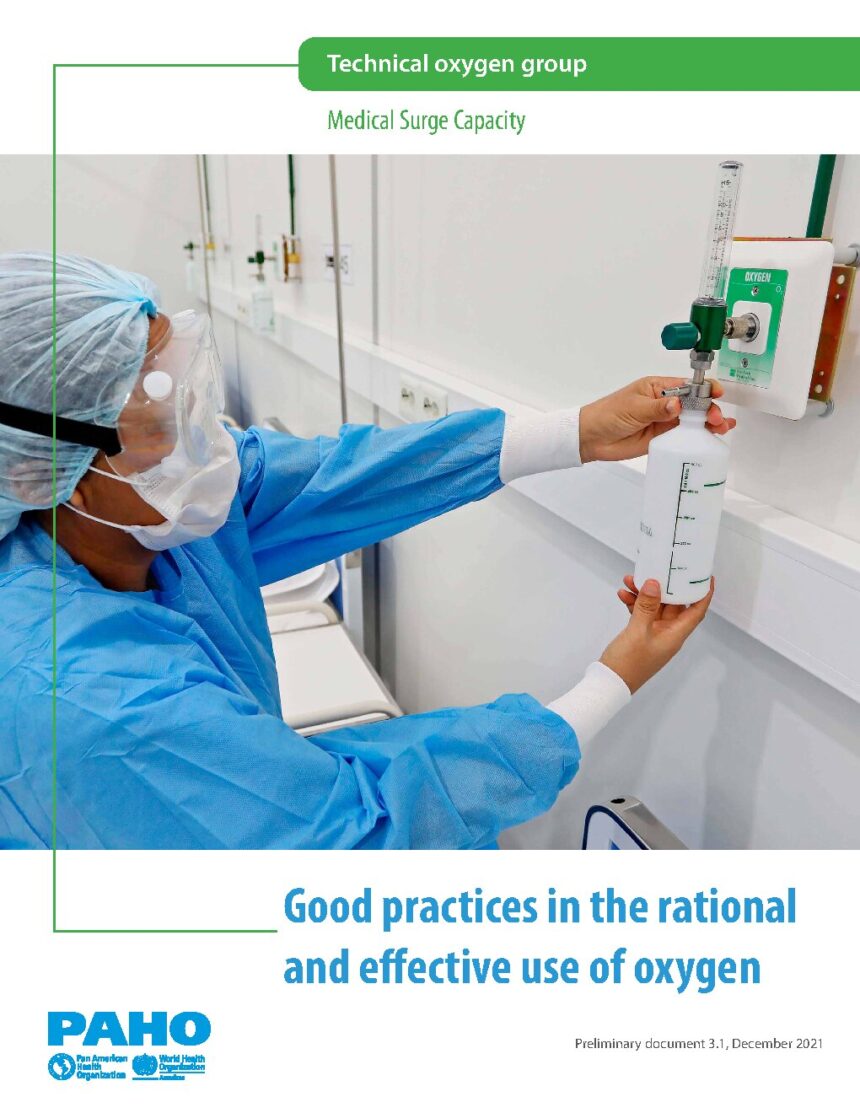
Pan American Health Organization · Preliminary document 3.1, December 2021
Practical guidance for optimising medical oxygen management and use during COVID-19 and other respiratory emergencies.
- Issuer
- Pan American Health Organization
- Edition
- Preliminary document 3.1, December 2021
- Audience
- Hospital managers, clinicians, pharmacists, engineers, procurement staff
- Evidence
- Expert consensus and technical best practices
- Reviewed
- 18 Oct 2026 · GMJ
What this guideline says
GMJ summary
This PAHO guidance document provides comprehensive recommendations for the rational and effective use of medical oxygen in health facilities, developed in response to oxygen shortages during the COVID-19 pandemic in Latin America and the Caribbean. The document addresses the entire oxygen supply chain, from procurement and quality control through storage, distribution, and clinical administration.
The guidance emphasises that oxygen is an essential medicine requiring systematic management across five key domains: service organisation, administrative management, patient care, logistics and control, and engineering and maintenance. Central recommendations include maintaining a 72-hour emergency reserve, using algorithms for oxygen delivery based on disease severity, implementing flowmeters at correct pressure (3.5 kgf/cm² or 50 PSI), and establishing systematic monitoring of consumption patterns.
The document stresses waste reduction through leak prevention, proper equipment maintenance, prescription recording, and training of all staff involved in the oxygen supply chain. It advocates for multi-level care units matched to patient severity, pharmacy team leadership in gas management, and quality control systems especially for facilities producing their own oxygen.
Key points
For clinicians — doses and thresholds as stated in the guideline
- For COVID-19 patients, start oxygen at 1–2 litres/minute in children and 5 litres/minute via nasal cannula in adults, escalating to 6–10 litres/minute with Venturi mask or 10–15 litres/minute with reservoir bag mask as needed
- Maintain a minimum 72-hour emergency reserve of medical gases at all health facilities, as recommended in the Hospital Safety Index
- Operate oxygen systems at 3.5 kgf/cm² (50 PSI or 345 kPa) pressure, as higher pressures cause flowmeters to deliver significantly more oxygen than indicated
- Use algorithms for oxygen delivery based on initial triage assessment of severity, with continuous SpO₂ monitoring to guide therapy
- Record all medical gas use in patient prescriptions to enable comparison between amounts prescribed and purchased, identifying system losses
- Establish units of increasing complexity to rationally allocate human and technology resources based on patient severity
- Calculate mean effective consumption as the arithmetic mean of oxygen use over the previous 12 months to guide procurement planning
- Ensure daily checks of flowmeter pressures, device connections, and oxygen inlets to identify and report leaks, even small ones
From the guideline
Verbatim
“A drug is considered to be used rationally when patients receive it according to their clinical needs, in doses appropriate to their individual needs, for an appropriate period, and at a low cost to them and their community.”
Editor’s perspective
Why this matters for Georgia and the region
Prof. Giorgi Pkhakadze, MD, MPH, PhD
Editor-in-Chief, Georgian Medical Journal · Chair, Public Health Institute of Georgia · WHO consultant, health and migration
As someone who has advised on health system strengthening across the South Caucasus, I recognise that oxygen management remains a critical vulnerability in our regional health systems. During the COVID-19 pandemic, Georgia and neighbouring countries experienced severe oxygen shortages not primarily due to total supply limitations but because of system inefficiencies—leaks, incorrect pressures, and lack of consumption monitoring—that this PAHO guidance directly addresses. The recommendation I would most emphasise to Georgian clinicians and hospital administrators is the systematic recording of oxygen prescriptions and comparison with procurement data; in my consultancy experience, this single intervention often reveals 20–30% losses that are entirely preventable. The realistic implementation challenge for our region is that many facilities still operate Soviet-era pipeline systems with pressures exceeding 5–6 kgf/cm², meaning the 3.5 kgf/cm² recommendation would require either system-wide pressure reduction (complex and expensive) or installation of individual pressure regulators at each flowmeter point (more feasible as an interim solution).
ORCID 0000-0001-7609-4515 · Perspective written for the GMJ Guidelines Library, 18 Oct 2026
Applicability
Georgia and the South Caucasus
For Georgia and the South Caucasus, this guidance is directly applicable given the region’s experience with COVID-19 surges and ongoing challenges with medical oxygen infrastructure in both urban and rural settings. National health programmes would need to assess current oxygen system pressures across facilities (many Soviet-era systems operated at higher pressures than the recommended 3.5 kgf/cm²), establish monitoring systems for consumption data that may not currently exist, and develop training programmes for the entire oxygen supply chain from procurement officers to bedside clinicians. The 72-hour reserve recommendation is particularly relevant for facilities in mountainous or remote areas of Georgia, Armenia, and Azerbaijan where supply chain disruptions are more likely. Quality control mechanisms are essential for any facilities using oxygen concentrators or local production systems, which became more common during the pandemic.
Questions this guideline answers
Quick answers
What oxygen flow rates should I use for adult COVID-19 patients?
Start with 5 litres/minute via nasal cannula, then escalate to moderate flow rates of 6–10 litres/minute using a Venturi-type mask or higher flow rates of 10–15 litres/minute using a mask with reservoir bag based on patient response. High-flow nasal cannula, non-invasive ventilation, or invasive ventilation may be needed for severe cases.
Why does oxygen system pressure matter?
Flowmeters are calibrated to operate at 3.5 kgf/cm² (50 PSI or 345 kPa). If your system pressure is higher, flowmeters will deliver much more oxygen than the dial indicates (e.g. setting '5 litres/minute' may actually deliver 8–10 litres/minute), leading to massive waste and potential supply shortages.
How much oxygen reserve should our hospital maintain?
Maintain at least a 72-hour supply of medical oxygen as an emergency reserve. This should be in addition to your primary and secondary supply sources, and is critical for maintaining patient safety during supply disruptions or disaster situations.
What is the single most effective way to reduce oxygen waste?
Systematic daily checks: verify flowmeter pressures are correct, check all connections for leaks, disconnect unused equipment from outlets, and record prescribed oxygen doses in medical charts. The difference between purchased and prescribed amounts often reveals significant system losses that can be prevented.
Related on GMJ
Interconnected resources
Dictionary of Public Health
GMJ News coverage
- UK flu and COVID-19 surveillance data to May 2027 shows continued monitoring amid seasonal trendsOct 2026
- Community Health Workers Boost COVID-19 Testing Among Formerly Incarcerated PeopleAug 2026
- New drug slows lung decline in idiopathic pulmonary fibrosis, landmark trial showsSep 2026
- The Teenager Whose Heart Failure Looked Like a Stomach Bug — A Fatal Lesson for Paediatric ScreeningAug 2026
Quality & accreditation
- ASF Hospital — Standard 5 — Safety & Emergency Preparedness
- ASF Hospital — Standard 11 — Critical Care
- ASF Medical Transport — Standard 6 — Emergency Response During Transport
- ASF Hospital — Standard 7 — Governance & Management
- ASF Hospital — Standard 4 — Care & Treatment
- ASF Hospital — Standard 13 — Radiology
- ASF Laboratory — Standard 4 — Equipment, Reagents & Traceability
Other guidelines on this topic
- Considerations on the Use of Antivirals, Monoclonal Antibodies, and Other Interventions for the Management of COVID-19 Patients in Latin America and the Caribbean
- Guidelines for the Care of Adult Patients with Severe or Critical COVID-19 in the Americas. Abridged version, 4th edition
- Guidelines for the Prophylaxis and Management of Patients with Non-severe COVID-19 in Latin America and the Caribbean
- STAR-H: Strategic Toolkit for Assessing Risks in Health Facilities
- Regional manual with operating guides on respiratory care equipment and devices
- Issuer
- Pan American Health Organization
- Type
- Procedures, manuals, guidelines
- Edition
- Preliminary document 3.1, December 2021
- Status
- Current
- Published
- 2022-01-01
- Scope
- Medical oxygen management across all levels of health services
- Audience
- Hospital managers, clinicians, pharmacists, engineers, procurement staff
- Licence
- CC BY-NC-SA 3.0 IGO
- Evidence
- Expert consensus and technical best practices
- Record history
- Created 18 Oct 2026 · updated 18 Oct 2026 · next check Apr 2027
Pan American Health Organization. Good Practices in the Rational and Effective Use of Oxygen. Preliminary document 3.1, December 2021. Washington, D.C.: PAHO; 2022. (PAHO/PHE/IMS/COVID-19/21-0019).GMJ Guidelines Library records are original summaries written by the GMJ editorial team from the issuer’s published document and reviewed by a physician. They do not replace the full guideline. The document is the copyright of its issuer and is linked, not hosted. Spotted an error or a newer edition? Tell the Guidelines Desk.
Was this article helpful?