Pan American Health Organization · Interim recommendations, 6 February 2020
Interim recommendations on PPE selection, quantities and use for healthcare workers managing suspected or confirmed 2019-nCoV cases.
- Issuer
- Pan American Health Organization
- Edition
- Interim recommendations, 6 February 2020
- Audience
- Healthcare workers, infection prevention and control professionals, health facility managers, procurement officers
- Evidence
- Based on simulation exercises from SARS and MERS outbreaks; expert consensus
- Reviewed
- 19 Oct 2026 · GMJ
What this guideline says
GMJ summary
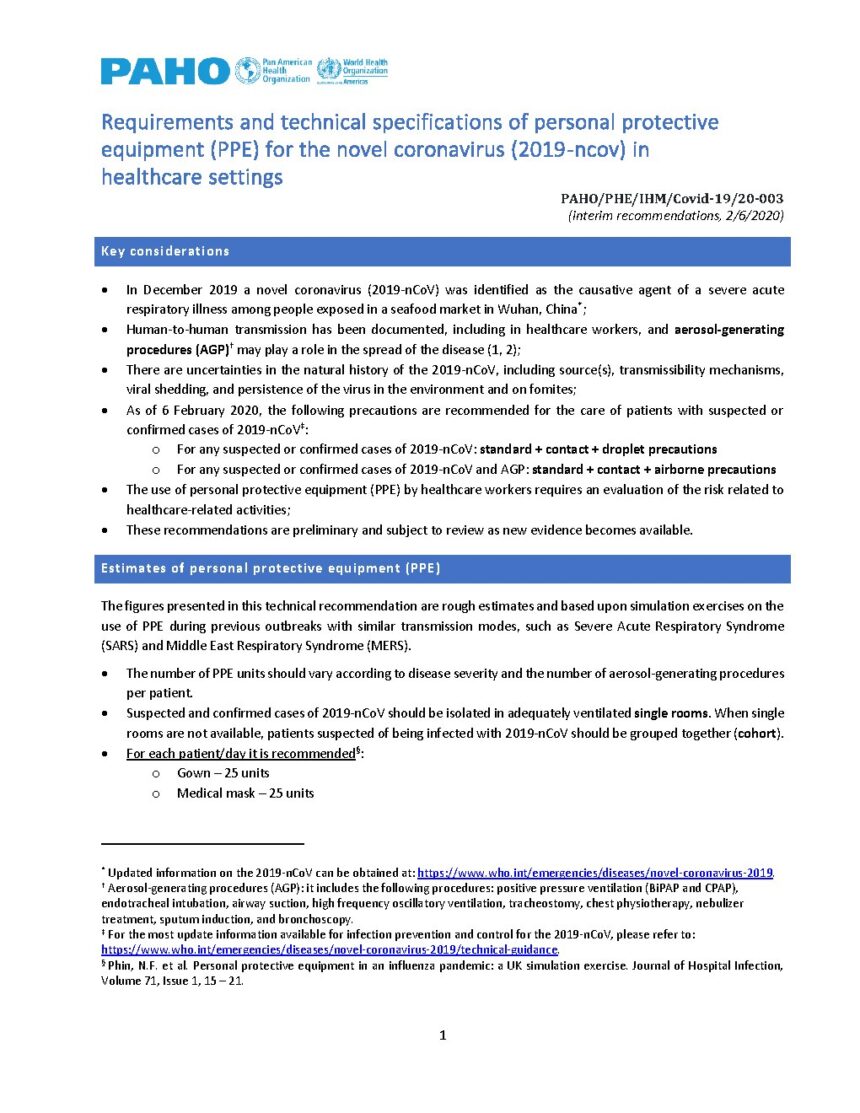
This interim guidance, issued on 6 February 2020 by the Pan American Health Organization, provides technical specifications and estimates for personal protective equipment (PPE) required by healthcare workers managing patients with suspected or confirmed 2019-nCoV infection. It distinguishes between standard care (standard + contact + droplet precautions) and care involving aerosol-generating procedures (standard + contact + airborne precautions).
The document specifies estimated PPE quantities per patient per day based on simulation exercises from previous SARS and MERS outbreaks: 25 gowns, 25 medical masks, 1 particulate respirator (N95/FFP2), 50 non-sterile gloves, and 1 pair of goggles or face shield. Detailed technical specifications are provided for each item, including international standards compliance (EN, ANSI, ASTM). Recommendations vary by level of care: triage, specimen collection, routine care without aerosol-generating procedures, and care with aerosol-generating procedures such as intubation, BiPAP/CPAP, bronchoscopy and sputum induction.
The guidance emphasizes that PPE use must follow risk assessment of healthcare activities, that suspected and confirmed cases should be isolated in adequately ventilated single rooms (or cohorting if unavailable), and that these recommendations are preliminary and subject to revision as new evidence emerges about the novel coronavirus transmission mechanisms.
Key points
For clinicians — doses and thresholds as stated in the guideline
- For suspected or confirmed 2019-nCoV without aerosol-generating procedures: standard + contact + droplet precautions (hand hygiene, gown, medical mask, gloves, goggles or face shield)
- For suspected or confirmed 2019-nCoV with aerosol-generating procedures: standard + contact + airborne precautions (hand hygiene, gown, N95/FFP2 respirator, gloves, goggles or face shield)
- Estimated PPE per patient per day: 25 gowns, 25 medical masks, 1 particulate respirator (N95/FFP2), 50 non-sterile gloves, 1 pair of goggles or face shield
- Aerosol-generating procedures include: positive pressure ventilation (BiPAP and CPAP), endotracheal intubation, airway suction, high frequency oscillatory ventilation, tracheostomy, chest physiotherapy, nebulizer treatment, sputum induction, and bronchoscopy
- Isolate suspected and confirmed cases in adequately ventilated single rooms; when unavailable, cohort suspected patients together
- For triage: hand hygiene and medical mask only
- For specimen collection: hand hygiene, gown, medical mask, gloves, and goggles or face shield
- Hand rub formulations should contain 75% isopropanol or 80% ethanol
Use of personal protective equipment (PPE) according to level of care
Table extracted from the guideline
| Level of care | Hand hygiene | Gown | Medical mask | Respirator (N95 or FFP2) | Goggles or Face shield | Gloves |
|---|---|---|---|---|---|---|
| Triage | X | X | ||||
| Collection of specimens for laboratory diagnosis | X | X | X | X | X | |
| Suspected or confirmed case of 2019-nCoV requiring healthcare facility admission and NO aerosol-generating procedure | X | X | X | X | X | |
| Suspected or confirmed case of 2019-nCoV requiring healthcare facility admission and WITH aerosol-generating procedure | X | X | X | X | X |
Source: Pan American Health Organization, Requirements and technical specifications of personal protective equipment (PPE) for the novel coronavirus (2019-nCoV) in healthcare settings. Reproduced in summary form.
From the guideline
Verbatim
“For any suspected or confirmed cases of 2019-nCoV: standard + contact + droplet precautions. For any suspected or confirmed cases of 2019-nCoV and AGP: standard + contact + airborne precautions.”
Editor’s perspective
Why this matters for Georgia and the region
Prof. Giorgi Pkhakadze, MD, MPH, PhD
Editor-in-Chief, Georgian Medical Journal · Chair, Public Health Institute of Georgia · WHO consultant, health and migration
As Georgia continues strengthening its epidemic preparedness capacity following successful public health programmes in hepatitis C elimination and universal health coverage, this PAHO guidance provides essential technical benchmarks for PPE procurement and infection control protocols. The distinction between droplet and airborne precautions based on aerosol-generating procedures is critical for Georgian healthcare facilities to implement rationally, avoiding both under-protection of staff and wasteful overuse of scarce N95 respirators. The specified daily quantities—25 gowns and 25 masks per patient—may challenge supply chains in regional Georgian hospitals during surge conditions, necessitating national stockpiling strategies and agreements with reliable suppliers meeting the EN and ASTM standards detailed in this document. Georgian infection prevention and control teams should use the technical specifications table as a mandatory procurement checklist, ensuring that locally purchased PPE meets international standards rather than accepting substandard donations during emergencies.
ORCID 0000-0001-7609-4515 · Perspective written for the GMJ Guidelines Library, 19 Oct 2026
Applicability
Georgia and the South Caucasus
This guidance remains relevant for Georgia and the South Caucasus as foundational principles for PPE selection and infection prevention during respiratory pathogen outbreaks with similar transmission characteristics. National health programmes must ensure adequate stockpiling based on the specified quantities (25 gowns, 25 masks, 50 gloves per patient daily), verify that procured PPE meets the international standards cited (EN, ANSI, ASTM), and train healthcare workers on appropriate selection based on aerosol-generating versus non-aerosol procedures. Georgia’s healthcare facilities should assess their capacity for single-room isolation and adequate ventilation, particularly in regional hospitals, and establish cohorting protocols where infrastructure limitations exist. The technical specifications table provides a practical procurement checklist for supply chain managers ensuring quality standards during epidemic preparedness.
Questions this guideline answers
Quick answers
What PPE is needed for routine care of a confirmed 2019-nCoV patient without intubation or nebulisation?
Hand hygiene, gown, medical mask, non-sterile gloves, and goggles or face shield. An N95 respirator is not required unless aerosol-generating procedures are performed.
Which procedures are considered aerosol-generating and require N95/FFP2 respirators?
Positive pressure ventilation (BiPAP and CPAP), endotracheal intubation, airway suction, high frequency oscillatory ventilation, tracheostomy, chest physiotherapy, nebulizer treatment, sputum induction, and bronchoscopy.
How much PPE should be estimated per patient per day?
Based on simulation exercises: 25 gowns, 25 medical masks, 1 particulate respirator (N95/FFP2), 50 non-sterile gloves, and 1 pair of goggles or face shield. Actual quantities vary by disease severity and number of aerosol-generating procedures.
What are the minimum technical specifications for medical masks?
High fluid resistance (minimum 120 mmHg pressure), good breathability, EN 14683 Type IIR performance or ASTM F2100 level 2 or 3, structured design that does not collapse against the mouth, with clearly identified internal and external faces.
Related on GMJ
Interconnected resources
Dictionary of Public Health
GMJ News coverage
Quality & accreditation
- ASF Hospital — Standard 5 — Safety & Emergency Preparedness
- ASF Medical Transport — Standard 5 — Infection Prevention & Control
- ASF Laboratory — Standard 7 — Examination: Process & Safety
- ASF Hospital — Standard 13 — Radiology
- ASF Laboratory — Standard 4 — Equipment, Reagents & Traceability
- ASF Hospital — Standard 11 — Critical Care
- ASF Medical Transport — Standard 6 — Emergency Response During Transport
Other guidelines on this topic
- The COVID-19 Risk Communication Package for Healthcare Facilities
- Administrative Controls to Guarantee Implementation of Infection Prevention and Control Measures in the Context of COVID-19
- Caribbean Shelter Guide: COVID-19 Considerations
- Prehospital Emergency Medical Services Readiness Checklist for COVID-19
- Recommendations to expand access to hand washing and its proper use
- Issuer
- Pan American Health Organization
- Type
- Procedures, manuals, guidelines
- Edition
- Interim recommendations, 6 February 2020
- Status
- Current
- Published
- 2020-01-01
- Scope
- Healthcare settings
- Audience
- Healthcare workers, infection prevention and control professionals, health facility managers, procurement officers
- Licence
- CC BY-NC-SA 3.0 IGO
- Evidence
- Based on simulation exercises from SARS and MERS outbreaks; expert consensus
- Record history
- Created 19 Oct 2026 · updated 19 Oct 2026 · next check Apr 2027
Pan American Health Organization. Requirements and technical specifications of personal protective equipment (PPE) for the novel coronavirus (2019-nCoV) in healthcare settings. Interim recommendations, 6 February 2020. Washington, D.C.: PAHO; 2020. (PAHO/PHE/IHM/Covid-19/20-003).GMJ Guidelines Library records are original summaries written by the GMJ editorial team from the issuer’s published document and reviewed by a physician. They do not replace the full guideline. The document is the copyright of its issuer and is linked, not hosted. Spotted an error or a newer edition? Tell the Guidelines Desk.
Was this article helpful?