Pan American Health Organization · 2020
COVID-19 infection prevention guidance on water, hygiene, cleaning, ventilation and waste management for collective residential facilities.
- Issuer
- Pan American Health Organization
- Edition
- 2020
- Audience
- Caregivers, service personnel, facility managers, residents, families and visitors in collective residential settings
- Evidence
- Expert consensus
- Reviewed
- 19 Oct 2026 · GMJ
What this guideline says
GMJ summary
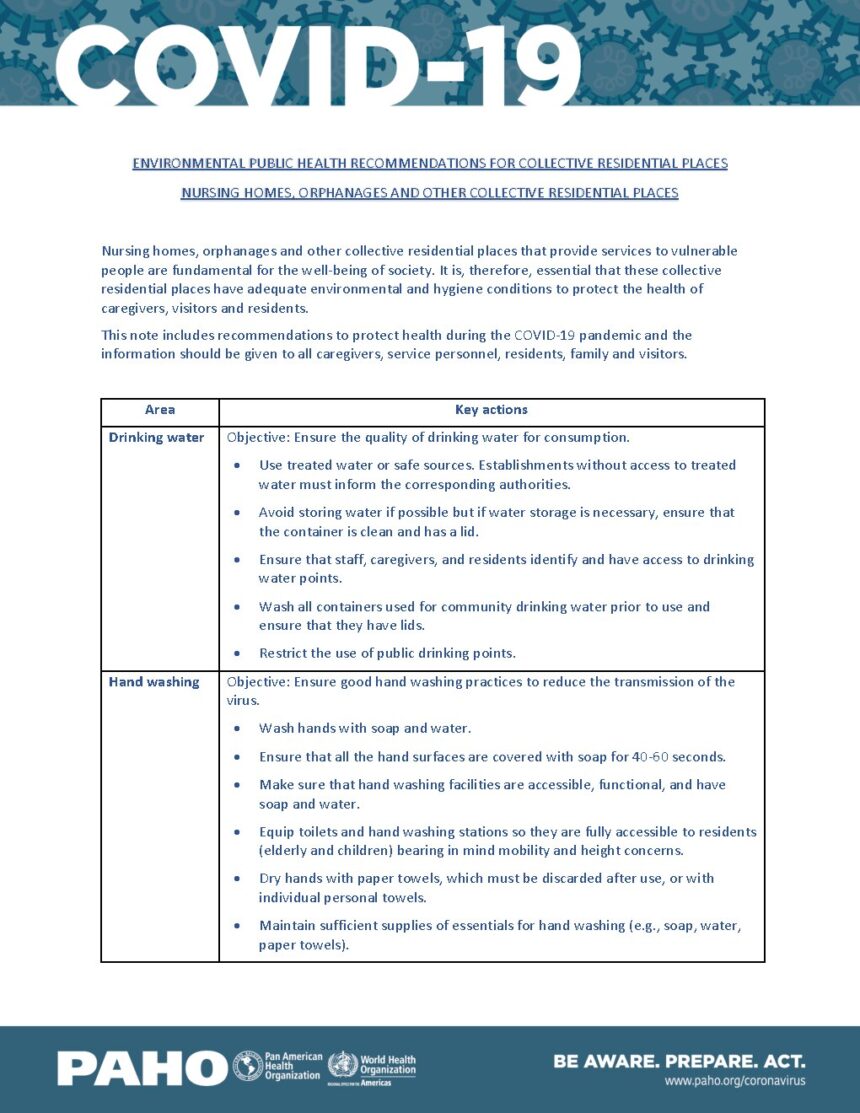
This guidance provides environmental public health recommendations to protect residents, caregivers and visitors in nursing homes, orphanages and other collective residential places during the COVID-19 pandemic. It addresses five key environmental health domains: drinking water quality, hand washing practices, surface cleaning and laundry, ventilation, and waste management.
The document emphasises hand hygiene as central to reducing virus transmission, specifying hand washing with soap and water for 40–60 seconds covering all hand surfaces. When soap and water are unavailable, 70% alcohol-based hand sanitiser or 0.05% sodium hypochlorite solution may be used if hands are not visibly dirty. High-touch surfaces should be cleaned at least twice daily with 0.1% sodium hypochlorite solution or 70% alcohol-based disinfectant.
Detailed instructions are provided for preparing sodium hypochlorite disinfectant solutions at 0.05% concentration (for hand washing and laundry) and 0.1% concentration (for surface disinfection) from commercially available products of varying strengths. The guidance includes safety precautions for solution preparation, storage and use, and specifies that laundry worn by patients should be soaked in 0.05% sodium hypochlorite solution for 30 minutes after washing.
Key points
For clinicians — doses and thresholds as stated in the guideline
- Wash hands with soap and water ensuring all hand surfaces are covered with soap for 40–60 seconds
- Use 70% alcohol-based hand sanitiser or 0.05% sodium hypochlorite solution for hand hygiene only when soap and water are unavailable and hands are not visibly dirty
- Clean high-touch surfaces (light switches, door handles, bed rails, telephones) at least twice daily with 0.1% sodium hypochlorite solution or 70% alcohol-based disinfectant
- Allow 0.1% sodium hypochlorite disinfectant solution to act for at least 1 minute on visibly dirty surfaces before rinsing with water
- Soak laundry worn by patients in 0.05% sodium hypochlorite solution for 30 minutes after washing, then rinse in clean water and dry in the sun
- Clean bathrooms at least twice daily using the same procedure as for other surfaces
- Prepare disinfectant solutions daily using personal protective equipment (gloves, masks, eye protection and aprons)
- Ensure hand washing facilities are accessible, functional, and equipped with soap, water and paper towels or individual personal towels
Sodium hypochlorite disinfectant solution preparation guide
Table extracted from the guideline
| Sodium hypochlorite concentration (as per label) | For 0.05% solution (hand washing and laundry): Quantity of sodium hypochlorite | For 0.05% solution: Quantity of water | For 0.1% solution (surfaces and floors): Quantity of sodium hypochlorite | For 0.1% solution: Quantity of water |
|---|---|---|---|---|
| 1% | 50 ml (1/5 cup) | 1 L (1 qt) | 100 ml (2/5 cup) | 1 L (1 qt) |
| 3% | 16 ml (3 tsp) | 1 L (1 qt) | 30 ml (1 oz) | 1 L (1 qt) |
| 4% | 13 ml (1/2 oz) | 1 L (1 qt) | 25 ml | 1 L (1 qt) |
| 5% | 10 ml (2 tsp) | 1 L (1 qt) | 20 ml (4 tsp) | 1 L (1 qt) |
| 10% | 5 ml (1 tsp) | 1 L (1 qt) | 10 ml (2 tsp) | 1 L (1 qt) |
Source: Pan American Health Organization, Environmental Public Health Recommendations for Collective Residential Places: Nursing Homes, Orphanages, and Other Collective Residential Places. Reproduced in summary form.
From the guideline
Verbatim
“Horizontal surfaces and surfaces with a high frequency of contact (for example: light switches, door handles, bed rails and telephones) should be cleaned at least twice a day, with a sodium hypochlorite disinfectant solution at 0.1% concentration or with 70% alcohol-based disinfectant.”
Editor’s perspective
Why this matters for Georgia and the region
Prof. Giorgi Pkhakadze, MD, MPH, PhD
Editor-in-Chief, Georgian Medical Journal · Chair, Public Health Institute of Georgia · WHO consultant, health and migration
As someone who has worked extensively on health system strengthening in Georgia and the region, I recognise that collective residential facilities—nursing homes, orphanages and institutions for vulnerable populations—represent critical transmission nodes during respiratory pandemics, yet often lack standardised infection prevention protocols. This PAHO guidance provides actionable, resource-appropriate recommendations that Georgian facilities can implement immediately, particularly the detailed sodium hypochlorite dilution tables that eliminate guesswork in preparing disinfectant solutions. I would stress to Georgian colleagues the specification that high-touch surfaces require twice-daily cleaning with 0.1% sodium hypochlorite solution and that hand washing must involve 40–60 seconds of soap contact covering all hand surfaces—both frequently overlooked in practice. The realistic implementation challenge for Georgia will be ensuring consistent supplies of soap, paper towels and sodium hypochlorite products to facilities outside Tbilisi, as well as providing staff training and supervision to maintain these practices beyond the initial pandemic response phase when attention inevitably shifts to other priorities.
ORCID 0000-0001-7609-4515 · Perspective written for the GMJ Guidelines Library, 19 Oct 2026
Applicability
Georgia and the South Caucasus
This guidance is directly applicable to Georgia’s network of collective residential facilities, including state-run and private nursing homes, orphanages and institutions for persons with disabilities. Georgian national programmes should ensure that facilities without access to treated municipal water supplies have appropriate alternative safe water sources and that sodium hypochlorite products of known concentration are available through procurement systems. Given Georgia’s ageing population and the expansion of long-term care services, standardising environmental infection prevention measures across all collective residential settings is essential. Implementation will require assessing the accessibility of hand washing facilities for elderly residents and children with mobility limitations, ensuring adequate supplies of soap, paper towels and disinfectants, and providing staff training on correct dilution and application of disinfectant solutions with appropriate personal protective equipment.
Questions this guideline answers
Quick answers
What concentration of sodium hypochlorite should be used for cleaning high-touch surfaces?
Use 0.1% sodium hypochlorite solution or 70% alcohol-based disinfectant for high-touch surfaces such as light switches, door handles, bed rails and telephones. Clean these surfaces at least twice daily, allowing the disinfectant to act for at least 1 minute on visibly dirty surfaces before rinsing.
How should laundry worn by COVID-19 patients be handled?
Wash clothes normally with warm soapy water. After washing, soak them in 0.05% sodium hypochlorite solution for 30 minutes, then rinse in clean water and dry in the sun.
Can sodium hypochlorite solution be used for hand washing if soap is unavailable?
Sodium hypochlorite solution at 0.05% concentration can be used for hand hygiene only if soap and water are not available and hands are not visibly dirty or contaminated with secretions. However, this is the least recommended option, as frequent use can lead to allergies, dermatitis, depigmentation and even asthma. Prioritise 70% alcohol-based hand sanitiser or soap and water.
How do I prepare 0.05% sodium hypochlorite solution from a 5% household bleach product?
Add 10 ml (2 teaspoons) of 5% sodium hypochlorite to 1 litre (1 quart) of water. Prepare solutions daily, use personal protective equipment when mixing, label containers clearly with the concentration, and store out of reach of children away from light and heat.
Related on GMJ
Interconnected resources
Dictionary of Public Health
GMJ News coverage
Quality & accreditation
Other guidelines on this topic
- Recommendations for Cleaning and Disinfection Public Places: Supermarkets, Markets, Neighborhood Stores, Banks, Public Transport, and Others
- Requirements and technical specifications of personal protective equipment (PPE) for the novel coronavirus (2019-nCoV) in healthcare settings
- The COVID-19 Risk Communication Package for Healthcare Facilities
- Administrative Controls to Guarantee Implementation of Infection Prevention and Control Measures in the Context of COVID-19
- Caribbean Shelter Guide: COVID-19 Considerations
- Issuer
- Pan American Health Organization
- Type
- Procedures, manuals, guidelines
- Status
- Current
- Published
- 2020-01-01
- Scope
- COVID-19 infection prevention in nursing homes, orphanages and other collective residential facilities
- Audience
- Caregivers, service personnel, facility managers, residents, families and visitors in collective residential settings
- Licence
- CC BY-NC-SA 3.0 IGO
- Evidence
- Expert consensus
- Record history
- Created 19 Oct 2026 · updated 19 Oct 2026 · next check Apr 2027
Pan American Health Organization. Environmental Public Health Recommendations for Collective Residential Places: Nursing Homes, Orphanages, and Other Collective Residential Places. Washington, D.C.: PAHO; 2020. (PAHO/CDE/CE/COVID-19/20-0022).GMJ Guidelines Library records are original summaries written by the GMJ editorial team from the issuer’s published document and reviewed by a physician. They do not replace the full guideline. The document is the copyright of its issuer and is linked, not hosted. Spotted an error or a newer edition? Tell the Guidelines Desk.
Was this article helpful?