Pan American Health Organization · 2020
Guidance on personal protective equipment, hygiene practices and disinfection for sanitation workers during COVID-19.
- Issuer
- Pan American Health Organization
- Edition
- 2020
- Audience
- Sanitation workers, waste management supervisors, occupational health professionals, municipal authorities
- Evidence
- Expert consensus based on existing occupational health standards
- Reviewed
- 19 Oct 2026 · GMJ
What this guideline says
GMJ summary
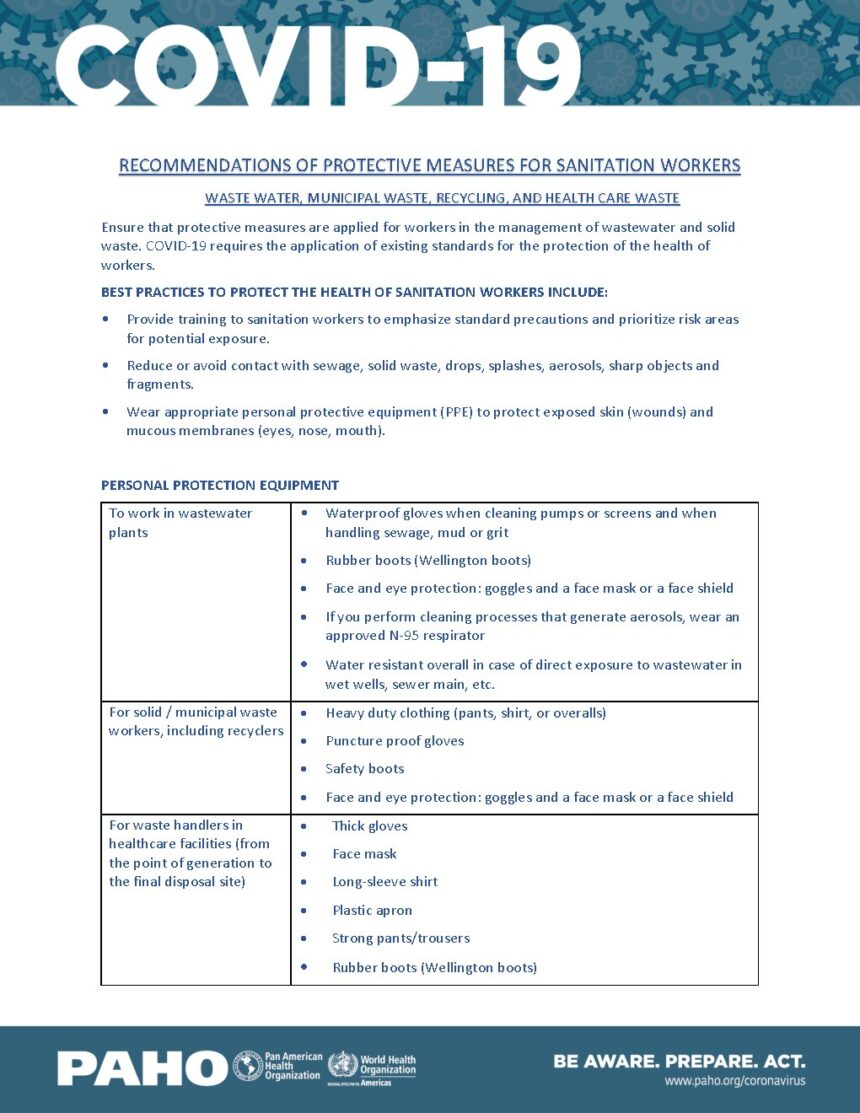
This Pan American Health Organization guidance provides comprehensive protective measures for workers managing wastewater, municipal solid waste, recycling, and healthcare waste during the COVID-19 pandemic. The document emphasizes that COVID-19 requires application of existing occupational health standards for sanitation workers, with particular attention to training, reduction of exposure to sewage and waste, and appropriate use of personal protective equipment.
The guidance specifies PPE requirements for three worker categories: wastewater plant workers (waterproof gloves, rubber boots, face and eye protection, N-95 respirators for aerosol-generating procedures, water-resistant overalls); solid/municipal waste workers including recyclers (heavy duty clothing, puncture-proof gloves, safety boots, face and eye protection); and healthcare waste handlers (thick gloves, face masks, long-sleeve shirts, plastic aprons, strong trousers, rubber boots). Detailed personal hygiene practices include handwashing at critical moments, keeping nails short, covering wounds, showering and changing before leaving work, annual medical check-ups with stool samples, and maintaining vaccination against hepatitis A and B, diphtheria, tetanus, and typhoid.
Vehicle and facility disinfection protocols require cleaning with soap and water followed by 0.1% sodium hypochlorite solution at each shift change for vehicle cabins, daily washing of vehicles with leachate disposal to sewers, and cleaning of transfer station floors each shift. The document includes detailed tables for preparing disinfectant solutions from various concentrations of sodium hypochlorite and provides communication messages for the public on safe disposal of needles and separation of medical waste.
Key points
For clinicians — doses and thresholds as stated in the guideline
- Wastewater plant workers require waterproof gloves, rubber boots, face and eye protection (goggles and face mask or face shield), and N-95 respirators when performing aerosol-generating cleaning processes
- Solid/municipal waste workers and recyclers must wear heavy duty clothing, puncture-proof gloves, safety boots, and face and eye protection
- Healthcare waste handlers from point of generation to final disposal require thick gloves, face masks, long-sleeve shirts, plastic aprons, strong trousers, and rubber boots
- Vehicle cabins must be cleaned with soap and water then disinfected with 0.1% sodium hypochlorite solution at each shift change; vehicles washed daily with leachate disposed to sewers
- Transfer station floors must be washed each shift with soap and water followed by 0.1% sodium hypochlorite disinfection solution
- Workers must have regular medical check-ups at least once a year including stool samples, and maintain vaccination against hepatitis A and B, diphtheria, tetanus, and typhoid
- Disinfection solutions of 0.1% concentration prepared by mixing sodium hypochlorite with water according to starting concentration: 100 ml of 1% product in 1 litre water, 30 ml of 3% product in 1 litre, 25 ml of 4% in 1 litre, 20 ml of 5% in 1 litre, or 10 ml of 10% in 1 litre
- Workers must wash hands thoroughly with soap and safe water before and after eating, after using the bathroom, before and after cleaning tasks, before and after using PPE, before and after drinking, and after touching money
Preparation of 0.1% disinfection solution from various sodium hypochlorite concentrations
Table extracted from the guideline
| Sodium hypochlorite concentration (as on label) | Quantity of sodium hypochlorite | Quantity of water |
|---|---|---|
| 1% | 100 ml (4/5 cup) | 1 litre (1 quart) |
| 3% | 30 ml (1 oz) | 1 litre (1 quart) |
| 4% | 25 ml | 1 litre (1 quart) |
| 5% | 20 ml (2/3 oz) | 1 litre (1 quart) |
| 10% | 10 ml (1/3 oz) | 1 litre (1 quart) |
Source: Pan American Health Organization, Recommendations of Protective Measures for Sanitation Workers: Waste Water, Municipal Waste, Recycling, and Healthcare Waste. Reproduced in summary form.
From the guideline
Verbatim
“Reduce or avoid contact with sewage, solid waste, drops, splashes, aerosols, sharp objects and fragments.”
Editor’s perspective
Why this matters for Georgia and the region
Prof. Giorgi Pkhakadze, MD, MPH, PhD
Editor-in-Chief, Georgian Medical Journal · Chair, Public Health Institute of Georgia · WHO consultant, health and migration
As Chair of the Public Health Institute of Georgia and having advised on health protection programmes across the region, I recognize that sanitation workers represent a consistently overlooked occupational group in our national health strategies. This PAHO guidance provides immediately actionable protocols that Georgian municipalities can implement without requiring sophisticated infrastructure—the emphasis on hepatitis A and B vaccination is particularly relevant given our ongoing hepatitis C elimination programme and existing vaccine supply chains. I would stress to local occupational health physicians the requirement for annual medical surveillance including stool samples, as this represents a feasible intervention that could identify infections early and protect both workers and the communities they serve. The principal implementation challenge will be ensuring consistent PPE supply to smaller municipalities and rural waste collection services where procurement systems are less developed and where sanitation work is often performed by informal or contract workers without access to occupational health services.
ORCID 0000-0001-7609-4515 · Perspective written for the GMJ Guidelines Library, 19 Oct 2026
Applicability
Georgia and the South Caucasus
Georgia’s rapid urbanization and development of municipal waste management systems make these recommendations highly relevant for protecting sanitation workers in Tbilisi, Batumi, Kutaisi, and regional municipalities. The guidance is particularly pertinent given ongoing investments in wastewater treatment infrastructure and the expansion of healthcare facilities across the South Caucasus. National occupational health programmes would need to assess current PPE availability and distribution systems, establish baseline vaccination coverage among sanitation workers (particularly for hepatitis A and B given Georgia’s hepatitis elimination programme experience), and develop training curricula adapted to local languages and literacy levels. The emphasis on regular medical surveillance and stool sample screening aligns with Georgia’s public health infrastructure capacity, whilst the disinfection protocols using sodium hypochlorite are practical given widespread availability of this agent in the region.
Questions this guideline answers
Quick answers
What personal protective equipment is required for wastewater treatment plant workers?
Waterproof gloves when handling sewage, mud or grit and cleaning pumps or screens; rubber Wellington boots; face and eye protection including goggles and a face mask or face shield; an approved N-95 respirator when performing aerosol-generating cleaning processes; and water-resistant overalls in case of direct exposure to wastewater in wet wells and sewer mains.
How should waste collection vehicle cabins be disinfected during COVID-19?
Clean inside the cabins with soap and water, then apply a 0.1% sodium hypochlorite disinfection solution at each shift change. Wash the vehicle exterior with soap and water daily and discard leachate directly into the sewer. Transfer station floors should be washed each shift with soap and water followed by 0.1% sodium hypochlorite solution.
Which vaccinations should sanitation workers maintain?
Sanitation workers should keep up to date with vaccination against hepatitis A and B, diphtheria, tetanus, and typhoid. Regular medical check-ups should be performed at least once a year, including stool samples.
How do you prepare 0.1% sodium hypochlorite disinfection solution?
The preparation depends on the starting concentration: for 1% sodium hypochlorite add 100 ml to 1 litre water; for 3% add 30 ml to 1 litre; for 4% add 25 ml to 1 litre; for 5% add 20 ml to 1 litre; for 10% add 10 ml to 1 litre. Prepare solutions daily, use protective equipment when mixing, label containers clearly, and do not reuse food packaging.
Related on GMJ
Interconnected resources
Dictionary of Public Health
GMJ News coverage
- UK flu and COVID-19 surveillance data to May 2027 shows continued monitoring amid seasonal trendsOct 2026
- Community Health Workers Boost COVID-19 Testing Among Formerly Incarcerated PeopleAug 2026
- Micronutrients Are the Hidden Engine of Cellular Energy: What You Need to KnowOct 2026
- Heat stress risk from PPE requires urgent clinical vigilance, UK health officials warnOct 2026
Quality & accreditation
Other guidelines on this topic
- Dead Body Management in the Context of COVID-19
- Frequently asked questions for the management of health workers in response to COVID-19
- Environmental Public Health Recommendations for Collective Residential Places: Nursing Homes, Orphanages, and Other Collective Residential Places
- Recommendations for Cleaning and Disinfection Public Places: Supermarkets, Markets, Neighborhood Stores, Banks, Public Transport, and Others
- Requirements and technical specifications of personal protective equipment (PPE) for the novel coronavirus (2019-nCoV) in healthcare settings
- Issuer
- Pan American Health Organization
- Type
- Procedures, manuals, guidelines
- Status
- Current
- Published
- 2020-01-01
- Scope
- Wastewater, municipal solid waste, recycling, and healthcare waste management
- Audience
- Sanitation workers, waste management supervisors, occupational health professionals, municipal authorities
- Licence
- CC BY-NC-SA 3.0 IGO
- Evidence
- Expert consensus based on existing occupational health standards
- Record history
- Created 19 Oct 2026 · updated 19 Oct 2026 · next check Apr 2027
Pan American Health Organization. Recommendations of Protective Measures for Sanitation Workers: Waste Water, Municipal Waste, Recycling, and Healthcare Waste. Washington, D.C.: PAHO; 2020. (PAHO/CDE/CE/COVID-19/20-0023).GMJ Guidelines Library records are original summaries written by the GMJ editorial team from the issuer’s published document and reviewed by a physician. They do not replace the full guideline. The document is the copyright of its issuer and is linked, not hosted. Spotted an error or a newer edition? Tell the Guidelines Desk.
Was this article helpful?