Pan American Health Organization · 2020
Guidance on interpreting virological and serological COVID-19 test results for clinicians and public health professionals.
- Issuer
- Pan American Health Organization
- Edition
- 2020
- Evidence
- Expert consensus based on early COVID-19 literature
- Reviewed
- 19 Oct 2026 · GMJ
What this guideline says
GMJ summary
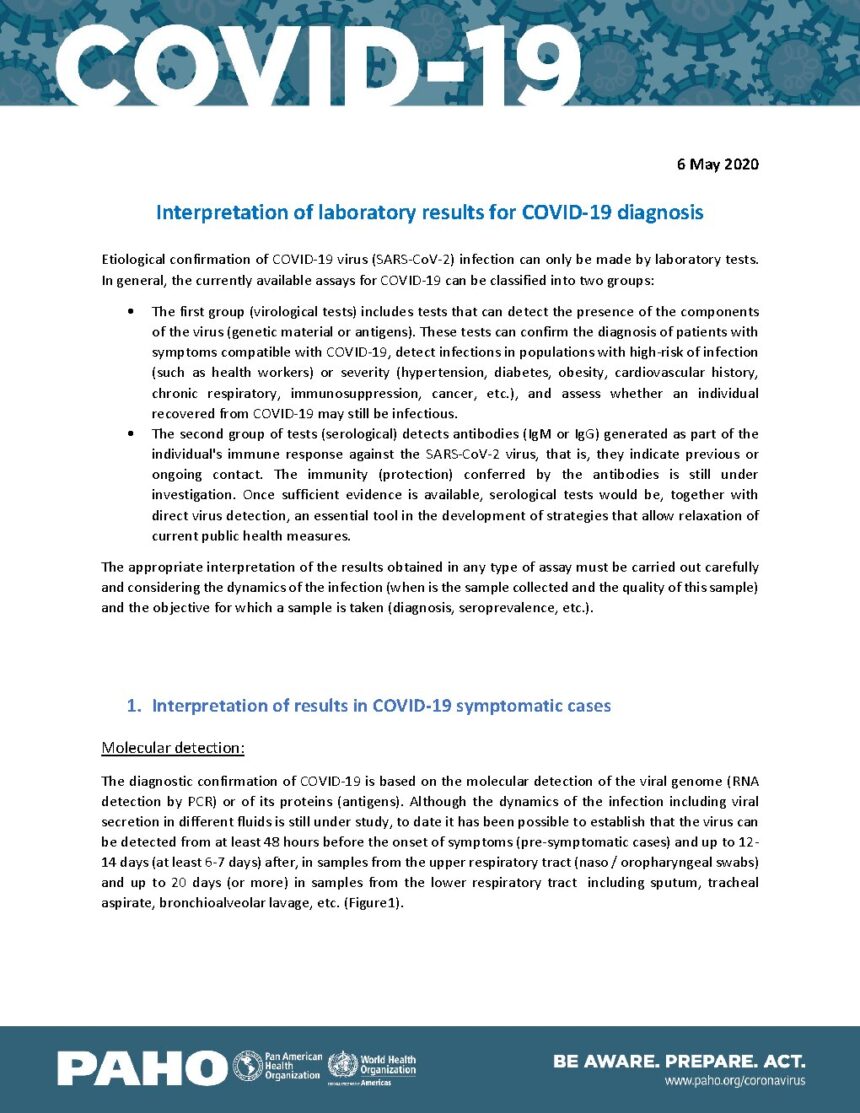
This technical document provides guidance on interpreting COVID-19 laboratory test results across different clinical scenarios. It divides COVID-19 testing into two categories: virological tests (PCR and antigen detection) that identify active infection, and serological tests (IgM/IgG antibody detection) that indicate previous or ongoing contact with SARS-CoV-2.
The guidance emphasises that appropriate interpretation requires understanding the dynamics of infection, timing of sample collection, sample quality, and the objective of testing. For symptomatic cases, viral RNA can be detected from 48 hours before symptom onset up to 12–14 days after in upper respiratory samples and up to 20 days or more in lower respiratory samples. Antibodies become detectable around day 7 from symptom onset in approximately 50% of cases.
The document cautions against using serology alone for diagnosis, as positive antibody results do not rule out active infection during days 7–14, and protective immunity conferred by antibodies was still under investigation at the time of publication. It provides specific guidance for interpreting results in symptomatic cases, contacts, and asymptomatic individuals.
Key points
For clinicians — doses and thresholds as stated in the guideline
- SARS-CoV-2 can be detected from 48 hours before symptom onset up to 12–14 days (at least 6–7 days) after in upper respiratory tract samples
- Viral detection in lower respiratory tract samples (sputum, tracheal aspirate, bronchoalveolar lavage) extends up to 20 days or more
- Antibodies (IgM/IgG) are detectable around day 7 from symptom onset in approximately 50% of cases
- Negative serology during the first 7 days of illness cannot be used as a rule-out criterion
- Serology alone should not be used to rule out a case or to consider a patient non-infectious between days 7 to 14
- Contacts of confirmed cases require at least 14 days of quarantine from the day of last contact, regardless of test results
- A positive PCR in an asymptomatic individual constitutes an asymptomatic case requiring isolation
- Detection of both IgM and IgG simultaneously, or only one antibody type, is not an adequate criterion to define timing of contact
From the guideline
Verbatim
“A positive result between days 7 to 14 indicates a previous contact and does not rule out the presence of the virus.”
Editor’s perspective
Why this matters for Georgia and the region
Prof. Giorgi Pkhakadze, MD, MPH, PhD
Editor-in-Chief, Georgian Medical Journal · Chair, Public Health Institute of Georgia · WHO consultant, health and migration
As Georgia continues COVID-19 surveillance alongside endemic influenza and emerging respiratory pathogens, this PAHO guidance provides essential principles for our laboratory networks and clinicians to avoid diagnostic pitfalls. I would stress to Georgian colleagues the critical message that serology between days 7 and 14 cannot exclude active infection—a misinterpretation that could lead to premature release from isolation or missed co-infections with influenza. The main implementation challenge for our national programme is ensuring that all testing sites, particularly in rural Kakheti, Samegrelo and the highlands, understand these timing dynamics and do not use rapid antibody tests as standalone diagnostic tools, which requires sustained training beyond initial guideline dissemination.
ORCID 0000-0001-7609-4515 · Perspective written for the GMJ Guidelines Library, 19 Oct 2026
Applicability
Georgia and the South Caucasus
This guidance remains relevant for Georgia’s ongoing COVID-19 surveillance and laboratory testing programmes. Georgian laboratories and clinicians must understand these interpretation principles to avoid misdiagnosis, particularly the limitations of serological testing for determining infectiousness and the need for quarantine regardless of test results in contacts. National testing strategies should incorporate the documented viral shedding timelines (48 hours pre-symptomatic to 12–14 days in upper respiratory samples) when designing surveillance protocols for healthcare workers and high-risk populations, and ensure that clinicians do not rely on serology alone for diagnostic confirmation or clearance decisions.
Questions this guideline answers
Quick answers
Can a negative PCR test in a contact of a confirmed case rule out infection?
No. A negative molecular test does not rule out previous contact or the possibility that the contact is in the incubation period. Regardless of the test result, the contact requires at least 14 days of quarantine from the day of last contact with the case.
When can antibodies against SARS-CoV-2 be detected?
Antibodies (IgM/IgG) are detectable around day 7 from symptom onset in approximately 50% of cases. A negative serology result during the first 7 days of illness cannot be used to rule out COVID-19.
Can serology be used alone to diagnose COVID-19?
No. Serology alone should not be used as a diagnostic criterion. A positive antibody result indicates previous contact but does not rule out active infection, and a patient with previous COVID-19 exposure may have antibodies while being infected with a different respiratory pathogen.
How long can SARS-CoV-2 be detected in respiratory samples?
The virus can be detected from 48 hours before symptom onset up to 12–14 days (at least 6–7 days) in upper respiratory tract samples, and up to 20 days or more in lower respiratory tract samples including sputum, tracheal aspirate, and bronchoalveolar lavage.
Related on GMJ
Interconnected resources
Dictionary of Public Health
GMJ News coverage
Quality & accreditation
Other guidelines on this topic
- Breastfeeding and COVID-19
- Dead Body Management in the Context of COVID-19
- Ethics guidance on issues raised by the novel coronavirus disease (COVID-19) pandemic
- Technical specifications of medical devices for the case management of COVID-19 in healthcare settings
- Frequently asked questions for the management of health workers in response to COVID-19
- Issuer
- Pan American Health Organization
- Type
- Procedures, manuals, guidelines
- Status
- Current
- Published
- 2020-01-01
- Licence
- CC BY-NC-SA 3.0 IGO
- Evidence
- Expert consensus based on early COVID-19 literature
- Record history
- Created 19 Oct 2026 · updated 19 Oct 2026 · next check Apr 2027
Pan American Health Organization. Interpretation of laboratory results for COVID-19 diagnosis, 6 May 2020. Washington, DC: PAHO; 2020. Available from: https://iris.paho.org/handle/10665.2/52138GMJ Guidelines Library records are original summaries written by the GMJ editorial team from the issuer’s published document and reviewed by a physician. They do not replace the full guideline. The document is the copyright of its issuer and is linked, not hosted. Spotted an error or a newer edition? Tell the Guidelines Desk.
Was this article helpful?