Pan American Health Organization · 2020
Guidance for public health authorities and health facilities on maintaining water access and hygiene during drought conditions in the context of COVID-19.
- Issuer
- Pan American Health Organization
- Edition
- 2020
- Evidence
- Expert consensus
- Reviewed
- 20 Oct 2026 · GMJ
What this guideline says
GMJ summary
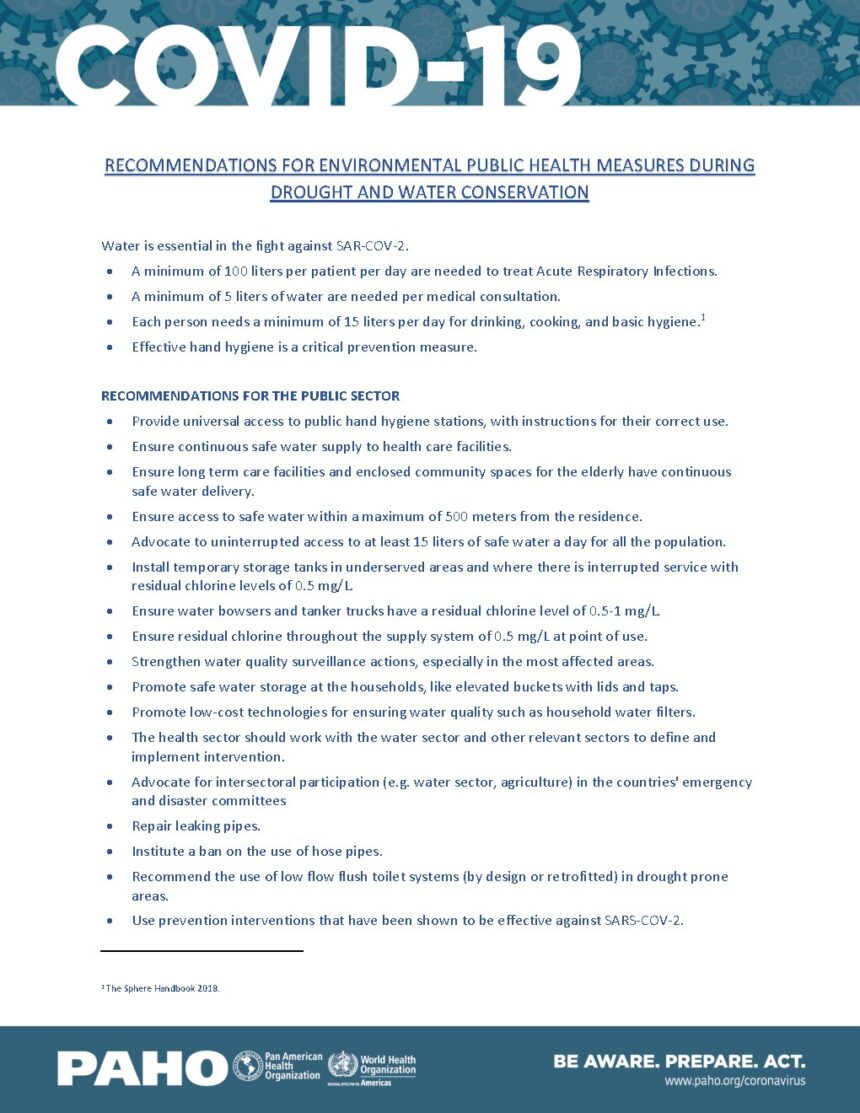
This document provides comprehensive recommendations for maintaining public health water security and hygiene practices during drought conditions, particularly in the context of the COVID-19 pandemic. It addresses water requirements for healthcare delivery, public access, and infection prevention, emphasising that water is essential in the fight against SARS-CoV-2.
The guidance specifies minimum water requirements: 100 litres per patient per day for treating acute respiratory infections, 5 litres per medical consultation, and 15 litres per person per day for drinking, cooking, and basic hygiene. It provides detailed recommendations across four sectors: public sector responsibilities (ensuring universal access and safe water supply), health care facilities (maintaining hygiene infrastructure), all settings (conservation measures), and the public (water-saving behaviours). The document includes specific technical guidance on chlorine concentrations for water safety and disinfection solutions for various purposes.
Central to the guidance is the principle of balancing water conservation with essential infection prevention practices, including hand hygiene, which remains critical for COVID-19 prevention. The recommendations advocate for intersectoral collaboration and implementation of low-cost technologies to ensure water quality and access during periods of scarcity.
Key points
For clinicians — doses and thresholds as stated in the guideline
- Ensure access to safe water within a maximum of 500 metres from residences and advocate for uninterrupted access to at least 15 litres of safe water per day for all population
- Maintain residual chlorine levels of 0.5 mg/L at point of use throughout water supply systems; 0.5 mg/L in temporary storage tanks; 0.5–1 mg/L in water bowsers and tanker trucks
- Allocate a minimum of 100 litres per patient per day for treating acute respiratory infections and a minimum of 5 litres per medical consultation
- Use disinfection solutions at specified concentrations: 0.05% for handwashing and laundry, 0.1% for surface and floor cleaning, and 0.5% for body fluid spills
- Ensure health care facilities maintain a minimum of 3 days of water storage based on usage data where water supply is interrupted
- Wash hands for 40–60 seconds without letting the faucet run; water is only needed for wetting hands and rinsing at the end
- Use a 1.5-L PET bottle to wash each waste container, then rinse and disinfect with 0.1% hypochlorite solution before air drying
- Do not wash public built environments (streets, pavements, parking lots) for decontamination against SARS-CoV-2
Preparation of sodium hypochlorite disinfection solutions at different concentrations
Table extracted from the guideline
| Sodium hypochlorite concentration | 0.05% solution (for handwashing and laundry) | 0.1% solution (for surface, floor, utensil cleaning) | 0.5% solution (for body fluid spills) | |||
|---|---|---|---|---|---|---|
| Sodium hypochlorite | Water | Sodium hypochlorite | Water | Sodium hypochlorite | Water | |
| 1% | 50 ml | 950 ml | 100 ml | 900 ml | 500 ml | 500 ml |
| 3% | 15 ml | 985 ml | 30 ml | 970 ml | 154 ml | 846 ml |
| 4% | 13 ml | 987 ml | 25 ml | 975 ml | 125 ml | 875 ml |
| 5% | 10 ml | 990 ml | 20 ml | 980 ml | 100 ml | 900 ml |
| 10% | 5 ml | 995 ml | 10 ml | 990 ml | 50 ml | 950 ml |
Source: Pan American Health Organization, Recommendations for Environmental Public Health Measures during Drought and Water Conservation. Reproduced in summary form.
From the guideline
Verbatim
“Each person needs a minimum of 15 liters per day for drinking, cooking, and basic hygiene.”
Editor’s perspective
Why this matters for Georgia and the region
Prof. Giorgi Pkhakadze, MD, MPH, PhD
Editor-in-Chief, Georgian Medical Journal · Chair, Public Health Institute of Georgia · WHO consultant, health and migration
As someone who has worked extensively on environmental health determinants in the Caucasus region, I recognise that water scarcity during summer months poses a genuine challenge for Georgian healthcare facilities, particularly in rural and mountainous areas. The recommendation I would emphasise most strongly to Georgian colleagues is the requirement for health facilities to maintain a minimum of 3 days of water storage based on usage data—this is both achievable and critical for maintaining infection prevention standards during supply interruptions. However, implementation will require realistic assessment of our current water infrastructure capacity; many rural health posts lack adequate storage facilities, and the specified chlorine monitoring at point of use would require strengthening our water quality surveillance systems beyond current capacity in some regions. The intersectoral coordination called for between health and water sectors aligns well with ongoing public health reforms in Georgia, but will need dedicated resources and clear protocols to be effective during actual drought emergencies.
ORCID 0000-0001-7609-4515 · Perspective written for the GMJ Guidelines Library, 20 Oct 2026
Applicability
Georgia and the South Caucasus
For Georgia and the South Caucasus region, where water infrastructure varies significantly between urban and rural areas and where seasonal water scarcity affects many communities, these recommendations provide essential guidance for maintaining public health during drought conditions. Georgian health authorities would need to assess current water access patterns, particularly in mountainous rural areas where the 500-metre access threshold may be challenging, and evaluate existing water quality surveillance capacity. The specified chlorine levels and disinfection protocols are directly applicable to Georgian healthcare facilities and public water systems. National adaptation would require coordination between the Ministry of Health, water utilities, and municipal authorities to implement temporary storage solutions and strengthen water quality monitoring, particularly given ongoing investments in water infrastructure across the region. The guidance on water conservation while maintaining infection prevention is particularly relevant for healthcare facilities in areas experiencing seasonal water shortages.
Questions this guideline answers
Quick answers
How much water is needed daily for a person to maintain basic health and hygiene?
Each person needs a minimum of 15 litres per day for drinking, cooking, and basic hygiene. This is the minimum threshold that should be guaranteed even during drought conditions.
What chlorine concentration should be maintained in the public water supply during drought?
A residual chlorine level of 0.5 mg/L should be maintained at the point of use throughout the supply system. Temporary storage tanks should have 0.5 mg/L, while water bowsers and tanker trucks should have 0.5–1 mg/L.
How can we practice effective hand hygiene while conserving water?
Wash hands for the required 40–60 seconds without letting the faucet run. Water is only needed for wetting hands at the beginning and rinsing hands at the end. The actual scrubbing with soap does not require running water.
What concentration of hypochlorite solution should be used for cleaning surfaces in healthcare facilities?
Use 0.1% hypochlorite solution for surface, floor, and utensil cleaning. For body fluid spills (blood, vomit, etc.), use a stronger 0.5% solution. For handwashing and laundry disinfection, use 0.05% solution.
Related on GMJ
Interconnected resources
Dictionary of Public Health
GMJ News coverage
- UK flu and COVID-19 surveillance data to May 2027 shows continued monitoring amid seasonal trendsOct 2026
- Community Health Workers Boost COVID-19 Testing Among Formerly Incarcerated PeopleAug 2026
- 655 Million Without Electricity Face Growing Health Crisis, WHO WarnsOct 2026
- Lassa Fever Vaccine and Therapeutic Trials Mark First Major Clinical Progress in DecadesOct 2026
Quality & accreditation
Other guidelines on this topic
- Initial care of persons with acute respiratory illness (ARI) in the context of coronavirus disease (COVID-19) in healthcare facilities: assess the risk, isolate, refer
- Recommendations for the Management of Solid Waste
- Considerations for the Use of Hotels during the COVID-19 Pandemic
- Considerations for the Use of Hotels during the COVID-19 Pandemic
- Technical recommendations for configuration of a triage area for patients with respiratory symptoms
- Issuer
- Pan American Health Organization
- Type
- Procedures, manuals, guidelines
- Status
- Current
- Published
- 2020-01-01
- Licence
- CC BY-NC-SA 3.0 IGO
- Evidence
- Expert consensus
- Record history
- Created 20 Oct 2026 · updated 20 Oct 2026 · next check Apr 2027
Pan American Health Organization. Recommendations for Environmental Public Health Measures during Drought and Water Conservation. Washington, D.C.: PAHO; 2020. (PAHO/CDE/CE/COVID-19/20-0020).GMJ Guidelines Library records are original summaries written by the GMJ editorial team from the issuer’s published document and reviewed by a physician. They do not replace the full guideline. The document is the copyright of its issuer and is linked, not hosted. Spotted an error or a newer edition? Tell the Guidelines Desk.
Was this article helpful?