Pan American Health Organization · Interim recommendations, 18 May 2020
Interim recommendations for IPC practices in hotels, motels, shelters, and homecare settings adapted for COVID-19 patient care.
- Issuer
- Pan American Health Organization
- Edition
- Interim recommendations, 18 May 2020
- Audience
- Healthcare managers, infection prevention and control practitioners, nontraditional facility staff, public health authorities
- Evidence
- Expert consensus, interim recommendations
- Reviewed
- 20 Oct 2026 · GMJ
What this guideline says
GMJ summary
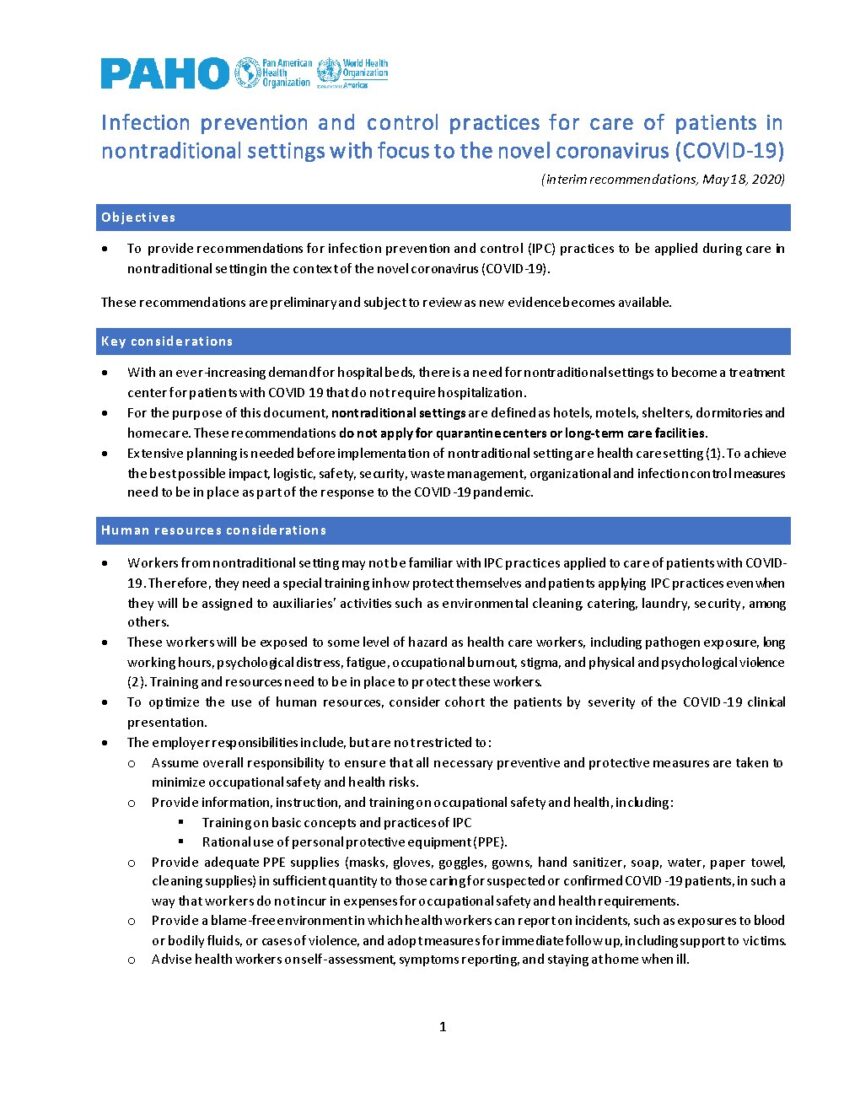
This interim guidance addresses infection prevention and control (IPC) practices for COVID-19 patients cared for in nontraditional settings—hotels, motels, shelters, dormitories, and homecare—when hospital capacity is exceeded. It does not apply to quarantine centres or long-term care facilities. The document emphasises that extensive planning encompassing logistics, safety, waste management, and IPC measures must precede implementation.
Key components include training workers unfamiliar with IPC in pathogen protection, providing complete personal protective equipment (PPE: long-sleeved gowns, medical mask, goggles or face shield, and gloves), establishing hand hygiene stations, and implementing environmental cleaning protocols. High-contact surfaces require cleaning at least twice daily, with terminal cleaning weekly or between patients. The employer is responsible for providing all PPE without cost to workers, ensuring training on basic IPC concepts and rational PPE use, and maintaining a blame-free reporting environment.
Administrative measures include weekly review by an IPC practitioner, tracking worker health status through temperature monitoring, managing unprotected exposures, and implementing notification systems for surveillance. The guidance recognises that workers in these settings face similar hazards to healthcare workers, including pathogen exposure, long hours, psychological distress, and potential violence, requiring appropriate protection and support.
Key points
For clinicians — doses and thresholds as stated in the guideline
- Use complete PPE (long-sleeved gowns, medical mask, goggles or face shield, and gloves) when entering patient rooms and performing regular care activities
- Clean high-contact surfaces (bed head, side tables, TV control, door) at least twice daily
- Use chlorine solution at 0.1% final concentration for large surfaces or 70% alcohol for small surfaces as disinfectants
- Perform terminal cleaning weekly or when patient is discharged before new patient enters, by trained staff wearing complete PPE
- Clean floors, surfaces, and bathrooms daily in patient areas
- Wash hands before entering patient rooms and immediately after leaving, as well as after touching patients, before clean/aseptic procedures, after body fluid exposure, and after touching patient surroundings
- Ensure an IPC practitioner is available to review practices at least weekly
- Classify all waste from isolation areas/patient rooms (including PPE) as infectious hazardous waste requiring specific treatment protocols
Use of personal protective equipment according to activities in nontraditional settings
Table extracted from the guideline
| Type of activity | Hand hygiene | Gown | Medical mask | Goggle | Gloves |
|---|---|---|---|---|---|
| Inside room care of patients or cleaning | X | X | X | X | X |
| Outside room cleaning (patient area) | X | X | X | X | |
| Outside room cleaning (administrative area) | X | X |
Source: Pan American Health Organization, Infection prevention and control practices for care of patients in nontraditional settings with focus to the novel coronavirus (COVID-19). Reproduced in summary form.
From the guideline
Verbatim
“Workers from nontraditional setting may not be familiar with IPC practices applied to care of patients with COVID-19. Therefore, they need a special training in how protect themselves and patients applying IPC practices.”
Editor’s perspective
Why this matters for Georgia and the region
Prof. Giorgi Pkhakadze, MD, MPH, PhD
Editor-in-Chief, Georgian Medical Journal · Chair, Public Health Institute of Georgia · WHO consultant, health and migration
As someone who has worked extensively with WHO on health systems strengthening in our region, I recognise that this guidance addresses a critical gap that Georgia and neighbouring countries faced acutely during COVID-19 surge periods when hospital capacity was exceeded. The most important recommendation for our context is the requirement for weekly IPC practitioner review and structured training of non-healthcare workers, as we have limited infection control specialists relative to the potential scale of nontraditional facility use. The practical challenge for implementation in Georgia and the South Caucasus will be the supply chain for PPE and disinfectants to multiple dispersed sites beyond the established healthcare distribution networks, and ensuring adequate municipal waste management capacity to handle infectious waste from hotels and residential settings—infrastructure investments that require advance planning rather than emergency improvisation.
ORCID 0000-0001-7609-4515 · Perspective written for the GMJ Guidelines Library, 20 Oct 2026
Applicability
Georgia and the South Caucasus
For Georgia and South Caucasus countries, this guidance is highly relevant given limited hospital surge capacity and the need to adapt existing infrastructure during respiratory disease outbreaks. National programmes would need to consider the hospitality sector’s willingness and capacity to participate, establishing clear legal frameworks for commandeering or contracting facilities, training non-healthcare workers in IPC (potentially through public health institutes), ensuring PPE supply chains can meet expanded demand beyond traditional healthcare settings, and adapting waste management systems in municipalities to handle infectious waste from dispersed nontraditional sites. Georgia’s experience with UHC implementation since 2013 provides administrative infrastructure for worker protection and occupational health monitoring that could be extended to these settings.
Questions this guideline answers
Quick answers
What PPE is required for staff entering patient rooms in nontraditional settings?
Complete PPE is required: long-sleeved gowns, medical mask, goggles or face shield, and gloves. Staff must remove and dispose of PPE after leaving the area in a suitable receptacle.
How often should high-touch surfaces be cleaned in patient areas?
High-contact surfaces such as bed heads, side tables, TV controls, and doors should be cleaned and disinfected at least twice daily. Floors, surfaces, and bathrooms require daily cleaning.
What disinfectant concentrations are recommended?
WHO recommends chlorine solution at 0.1% final concentration for large surfaces or 70% alcohol final concentration for small surfaces, as these are widely available and less expensive. Each disinfectant has specific contact times, so follow label instructions.
What employer responsibilities are specified for worker protection?
Employers must provide all necessary PPE in sufficient quantity at no cost to workers, offer training on IPC and rational PPE use, maintain a blame-free reporting environment for exposures and violence, advise workers on self-assessment and staying home when ill, and assume overall responsibility for minimising occupational safety and health risks.
Related on GMJ
Interconnected resources
Dictionary of Public Health
GMJ News coverage
- UK flu and COVID-19 surveillance data to May 2027 shows continued monitoring amid seasonal trendsOct 2026
- Community Health Workers Boost COVID-19 Testing Among Formerly Incarcerated PeopleAug 2026
- Influenza dominates African respiratory surveillance; SARS-CoV-2 remains lowMay 2026
- Heat stress risk from PPE requires urgent clinical vigilance, UK health officials warnOct 2026
Quality & accreditation
- ASF Hospital — Standard 5 — Safety & Emergency Preparedness
- ASF Medical Transport — Standard 5 — Infection Prevention & Control
- ASF Laboratory — Standard 7 — Examination: Process & Safety
- ASF Hospital — Standard 11 — Critical Care
- ASF Medical Transport — Standard 6 — Emergency Response During Transport
Other guidelines on this topic
- Immunization throughout the Life Course at the Primary Care Level in the Context of the COVID-19 Pandemic
- Post-authorization Surveillance of Medical Products during a Pandemic Emergency
- Retrofit Measures for COVID-19
- Guidance and strategies to streamline ethics review and oversight of COVID-19-related research
- Summary on Advances in the Development of Vaccines against COVID-19, 3 April 2020
- Issuer
- Pan American Health Organization
- Type
- Procedures, manuals, guidelines
- Edition
- Interim recommendations, 18 May 2020
- Status
- Current
- Published
- 2020-01-01
- Scope
- Nontraditional settings (hotels, motels, shelters, dormitories, homecare) for COVID-19 patients not requiring hospitalisation
- Audience
- Healthcare managers, infection prevention and control practitioners, nontraditional facility staff, public health authorities
- Licence
- CC BY-NC-SA 3.0 IGO
- Evidence
- Expert consensus, interim recommendations
- Record history
- Created 20 Oct 2026 · updated 20 Oct 2026 · next check Apr 2027
Pan American Health Organization. Infection prevention and control practices for care of patients in nontraditional settings with focus to the novel coronavirus (COVID-19): interim recommendations, 18 May 2020. Washington, D.C.: PAHO; 2020. (PAHO/PHE/IHM/COVID-19-20-0021). Licence: CC BY-NC-SA 3.0 IGO.GMJ Guidelines Library records are original summaries written by the GMJ editorial team from the issuer’s published document and reviewed by a physician. They do not replace the full guideline. The document is the copyright of its issuer and is linked, not hosted. Spotted an error or a newer edition? Tell the Guidelines Desk.
Was this article helpful?