Pan American Health Organization · 2020
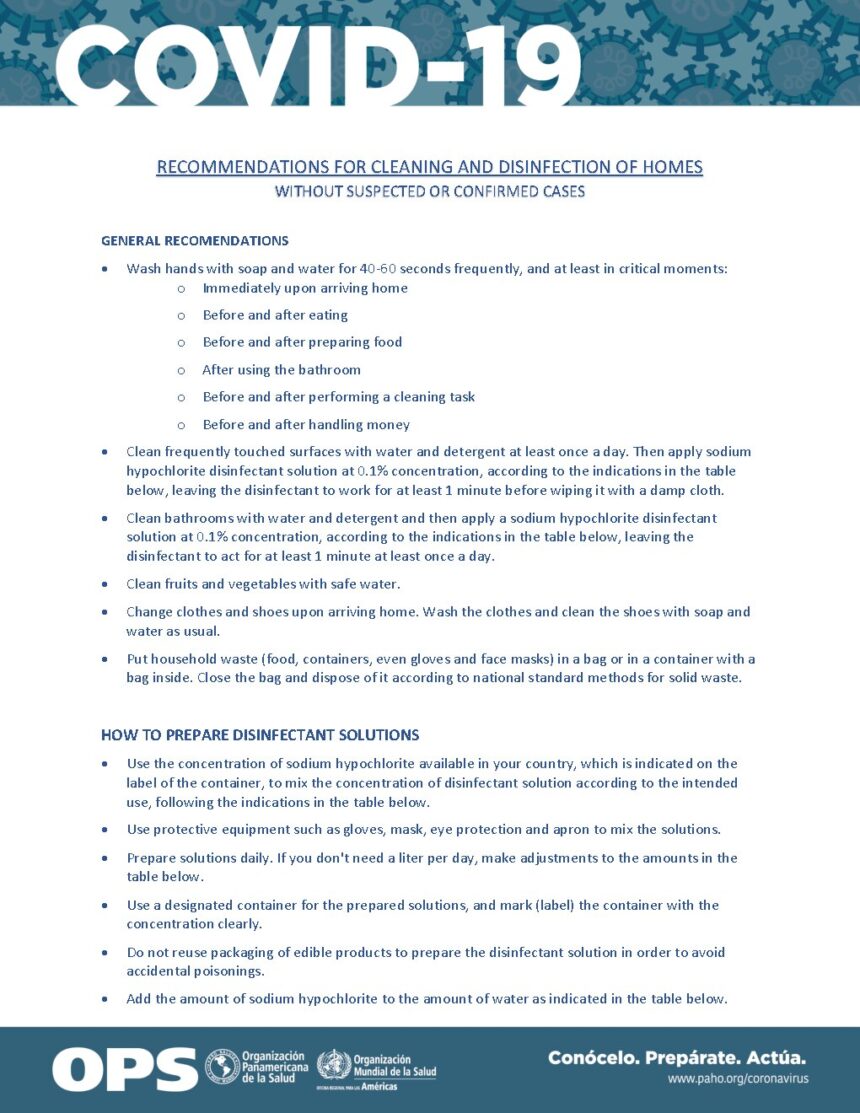
Technical guidance on domestic cleaning and disinfection for COVID-19 prevention in households without cases.
- Issuer
- Pan American Health Organization
- Edition
- 2020
- Audience
- Households, public health professionals
- Reviewed
- 21 Oct 2026 · GMJ
What this guideline says
GMJ summary
This technical note provides recommendations for routine cleaning and disinfection of domestic environments to prevent COVID-19 and other infectious agents in homes where there are no suspected or confirmed cases. It emphasises preventive environmental hygiene measures suitable for household settings.
The document includes practical guidelines for preparing disinfecting solutions at two specific concentrations: 0.05% and 0.1%, tailored to different cleaning needs within the home. These evidence-based protocols enable households to implement effective infection prevention measures using standardised disinfection procedures.
Key points
For clinicians — doses and thresholds as stated in the guideline
- Routine cleaning and disinfection of homes without COVID-19 cases reduces transmission risk of COVID-19 and other infectious agents
- Disinfecting solutions should be prepared at 0.05% concentration for general cleaning needs
- Disinfecting solutions at 0.1% concentration are recommended for specific cleaning requirements
- Standardised procedures ensure consistent and effective domestic environmental hygiene
- Guidelines apply to preventive settings where no suspected or confirmed COVID-19 cases are present
Editor’s perspective
Why this matters for Georgia and the region
Prof. Giorgi Pkhakadze, MD, MPH, PhD
Editor-in-Chief, Georgian Medical Journal · Chair, Public Health Institute of Georgia · WHO consultant, health and migration
As we reflect on pandemic preparedness in Georgia and the South Caucasus, this PAHO technical guidance offers protocols that remain highly relevant for routine infection prevention in households. The standardised disinfectant concentrations of 0.05% and 0.1% provide clear, actionable guidance that primary care physicians and community health workers can communicate to families, particularly important in our region where multi-generational households are common and environmental hygiene practices vary. One implementation challenge for Georgia would be ensuring consistent availability and affordability of appropriate disinfectants across urban and rural areas, as well as addressing water supply issues in some regions that affect the ability to prepare and use these solutions effectively. The broader principle of preventive household environmental hygiene articulated here should be integrated into our ongoing public health education efforts, extending beyond COVID-19 to address endemic communicable diseases.
ORCID 0000-0001-7609-4515 · Perspective written for the GMJ Guidelines Library, 21 Oct 2026
Applicability
Georgia and the South Caucasus
For Georgia and the South Caucasus, this guidance provides essential protocols for household infection prevention that remain relevant beyond the COVID-19 pandemic. National public health programmes should consider local availability of disinfectants, water quality and supply reliability, cultural practices around household cleaning, and the need for clear public education materials in Georgian, Armenian and Azerbaijani languages. Implementation would benefit from integration with existing community health worker networks and primary care messaging on environmental hygiene.
Questions this guideline answers
Quick answers
When should these recommendations be used?
These recommendations apply to homes without any suspected or confirmed COVID-19 cases, as part of routine preventive measures against COVID-19 and other infectious agents.
What concentrations of disinfecting solution are recommended?
The guidance provides instructions for preparing solutions at 0.05% concentration for general cleaning needs and 0.1% concentration for specific cleaning requirements.
Do these guidelines apply if someone in the home has COVID-19?
No, these recommendations are specifically for homes without suspected or confirmed cases; different protocols apply when cases are present in the household.
Can these disinfection methods prevent other infections besides COVID-19?
Yes, the technical note indicates these cleaning and disinfection practices help prevent COVID-19 and other infectious agents in domestic environments.
Related on GMJ
Interconnected resources
Dictionary of Public Health
GMJ News coverage
Quality & accreditation
- ASF PHC — Standard 4 — Acute & Same-Day Care · Primary Health Clinic
- ASF PHC — Standard 7 — Governance & Staffing · Primary Health Clinic
- ASF Hospital — Standard 5 — Safety & Emergency Preparedness
- ASF Medical Transport — Standard 5 — Infection Prevention & Control
- ASF Laboratory — Standard 7 — Examination: Process & Safety
- ASF Hospital — Standard 11 — Critical Care
- ASF Medical Transport — Standard 6 — Emergency Response During Transport
Other guidelines on this topic
- PAHO Does Not Recommend Taking Products that Contain Chlorine Dioxide, Sodium Chlorite, Sodium Hypochlorite, or Derivatives
- Considerations for Regulatory Oversight of Clinical Trials in the COVID-19 Pandemic
- Recommendations on Environmental Public Health for Temporary Shelters
- Recommendations for medical surge capacity and deployment of emergency medical teams
- Water, Sanitation, and Hygiene Standards in Health Care Facilities
- Issuer
- Pan American Health Organization
- Type
- Procedures, manuals, guidelines
- Status
- Current
- Published
- 2020-01-01
- Scope
- Domestic environments without suspected or confirmed COVID-19 cases
- Audience
- Households, public health professionals
- Licence
- CC BY-NC-SA 3.0 IGO
- Record history
- Created 21 Oct 2026 · updated 21 Oct 2026 · next check Apr 2027
Pan American Health Organization. Recommendations for Cleaning and Disinfection of Homes without Suspected or Confirmed Cases, 8 May 2020. Washington, D.C.: PAHO; 2020. IRIS: 10665.2/52174.GMJ Guidelines Library records are original summaries written by the GMJ editorial team from the issuer’s published document and reviewed by a physician. They do not replace the full guideline. The document is the copyright of its issuer and is linked, not hosted. Spotted an error or a newer edition? Tell the Guidelines Desk.
Was this article helpful?