World Health Organization · 1st edition, 2025 · 107 pages
Minimum technical requirements for oxygen source, storage and distribution equipment for health facilities worldwide.
- Issuer
- World Health Organization
- Edition
- 1st edition, 2025
- Audience
- Procurement officers, planning officers, clinical/biomedical engineers and technicians, civil/mechanical/electrical engineers and technicians, pharmacists, health facility administrators, policy makers, development agencies, NGOs, device manufacturers and distributors
- Evidence
- Expert working group consensus with public consultation; technical specifications based on international standards (ISO, ASME, IEC, EN), regulatory frameworks (EU CE, US FDA/CFR), and manufacturer specifications review
- Reviewed
- 23 Oct 2026 · GMJ
What this guideline says
GMJ summary
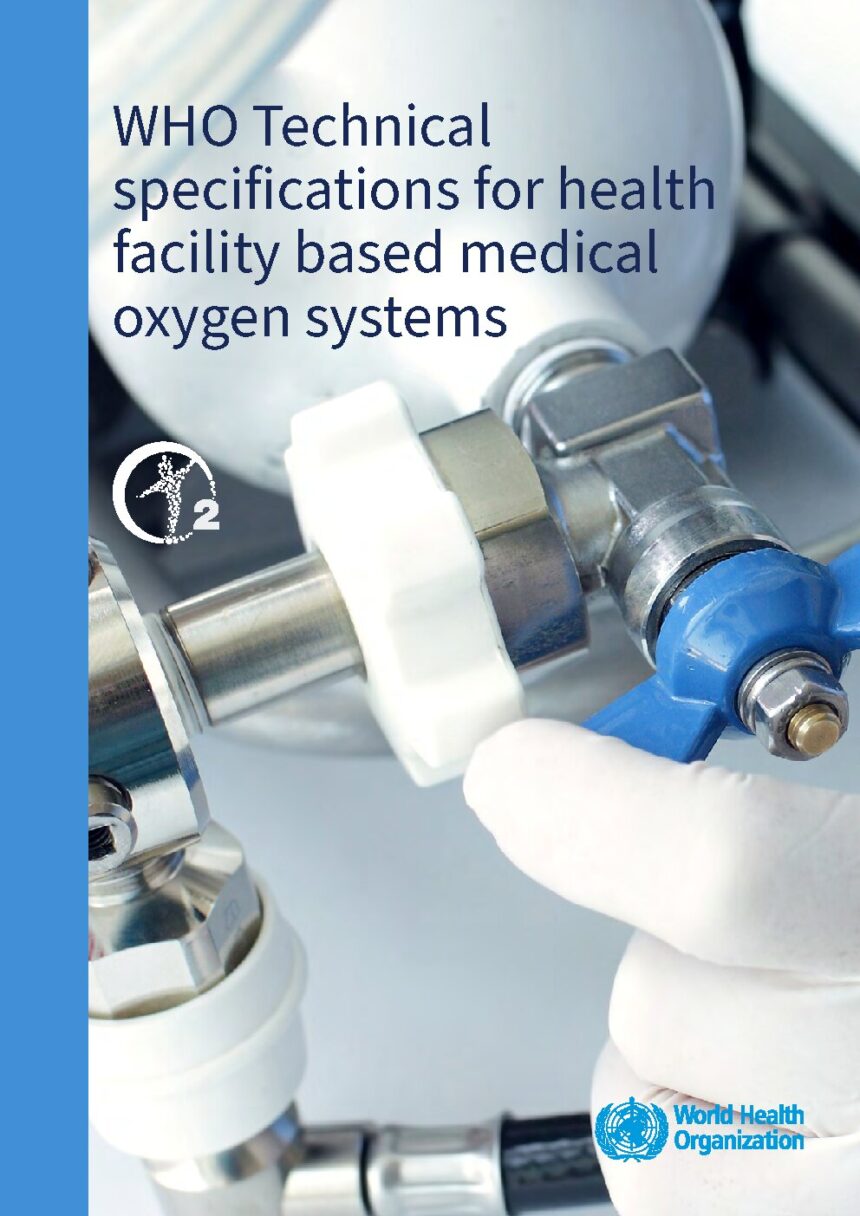
This 107-page technical document provides comprehensive minimum specifications for medical oxygen system components used in health facilities. It covers three categories: oxygen source equipment (PSA/VSA/VPSA generator plants, cylinder filling stations, containerized housing); oxygen storage equipment (high-pressure gas cylinders, vacuum insulated evaporator systems, liquid oxygen cylinders); and oxygen distribution components (distribution manifolds, medical gas pipeline system components).
The specifications detail technical characteristics, performance requirements, safety features, quality standards, regulatory compliance, installation requirements, maintenance schedules, and documentation needs for each product type. The document emphasizes that these are generic minimum requirements requiring contextual adaptation based on local needs, environmental conditions, national regulations, and available infrastructure and human resources.
Developed through expert working group consultation and public input, the specifications are intended to support procurement officers, engineers, biomedical technicians, and health facility planners in selecting appropriate, safe, and quality oxygen systems. Each specification can be adapted for tender documents by indicating required options and filling in context-specific details marked throughout the templates.
Key points
For clinicians — doses and thresholds as stated in the guideline
- Oxygen generator plants (PSA/VSA/VPSA) must produce oxygen ≥93±3% purity V/V, with automatic shut-off when concentration <90% and mandatory in-built purity monitoring
- High-pressure gas cylinders require nominal working pressure minimum 150 bar (2175 psi), hydraulic test pressure minimum 250 bar (3625 psi), with 20-year minimum lifespan and hydrocarbon contamination ≤220 mg/m²
- Vacuum insulated evaporator systems must maintain LOX storage at -196°C to +20°C with annular vacuum ≥0.05 mbar and dual-stage pressure regulation to safely deliver oxygen to MGPS
- Oxygen generator plants require output pressure 500–800 kPa (5–8 bar), temperature ≤40°C, with carbon monoxide ≤5 ppm V/V and carbon dioxide ≤300 ppm V/V where measured
- All equipment must operate continuously in ambient temperature 5–40°C and relative humidity 15–95%, with elevation effects on performance explicitly considered (every 300 m variance impacts efficiency)
- Cylinder filling stations must fill to maximum 150–200 bar with automatic shut-off at pre-set pressure and safety relief valves at each compression stage
- Medical gas pipeline system components must comply with ISO 7396-1 or equivalent, with terminal units colour-coded and indexed to prevent misconnection
- All oxygen-contact surfaces must be cleaned to ISO 15001 standard with hydrocarbon contamination ≤220–550 mg/m² depending on component and no particulates >100 microns
Oxygen generator plant displayed parameters (minimum requirements)
Table extracted from the guideline
| Parameter | Requirement | Alarm threshold |
|---|---|---|
| Oxygen purity | ≥93±3% V/V, measured ±1% accuracy | <90% |
| Output temperature | Displayed, °C | >40°C |
| Output pressure | 500–800 kPa (5–8 bar) | <5 bar or >8 bar |
| Carbon monoxide | ≤5 ppm V/V (if monitored) | >5 ppm |
| Carbon dioxide | ≤300 ppm V/V (if monitored) | >300 ppm |
| Air dryer dew point | ≤3°C | >3°C |
Source: World Health Organization, Technical specifications for health facility based medical oxygen systems. Reproduced in summary form.
From the guideline
Verbatim
“Medical oxygen is a life saving essential medicine with no substitute. It is used for the management of hypoxaemia across both communicable and noncommunicable diseases such as pneumonia, tuberculosis and chronic obstructive pulmonary disease.”
Editor’s perspective
Why this matters for Georgia and the region
Prof. Giorgi Pkhakadze, MD, MPH, PhD
Editor-in-Chief, Georgian Medical Journal · Chair, Public Health Institute of Georgia · WHO consultant, health and migration
As Editor-in-Chief of the Georgian Medical Journal and WHO consultant, I consider this technical guidance essential infrastructure for Georgia's health system strengthening. Following COVID-19, when oxygen shortages caused preventable deaths, our region invested significantly in oxygen systems—but procurements often lacked rigorous specifications, resulting in equipment failures, incompatible components, and maintenance difficulties. The specification that oxygen generator plants must operate continuously at elevations affecting efficiency is particularly relevant for Georgia's mountainous regions where many district hospitals are located above 500–1000 metres. I would stress to Georgian procurement officers and biomedical engineers the requirement for service level agreements specifying exact responsibility for preventive versus curative maintenance and guaranteed spare parts availability for 10 years minimum—our experience shows that without enforceable SLAs, expensive generator plants become non-functional within 2–3 years when filters or molecular sieves cannot be sourced. The realistic implementation caveat is that these specifications assume availability of trained biomedical engineers and regular electricity supply; Georgia's district hospitals often lack both, requiring parallel investments in backup power systems, biomedical engineering training programmes, and potentially simpler technologies like cylinder manifold systems rather than generator plants for facilities without technical capacity.
ORCID 0000-0001-7609-4515 · Perspective written for the GMJ Guidelines Library, 23 Oct 2026
Applicability
Georgia and the South Caucasus
For Georgia and the South Caucasus, these specifications are directly applicable to ongoing efforts to strengthen medical oxygen systems following COVID-19 experience. National oxygen programmes should adapt specifications to account for: ambient temperatures ranging -20°C to +40°C across the region requiring appropriate HVAC design; elevations up to 2000+ metres in mountainous areas affecting compressor sizing (300 m variance impacts efficiency); three-phase 380V 50Hz power supply standard but requiring voltage stabilization and backup generation given grid instability in some areas; need for Russian-language training materials alongside Georgian/Armenian/Azerbaijani; availability of LOX suppliers limited to major cities (Tbilisi, Yerevan, Baku) affecting VIE system feasibility for district hospitals; national regulatory frameworks for pressure equipment and medical devices that may differ from EU or US standards cited; and maintenance capacity requiring either manufacturer service agreements or systematic biomedical engineering training programmes. Specifications for ISO 5145 valve connections and metric measurements align with regional practice. High-pressure cylinder hydrostatic testing facilities exist in capital cities but may require establishment at regional level.
Questions this guideline answers
Quick answers
What is the minimum oxygen purity required from generator plants?
Oxygen generator plants must continuously produce medical oxygen of at least 93±3% purity volume per volume (V/V), measured with ±1% accuracy using paramagnetic or zirconia analyser technology. Automatic shut-off is required when purity falls below 90%, with both audible and visual alarms. Higher purity (≥96%, labeled 'oxygen 98%') can be achieved using double-stage adsorption.
How long must medical oxygen cylinders last and how are they tested?
High-pressure gas cylinders must have minimum 20-year guaranteed lifespan. They require nominal working pressure minimum 150 bar (2175 psi) and hydraulic test pressure minimum 250 bar (3625 psi). Visual checks are required at each fill interval, with periodic hydrostatic (pressure) testing and corrosion testing at predetermined intervals (typically 10 years). Cylinders must be cleaned for oxygen service with hydrocarbon contamination ≤220 mg/m² and no particulates >100 microns.
What backup power is needed for oxygen generator plants?
Oxygen generator plants require dedicated continuous, quality power supply including voltage stabilization and surge suppression when on mains power, plus mandatory backup power source (diesel-based electricity generator or photovoltaic/battery system). The control panel requires built-in uninterruptible power supply (UPS) to prevent system damage and data loss from micro-current cuts. Total power consumption varies by capacity and must be specified by vendor to size backup appropriately.
Can liquid oxygen cylinders be used for continuous high-flow oxygen therapy?
No. While LOX cylinders' initial flow rate can be 150–300 L/min, continuous high-flow offtake cannot be maintained. It will deplete tank pressure faster than the in-built vaporizer coils can accommodate, reducing flow capacity to as low as 45 L/min. LOX cylinders are suitable only for shorter bursts of direct use or should be connected to a manifold for distribution to an MGPS. Additionally, filled LOX cylinders weigh approximately 300 kg, making intra-facility movement very challenging.
Related on GMJ
Interconnected resources
Dictionary of Public Health
Conditions A–Z
GMJ News coverage
- The Teenager Whose Heart Failure Looked Like a Stomach Bug — A Fatal Lesson for Paediatric ScreeningAug 2026
- Cambridge researchers identify three distinct severe pneumonia subtypes, opening path to personalised treatmentSep 2026
- Machine Learning Model Predicts Child Pneumonia Hospitalisation Risk in Malawi Primary CareJun 2026
- Cancer and Tuberculosis in the Same Chest: The Diagnostic Trap a CT-Guided Biopsy SolvedAug 2026
- Mobile Health Tools Strengthen Tuberculosis Contact Tracing in Low-Resource SettingsJul 2026
ASF accreditation standards
Other guidelines on this topic
- Guiding Principles on Human Cell, Tissue and Organ Transplantation
- Using the Package of Interventions for Rehabilitation in Georgia
- Falls: assessment and prevention in older people and in people 50 and over at higher risk
- Health Technology Assessment of Medical Devices, 2nd edition
- Monitoring labour and delivery — MSF Essential obstetric and newborn care
- Issuer
- World Health Organization
- Type
- Publication
- Edition
- 1st edition, 2025
- Replaces
- WHO Technical specifications for pressure swing adsorption (PSA) oxygen plants: interim guidance, 2020 (cylinder and PSA plant specifications only)
- Status
- Current
- Published
- 2025-01-14
- Languages
- English
- Scope
- Technical specifications for oxygen source equipment (generator plants, cylinder filling stations, containerized housing), oxygen storage equipment (high-pressure cylinders, VIE systems, LOX cylinders), and oxygen distribution components (manifolds, MGPS components) for health facilities
- Audience
- Procurement officers, planning officers, clinical/biomedical engineers and technicians, civil/mechanical/electrical engineers and technicians, pharmacists, health facility administrators, policy makers, development agencies, NGOs, device manufacturers and distributors
- Pages
- 107
- Licence
- CC BY-NC-SA 3.0 IGO
- ISBN
- 978-92-4-010161-6
- Evidence
- Expert working group consensus with public consultation; technical specifications based on international standards (ISO, ASME, IEC, EN), regulatory frameworks (EU CE, US FDA/CFR), and manufacturer specifications review
- Next review
- 2030 (5-year review cycle specified)
- Record history
- Created 23 Oct 2026 · updated 23 Oct 2026 · next check Apr 2027
World Health Organization. WHO Technical specifications for health facility based medical oxygen systems. Geneva: World Health Organization; 2025. Licence: CC BY-NC-SA 3.0 IGO. ISBN 978-92-4-010161-6 (electronic version).GMJ Guidelines Library records are original summaries written by the GMJ editorial team from the issuer’s published document and reviewed by a physician. They do not replace the full guideline. The document is the copyright of its issuer and is linked, not hosted. Spotted an error or a newer edition? Tell the Guidelines Desk.
Was this article helpful?