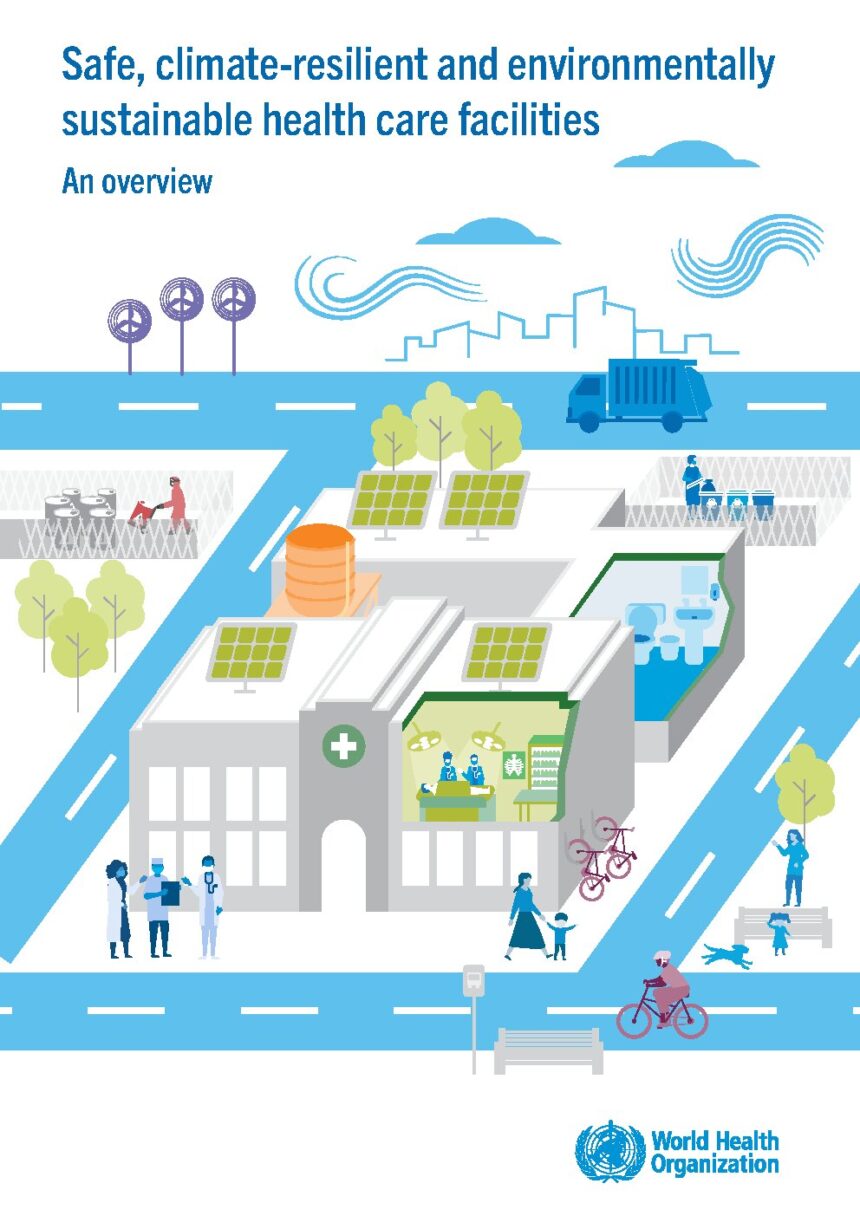
World Health Organization · 2024 · 43 pages
Technical guidance for health facility managers and policymakers on ensuring basic services, climate resilience and environmental sustainability in health care settings worldwide.
- Issuer
- World Health Organization
- Edition
- 2024
- Audience
- Health care facility managers, health practitioners, national authorities (ministries of health, water, infrastructure, energy, environment), global and subnational actors working on health care facilities
- Evidence
- Expert consensus with references to WHO guidelines and best practices
- Reviewed
- 23 Oct 2026 · GMJ
What this guideline says
GMJ summary
This WHO overview provides a comprehensive framework for transforming health care facilities to be safe, climate-resilient and environmentally sustainable. More than 1 billion people rely on facilities with no electricity or unreliable access, and inadequate water, sanitation and hygiene (WASH) services. Currently, 22% of health care facilities have no basic water supply, 49% lack basic hygiene services, and 1 in 10 operates without any sanitation services. These deficiencies contribute to 8 million deaths annually from poor-quality care, particularly in low-income countries.
The document outlines essential requirements: safe WASH with at least three waste-segregation bins, reliable electricity, climate-resilient infrastructure, sound management of chemicals and radiation, and occupational health programmes for health workers. It emphasizes that health care facilities must be resilient to climate hazards (heatwaves, floods, droughts) while reducing their environmental footprint—the health sector currently accounts for more than 5% of global greenhouse gas emissions. The guide provides actionable strategies including baseline assessments, implementation of the Water and Sanitation for Health Facility Improvement Tool (WASH FIT), national road maps with budgets, climate vulnerability assessments, and workforce training.
A stepwise approach is recommended: facilities should first prioritize basic services (water on premises, sex-separated toilets with menstrual hygiene facilities, hand hygiene stations at points of care and within 5 metres of toilets, safe waste segregation and treatment), then progressively advance toward climate resilience and environmental sustainability. The framework integrates infection prevention and control, occupational safety (including protection from chemicals, radiation and infectious diseases), and disaster preparedness into facility management.
Key points
For clinicians — doses and thresholds as stated in the guideline
- Ensure basic water service: water from an improved source available on premises at all times for drinking, medical activities, cleaning and hygiene
- Provide basic sanitation: at least one usable toilet dedicated for staff, at least one sex-separated toilet with menstrual hygiene facilities, and at least one toilet accessible for people with limited mobility
- Install functional hand hygiene facilities with water and soap or alcohol-based hand-rub at all points of care and within 5 metres of toilets
- Implement basic health care waste management: safely segregate waste into at least three bins (sharps, infectious waste, other waste); treat and dispose of sharps and infectious waste safely using non-burn technologies where sustainable
- Ensure reliable electricity that meets all facility needs; consider decentralized renewable energy (solar photovoltaic systems with batteries) as primary or backup supply
- Conduct climate vulnerability assessments using WHO checklists; develop disaster preparedness, response and recovery plans for extreme weather events
- Phase out mercury-containing medical devices (thermometers, sphygmomanometers) per the Minamata Convention; replace substances with high ozone-depletion or global warming potential
- Establish occupational health and safety programmes including: written policy, facility focal point, joint labour–management safety committees, hazard assessments, no-cost vaccinations for health workers, and adequate personal protective equipment for infection prevention and control
Essential elements of WASH in health care facilities
Table extracted from the guideline
| Element | Minimum requirement |
|---|---|
| Basic water | Water from improved source (piped, borehole, protected well/spring, rainwater) available on premises |
| Basic sanitation | Improved, usable toilets: ≥1 for staff, ≥1 sex-separated with menstrual hygiene facilities, ≥1 accessible for limited mobility |
| Hand hygiene | Functional facilities (water + soap or alcohol-based hand-rub) at points of care and within 5 m of toilets |
| Health care waste management | Waste segregated into ≥3 bins; sharps and infectious waste treated and disposed of safely |
| Environmental cleaning | Protocols available; all staff with cleaning responsibilities have received training |
Source: World Health Organization, Safe, climate-resilient and environmentally sustainable health care facilities: an overview. Reproduced in summary form.
From the guideline
Verbatim
“More than 1 billion people rely on health care facilities with no electricity or with unreliable access to it, and without WASH services or with inadequate WASH.”
Editor’s perspective
Why this matters for Georgia and the region
Prof. Giorgi Pkhakadze, MD, MPH, PhD
Editor-in-Chief, Georgian Medical Journal · Chair, Public Health Institute of Georgia · WHO consultant, health and migration
As Chair of the Public Health Institute of Georgia, I have witnessed firsthand how deficient facility infrastructure undermines even the best clinical protocols—our 2019 national WASH assessment found that 18% of Georgian primary care facilities lacked handwashing stations within 5 metres of toilets, directly compromising infection prevention. This WHO framework is particularly timely as Georgia updates health facility licensing standards under the UHC programme; I would urge the Ministry of Health to mandate basic WASH services, backup power for vaccine cold chain, and occupational health programmes as non-negotiable accreditation requirements by 2026. The critical implementation challenge will be financing: while donor-supported pilot facilities have successfully installed solar-battery systems and WASH FIT protocols, scaling these improvements to all 800+ primary care facilities and 300+ hospitals requires sustained domestic budget allocation beyond the current 7% health expenditure, alongside capacity-building of facility managers in climate risk assessment and maintenance planning. The document's incremental approach is realistic—Georgia should prioritize the 120 facilities in flood-prone and water-scarce regions for climate resilience interventions first, using WASH FIT assessments to baseline services and the WHO climate vulnerability checklists to inform infrastructure investments.
ORCID 0000-0001-7609-4515 · Perspective written for the GMJ Guidelines Library, 23 Oct 2026
Applicability
Georgia and the South Caucasus
Georgia and the South Caucasus face dual challenges of upgrading health facility infrastructure while building climate resilience against increasing heatwaves, floods and water scarcity. Many rural facilities in the region lack consistent water supply and reliable electricity, particularly in mountainous areas of Georgia, Armenia and Azerbaijan. National health facility accreditation programmes should integrate the WHO WASH FIT tool and climate vulnerability checklists into quality standards. Georgia’s ongoing UHC reforms and hospital modernization investments provide an opportunity to mandate basic WASH services, renewable energy systems and occupational health programmes as licensing requirements. Climate adaptation is urgent: the 2024 Caucasus heatwaves and recurrent Tbilisi flooding demonstrate that health facilities must serve dual roles—protecting vulnerable patients from climate hazards while maintaining infection prevention capacity during extreme weather disruptions to water and power supply.
Questions this guideline answers
Quick answers
What are the minimum WASH services every health facility must have?
Basic services include: water from an improved source on premises; at least one toilet for staff, one sex-separated toilet with menstrual hygiene facilities, and one accessible toilet; functional hand hygiene stations (water + soap or alcohol-based hand-rub) at all points of care and within 5 metres of toilets; waste segregated into at least three bins with safe treatment and disposal of sharps and infectious waste; and cleaning protocols with trained staff.
How can health facilities with unreliable grid electricity ensure continuous power?
The guidance recommends assessing each facility's energy needs and installing suitable climate-resilient systems. Decentralized renewable energy—particularly solar photovoltaic systems coupled with batteries—can serve as primary power in areas not reached by the grid or as backup for unreliable supply. An 'install and maintain' approach is essential, with dedicated funds for long-term operation, component replacement (batteries) and capacity-building of local energy technicians and health staff.
What is WASH FIT and how does it help improve facility services?
The Water and Sanitation for Health Facility Improvement Tool (WASH FIT) is a WHO/UNICEF risk-based improvement guide covering water, sanitation, hand hygiene, environmental cleaning, health care waste management and energy. It provides a framework to develop, monitor and implement a continual improvement plan, prioritizing climate-resilient, equitable and inclusive WASH actions. Facilities systematically assess current services, identify hazards, develop action plans and track progress incrementally.
What occupational health protections must be provided to health workers?
Health facilities must establish programmes that include: written safety policies; a facility focal point for occupational health; joint labour–management safety committees; regular hazard assessments (chemical, radiation, infectious disease, ergonomic); training on safe practices including waste and chemical management; no-cost vaccinations; adequate personal protective equipment; procedures for reporting and investigating exposure incidents; and facilities for personal hygiene, rest and dining. Services for early detection, diagnosis and treatment of occupational diseases and injuries are also required.
Related on GMJ
Interconnected resources
GMJ News coverage
ASF accreditation standards
Other guidelines on this topic
- Technical specifications for health facility based medical oxygen systems
- Guiding Principles on Human Cell, Tissue and Organ Transplantation
- Falls: assessment and prevention in older people and in people 50 and over at higher risk
- Suspected sepsis in people aged 16 or over: recognition, assessment and early management
- Guideline on environmentally friendly and less invasive oral health care for preventing and managing dental caries
- Issuer
- World Health Organization
- Type
- Technical document
- Edition
- 2024
- Status
- Current
- Published
- 2024-11-26
- Languages
- English
- Scope
- Global
- Audience
- Health care facility managers, health practitioners, national authorities (ministries of health, water, infrastructure, energy, environment), global and subnational actors working on health care facilities
- Pages
- 43
- Licence
- CC BY-NC-SA 3.0 IGO
- Evidence
- Expert consensus with references to WHO guidelines and best practices
- Record history
- Created 23 Oct 2026 · updated 23 Oct 2026 · next check Apr 2027
Safe, climate-resilient and environmentally sustainable health care facilities: an overview. Geneva: World Health Organization; 2024. https://doi.org/10.2471/B09119. Licence: CC BY-NC-SA 3.0 IGO.GMJ Guidelines Library records are original summaries written by the GMJ editorial team from the issuer’s published document and reviewed by a physician. They do not replace the full guideline. The document is the copyright of its issuer and is linked, not hosted. Spotted an error or a newer edition? Tell the Guidelines Desk.
Was this article helpful?