Updated 13/09/2026
Photo: NEC-Medical-137, by NEC Corporation of America (Flickr), cropped for layout · Licensed CC BY 2.0 · Source
Plain-language summary of research published in the Georgian Medical Journal. Written for the general public by the GMJ News editorial team.
Patients no longer arrive with just symptoms — increasingly, they arrive with AI-generated hypotheses, treatment suggestions, and questions already sharpened by a chatbot. A mixed-methods study in the Georgian Medical Journal, conducted in Georgian outpatient clinics, examines what that shift is actually doing to the doctor–patient relationship.

A Qualitatively Different Kind of Informed Patient
Internet health information has shaped doctor–patient communication for more than two decades, but the study argues generative AI is a different phenomenon: unlike a static webpage, conversational AI systems synthesise complex medical knowledge and produce interactive, dialogue-like responses that can feel like a consultation in themselves. Despite how widespread public use of these tools has become, the study notes that empirical evidence on how AI-generated health information actually plays out in real clinical consultations has remained limited — this study is aimed squarely at that gap.
What the Study Measured
Using an exploratory, convergent mixed-methods design, the researchers surveyed patients and physicians in Georgian outpatient clinics on how AI-generated health information influences patient behaviour, physician perceptions, and the communication dynamics of the consultation itself.

At a glance — the headline figures.
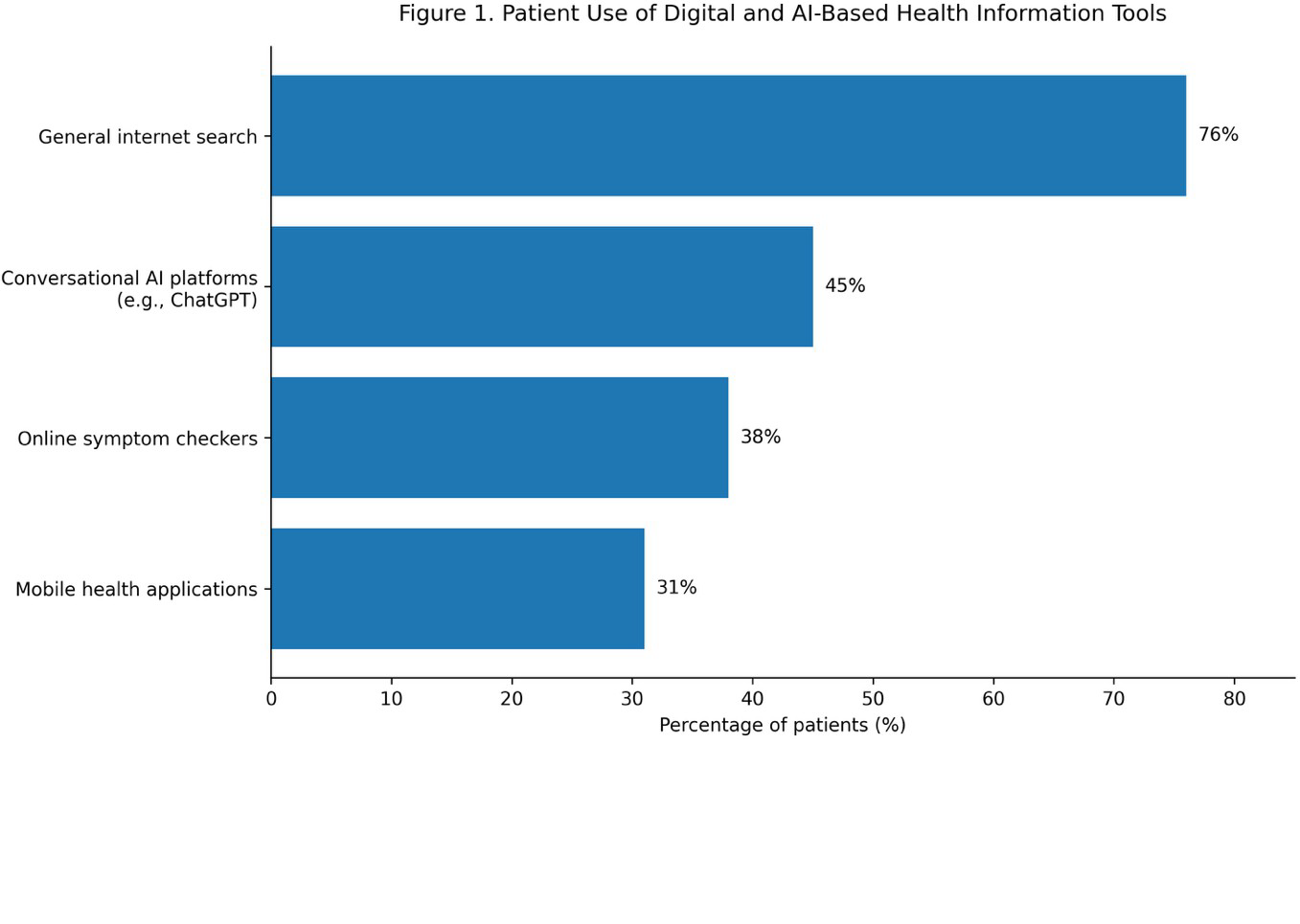
Patient use of digital and AI-based health information tools before their clinical consultation (n=127). Figure from the study. Source: Georgian Medical Journal, Vol. 1 No. 1 (2026). Full article: gmj.ge/index.php/pub/article/view/21.
The survey data shows AI tools have already become a routine part of patients’ pre-visit research: general internet search remained the most common source at 76%, but conversational AI platforms like ChatGPT were used by 45% of patients, ahead of dedicated online symptom checkers (38%) and mobile health apps (31%).

Physicians’ own assessment of the accuracy of the AI-generated information their patients brought in. Figure from the study.
Physicians’ assessment of that AI-generated information was decidedly mixed: only 18% rated it as completely accurate, while 62% called it partially accurate and 20% said it was misleading or outright incorrect — meaning in four out of five encounters, physicians found at least some fault with what their patients had been told by an AI tool.

Whether patients told their physician they had consulted an AI tool before the visit. Figure from the study.
Perhaps the most practically important finding: 58% of patients who had used an AI tool did not disclose that use to their physician during the consultation — meaning doctors are frequently working without knowing that a patient’s expectations, or their described symptoms, may already have been shaped by an AI conversation before they ever walked in the door.
The study’s implication isn’t that AI-informed patients are a problem to be managed away — conversational AI use in healthcare-seeking is clearly now routine. It’s that the current default, where most of that AI consultation happens invisibly to the physician, leaves a communication gap exactly where transparency would help most: knowing what a patient has already been told, right or wrong, before deciding how to respond to it.
🗺️ Find certified Georgian healthcare providers: sheniekimi.ge — Georgia Health Map · 998 clinics · 6,600+ doctors · 2,296 pharmacies
Read the Original Research
Original article: Your Patients Have Already Asked the AI: Inside Georgia’s Clinics in the ChatGPT Era
Published in: Georgian Medical Journal, Vol. 1 No. 1 (2026)
Note: a DOI is registered for this article on Zenodo but was not yet resolving at time of writing; the gmj.ge link above is the authoritative reference.
📄 Read the full article at gmj.ge →
Georgian Medical Journal (GMJ) · ISSN 3088-4322 · gmj.ge · Open Access CC BY 4.0 · Published by the Public Health Institute of Georgia (PHIG). This summary is an independent editorial product of GMJ News; for clinical decisions, consult the original peer-reviewed article and a qualified professional.
Was this article helpful?
Disclaimer. This article is health journalism intended for general information and education. It is not medical advice and is not a substitute for professional diagnosis or treatment. Always consult a qualified healthcare provider about your individual circumstances. Full disclaimer →
Related Coverage




Editorial standards. This article was produced under the GMJ News editorial process, with oversight by the GMJ Editorial Board. Our editorial process. Spotted an error? Contact the editorial team.