By using this site, you agree to the Privacy Policy and Terms of Use.
Accept
GMJ NewsGMJ NewsGMJ News
  • Latest News
    • GMJ Briefs
  • Podcast & Media
    • Podcast Episodes
    • GMJ Audio
    • GMJ Videos
  • Research Digest
    • New Studies
    • Georgian Research
    • Data & Numbers
  • Policy & Systems
    • Health Policy
    • Quality & Safety
    • Migration & Health
    • Global Health
  • Practice
    • Clinical Updates
    • Case Discussions
    • Pharmacy & Prescribing
    • Ingredients A-Z
  • Perspectives
    • Editorial
    • Explainers
    • Voices
    • Letters
  • Health Topics
  • GMJ Articles
    • Vol. 1 Issue 2 (2026)
    • Vol. 1 Issue 1 (2026)
    • Pre-Launch Articles (2025)
  • Read the Journal →
  • About GMJ News
Notification Show More
Font ResizerAa
GMJ NewsGMJ News
Font ResizerAa
  • Latest News
    • GMJ Briefs
  • Podcast & Media
    • Podcast Episodes
    • GMJ Audio
    • GMJ Videos
  • Research Digest
    • New Studies
    • Georgian Research
    • Data & Numbers
  • Policy & Systems
    • Health Policy
    • Quality & Safety
    • Migration & Health
    • Global Health
  • Practice
    • Clinical Updates
    • Case Discussions
    • Pharmacy & Prescribing
    • Ingredients A-Z
  • Perspectives
    • Editorial
    • Explainers
    • Voices
    • Letters
  • Health Topics
  • GMJ Articles
    • Vol. 1 Issue 2 (2026)
    • Vol. 1 Issue 1 (2026)
    • Pre-Launch Articles (2025)
  • Read the Journal →
  • About GMJ News
Follow US
GMJ News > GMJ Briefs > Over 1 Billion Children Navigate Multiple Climate Threats Simultaneously, UNICEF Data Shows

Over 1 Billion Children Navigate Multiple Climate Threats Simultaneously, UNICEF Data Shows

GMJ
Last updated: 18/07/2026 11:52
By
Prof. Giorgi Pkhakadze
Share
1 Min Read
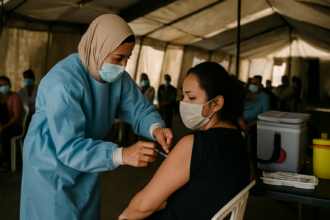
Global map showing regions of high child vulnerability to multiple climate hazards
UNICEF warns that over 1 billion children face three or more overlapping climate hazards simultaneously, with unequal exposure concentrating risk in low- and middle-income regions vulnerable to heat stress, flooding, drought, and air pollution combined. — Photo by Ilya Perelude on Pexels (Pexels License)
SHARE
1 min read|148 words

A landmark UNICEF assessment released in June 2026 reveals that more than 1 billion children worldwide are simultaneously exposed to three or more overlapping climate hazards, with vulnerability concentrated in regions already strained by limited healthcare infrastructure. The finding emphasizes that climate risks do not affect populations uniformly: sub-Saharan Africa, South Asia, and island nations bear disproportionately heavy burdens, where children face compounded threats of heat stress, flooding, drought, and air pollution in tandem.

When multiple climate stressors intersect, their health impacts amplify exponentially. A child experiencing heat stress alongside water scarcity and poor air quality faces multiplicative physiological strain, increasing risk of respiratory disease, waterborne illness, malnutilation, and heat-related mortality. Public health systems in low- and middle-income countries, already constrained by limited resources and early warning infrastructure, must urgently develop integrated climate adaptation strategies that strengthen both healthcare capacity and community resilience.

Read the full article on GMJ Newsroom.

Was this article helpful?

GMJ Brief · Announcement

📰 Read the full article: 1 billion children exposed to multiple climate hazards simultaneously, UNICEF warns →

Share This Article
Facebook LinkedIn Bluesky Copy Link Print
GMJ
ByProf. Giorgi Pkhakadze
Follow:
Prof. Giorgi Pkhakadze, MD, MPH, PhD, is Editor-in-Chief of the Georgian Medical Journal and Chair of the Public Health Institute of Georgia (PHIG). He is Professor and Head of the Department of Social and Behavioural Sciences at David Tvildiani Medical University, and Secretary/Treasurer of the UEMS Section of Public Health. ORCID: 0000-0001-7609-4515.

Submit Your Paper →

Georgia's peer-reviewed open-access medical journal. No APC until January 2027.
Submit Manuscript →
Actin: The Molecular Engine Powering Cell Movement, Division, and Immune Defense

Actin, comprising ~6% of cellular protein, is a multifunctional molecule enabling muscle…

Resistance Training Protects Brain Health Through Vascular and Cognitive Pathways, New Evidence Shows

Resistance training influences brain health through endothelial function, neurotrophic signalling, blood-brain barrier…

Beyond the Powerhouse: How Mitochondria Control Energy, Stress, and Cell Survival

Mitochondria perform four critical functions beyond energy production: ATP generation via the…

Submit Your Paper to GMJ

No APC until January 2027.
Submit Manuscript →

You Might Also Like

Laboratory researcher preparing nasal spray for brain aging study

Two-Dose Nasal Spray Shows Promise in Reversing Cognitive Aging Markers

By
Prof. Giorgi Pkhakadze
29/06/2026
Chart showing 12-month decline of olive oil antioxidants including alpha-tocopherol, polyphenols, and squalene

How Quickly Does Your Olive Oil Lose Its Health Benefits?

By
Prof. Giorgi Pkhakadze
27/07/2026
Medical illustration showing polycystic ovary metabolic syndrome diagnostic criteria and symptoms

Medical Organizations Officially Rebrand PCOS to PMOS, Reflecting Metabolic Focus

By
Prof. Giorgi Pkhakadze
17/06/2026

Ebola Cases in Eastern Congo Exceed 900 as Health Emergency Declared

By
Prof. Giorgi Pkhakadze
25/05/2026
Facebook Twitter Youtube Instagram
Company
  • Privacy Policy
  • Contact US
  • GMJ Journal
  • Submit Manuscript
  • Editorial Team
  • Register at GMJ
  • Terms of Use

Subscribe to GMJ News — Click here

Join Community
© 2026 Georgian Medical Journal (GMJ). Published by the Public Health Institute of Georgia (PHIG). All rights reserved.
Welcome Back!

Sign in to your account

Username or Email Address
Password

Lost your password?

Not a member? Sign Up