By using this site, you agree to the Privacy Policy and Terms of Use.
Accept
GMJ NewsGMJ NewsGMJ News
  • Latest News
    • GMJ Briefs
  • Podcast & Media
    • Podcast Episodes
    • GMJ Audio
    • GMJ Videos
  • Research Digest
    • New Studies
    • Georgian Research
    • Data & Numbers
  • Policy & Systems
    • Health Policy
    • Quality & Safety
    • Migration & Health
    • Global Health
  • Practice
    • Clinical Updates
    • Case Discussions
    • Pharmacy & Prescribing
    • Ingredients A-Z
  • Perspectives
    • Editorial
    • Explainers
    • Voices
    • Letters
  • GMJ Articles
    • Vol. 1 Issue 2 (2026)
    • Vol. 1 Issue 1 (2026)
    • Pre-Launch Articles (2025)
  • Read the Journal →
  • About GMJ News
Notification Show More
Font ResizerAa
GMJ NewsGMJ News
Font ResizerAa
  • Latest News
    • GMJ Briefs
  • Podcast & Media
    • Podcast Episodes
    • GMJ Audio
    • GMJ Videos
  • Research Digest
    • New Studies
    • Georgian Research
    • Data & Numbers
  • Policy & Systems
    • Health Policy
    • Quality & Safety
    • Migration & Health
    • Global Health
  • Practice
    • Clinical Updates
    • Case Discussions
    • Pharmacy & Prescribing
    • Ingredients A-Z
  • Perspectives
    • Editorial
    • Explainers
    • Voices
    • Letters
  • GMJ Articles
    • Vol. 1 Issue 2 (2026)
    • Vol. 1 Issue 1 (2026)
    • Pre-Launch Articles (2025)
  • Read the Journal →
  • About GMJ News
Follow US
GMJ News > GMJ Briefs > What Patients Should Know About Microbiome Screening and Parkinson’s Prevention

What Patients Should Know About Microbiome Screening and Parkinson’s Prevention

GMJ
Last updated: 14/07/2026 09:17
By
Prof. Giorgi Pkhakadze
Share
1 Min Read
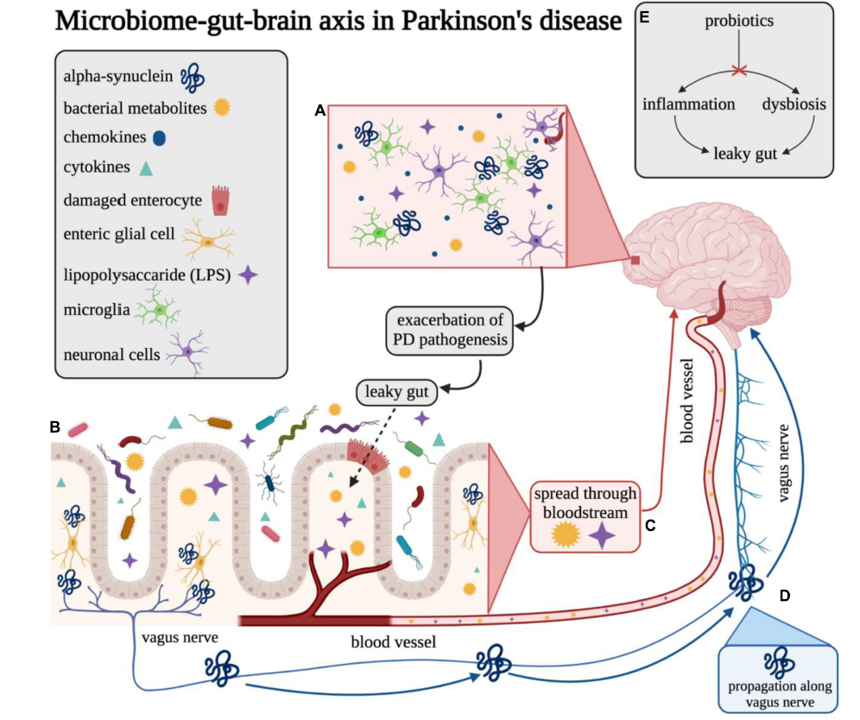
Scientific illustration of gut microbiome bacteria and brain connection for Parkinson's disease research
New research published in Nature Medicine reveals that gut microbiome analysis could identify Parkinson's disease risk years before symptoms appear. The study found progressive microbiome changes across healthy, at-risk, and symptomatic individuals, with healthy diet showing protective effects. — "Overview of the gut–brain axis in Parkinson’s disease" by Emily M. Klann, Upuli Dissanayake, Anjela Gurrala, Matthew Farrer, Aparna Wagle Shukla, Adolfo Ramirez-Zamora, Volker Mai, and Vinata Vedam-Mai is licensed under CC BY 4.0. To view a copy of this license, visit https://creativecommons.org/licenses/by/4.0/. (CC BY 4.0)
SHARE
1 min read|143 words

New research demonstrates three critical findings about the connection between gut health and Parkinson’s disease risk. First, progressive microbiome changes are detectable years before clinical symptoms develop, offering an unprecedented opportunity for early risk assessment. Second, dietary choices significantly influence these microbial alterations, with healthy eating patterns showing protective associations against disease-related microbiome changes. Third, these advances may enable early intervention strategies that could slow or prevent disease progression in high-risk individuals.

For readers with family histories of Parkinson’s disease or genetic risk factors, this research underscores the importance of maintaining healthy dietary habits and gut microbiome function as preventive measures. While microbiome screening is not yet standard clinical practice, these findings suggest future clinical protocols may incorporate microbiome analysis into risk assessment protocols for neurodegenerative disease, enabling personalized prevention strategies tailored to individual microbiome profiles.

Read the full article on GMJ Newsroom.

Was this article helpful?

GMJ Brief · Takeaway

📰 Read the full article: Gut microbiome screening could predict Parkinson’s disease risk years before symptoms emerge →

Share This Article
Facebook LinkedIn Bluesky Copy Link Print
GMJ
ByProf. Giorgi Pkhakadze
Follow:
Prof. Giorgi Pkhakadze, MD, MPH, PhD, is Editor-in-Chief of the Georgian Medical Journal and Chair of the Public Health Institute of Georgia (PHIG). He is Professor and Head of the Department of Social and Behavioural Sciences at David Tvildiani Medical University, and Secretary/Treasurer of the UEMS Section of Public Health. ORCID: 0000-0001-7609-4515.

Submit Your Paper →

Georgia's peer-reviewed open-access medical journal. No APC until January 2027.
Submit Manuscript →
Why Nearly Half of U.S. Counties Lack Maternity Care Despite Falling Birth Rates

Nearly 50% of U.S. counties lack an obstetrician-gynecologist despite falling birth rates.…

Why Sunlight Triggers Sneezing in Some People: The Science Behind Photic Sneeze Reflex

Approximately 18–35% of people experience involuntary sneezing when exposed to bright sunlight—a…

Correction issued for MAGE-A4/A8 immunotherapy trial in advanced solid tumours

Nature Medicine has published an author correction to a phase 1 trial…

Submit Your Paper to GMJ

No APC until January 2027.
Submit Manuscript →

You Might Also Like

PHEIC Declaration: Ebola Cross-Border Transmission DRC-Uganda

By
Prof. Giorgi Pkhakadze
31/05/2026
Clinical UpdatesGlobal HealthPolicy & SystemsPractice

CDC Activates Emergency Operations Center for New World Screwworm Outbreak

By
Prof. Giorgi Pkhakadze
15/06/2026
Medical illustration of HER2-positive cancer cells being targeted by bispecific antibody therapy

56% Progression-Free Survival Rate: Zanidatamab’s Compelling 18-Month Outcome in HER2+ Gastric Cancer

By
Prof. Giorgi Pkhakadze
11/06/2026
Pharmacy & PrescribingPractice

MHRA Recalls ChloraPrep Antiseptic Applicators Over Sterility Breach

By
Prof. Giorgi Pkhakadze
02/06/2026
Facebook Twitter Youtube Instagram
Company
  • Privacy Policy
  • Contact US
  • GMJ Journal
  • Submit Manuscript
  • Editorial Team
  • Register at GMJ
  • Terms of Use

Subscribe to GMJ News — Click here

Join Community
© 2026 Georgian Medical Journal (GMJ). Published by the Public Health Institute of Georgia (PHIG). All rights reserved.
Welcome Back!

Sign in to your account

Username or Email Address
Password

Lost your password?

Not a member? Sign Up