Updated 13/09/2026
Photo: Running Girl, by Scott 97006 (Flickr), cropped for layout · Licensed CC BY 2.0 · Source
Plain-language summary of research published in the Georgian Medical Journal. Written for the general public by the GMJ News editorial team.
Sudden cardiac death in children and adolescents is rare, but catastrophic — and a meaningful share of exercise-related cases trace back to undiagnosed structural or electrical heart abnormalities that systematic screening can catch. A population-based study in the Georgian Medical Journal delivers the first region-specific data of its kind for Eastern Europe and the Caucasus.

A Data Gap in Eastern Europe and the Caucasus
Debate over the ideal pre-participation cardiovascular screening model for young athletes is genuinely international, but region-specific epidemiological data for this part of the world has been limited. This study set out to determine the prevalence, clinical spectrum, and risk profile of cardiovascular abnormalities among pediatric athletes in Adjara, Georgia, and to draw out what that means for national sports safety policy.
The Screening Protocol
This population-based cross-sectional study, conducted in 2025, included 442 competitive athletes aged 7 to 18. Every participant underwent a standardised cardiovascular evaluation: structured medical history, physical examination, 12-lead ECG interpreted against contemporary international criteria, transthoracic echocardiography, and anthropometric assessment — a full, multi-modal screening package rather than a single quick test.
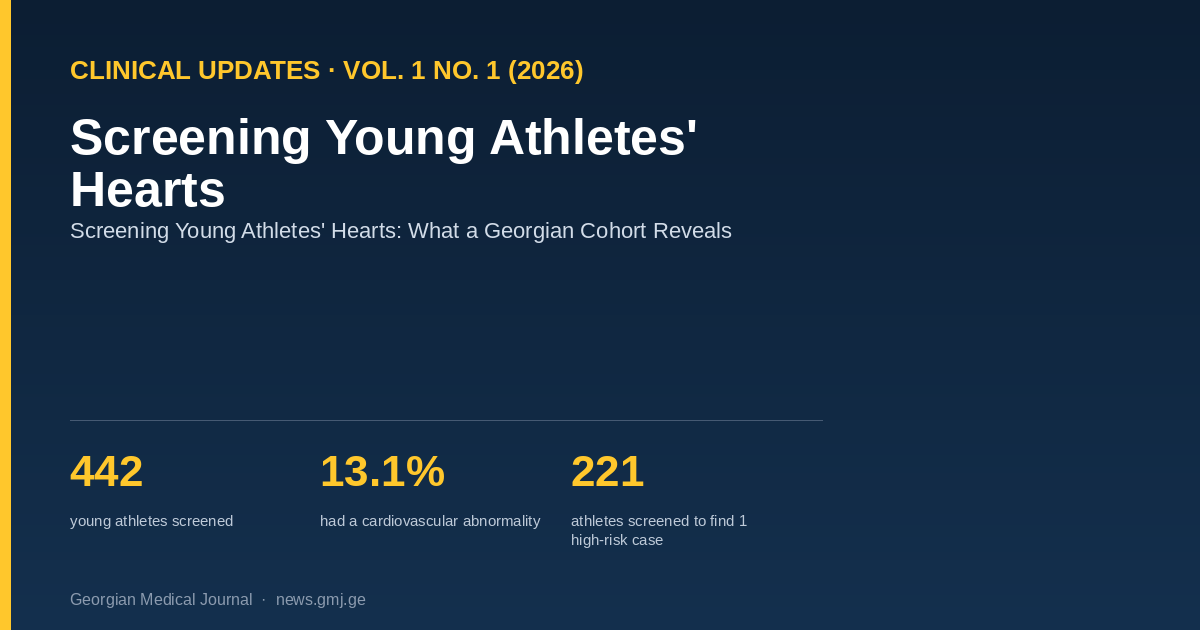
At a glance — the headline figures.

Screening outcomes among the 442 athletes: the large majority showed no abnormality, with a small number flagged as high-risk. Figure from the study. Source: Georgian Medical Journal, Vol. 1 No. 1 (2026), DOI: 10.5281/zenodo.19091480.
Cardiovascular abnormalities turned up in 58 athletes (13.1%, 95% CI 10.1–16.6%) — most of them low-risk structural valvular findings. High-risk conditions, though rare, were genuinely present: 2 athletes (0.45%) were found to have hypertrophic cardiomyopathy and Wolff–Parkinson–White syndrome respectively, both conditions specifically associated with exercise-related sudden cardiac death. The number needed to screen to catch one high-risk condition was 221 athletes.
The authors are careful not to overreach: cross-sectional data like this can’t demonstrate that screening actually reduces mortality, since that requires long-term outcome tracking this study wasn’t designed to provide. But the prevalence and detection yield found here line up closely with established international screening cohorts — meaning Georgia’s young athletes carry a comparable structural and electrical risk burden to populations already covered by formal screening programmes elsewhere, giving policymakers a concrete, region-specific evidence base for deciding how to structure youth sports cardiovascular screening going forward.
🗺️ Find certified Georgian healthcare providers: sheniekimi.ge — Georgia Health Map · 998 clinics · 6,600+ doctors · 2,296 pharmacies
Read the Original Research
Original article: Screening Young Athletes’ Hearts: What a Georgian Cohort Reveals
Published in: Georgian Medical Journal, Vol. 1 No. 1 (2026)
DOI: 10.5281/zenodo.19091480
📄 Read the full article at gmj.ge →
Georgian Medical Journal (GMJ) · ISSN 3088-4322 · gmj.ge · Open Access CC BY 4.0 · Published by the Public Health Institute of Georgia (PHIG). This summary is an independent editorial product of GMJ News; for clinical decisions, consult the original peer-reviewed article and a qualified professional.
Was this article helpful?
Disclaimer. This article is health journalism intended for general information and education. It is not medical advice and is not a substitute for professional diagnosis or treatment. Always consult a qualified healthcare provider about your individual circumstances. Full disclaimer →
Related Coverage




Editorial standards. This article was produced under the GMJ News editorial process, with oversight by the GMJ Editorial Board. Our editorial process. Spotted an error? Contact the editorial team.