Updated 13/09/2026
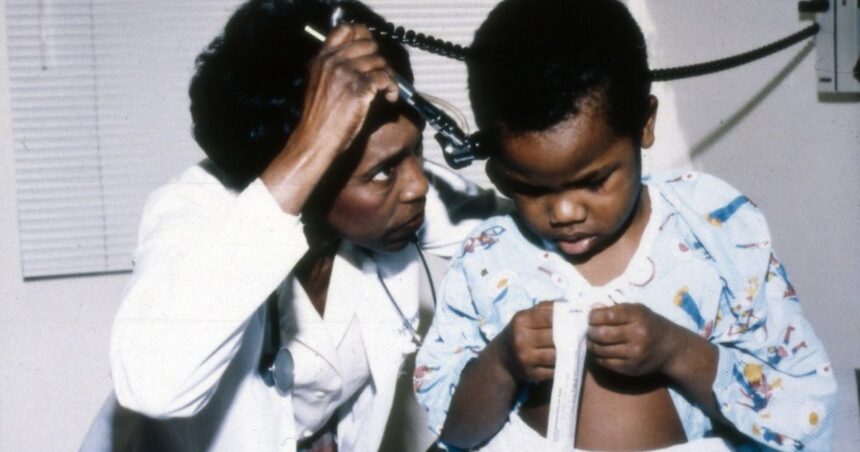
Photo: Doctor examining child, circa 1970s, by Seattle Municipal Archives (Flickr), cropped for layout · Licensed CC BY 2.0 · Source
Plain-language summary of research published in the Georgian Medical Journal. Written for the general public by the GMJ News editorial team.
Enlarged tonsils and adenoids are among the most common causes of childhood airway obstruction — and a frequent reason for surgery. A study in the Georgian Medical Journal, examining Georgian children scheduled for adenotonsillectomy, asks whether allergy is playing a bigger, more hidden role in causing that enlargement than clinicians typically recognise.

Why This Question Matters
Adenoid and adenotonsillar hypertrophy are leading causes of chronic upper airway obstruction in childhood, but how much IgE-mediated allergic sensitisation actually contributes to that enlargement remains incompletely understood — and regional data from the South Caucasus has been essentially absent until now. This single-centre, retrospective study examined 17 consecutive children aged 3 to 12 with confirmed Grade III adenoid or adenotonsillar hypertrophy, scheduled for elective surgery in Georgia’s Adjara region.
The Surprising Overlap
Clinical allergic manifestations — mostly respiratory — were documented in 47.1% of the children. But total serum IgE was elevated in a larger share still: 64.7% of children overall. Critically, elevated IgE showed up at nearly identical rates in children with clinically apparent allergy (62.5%) and those without any obvious allergic symptoms at all (66.7%).
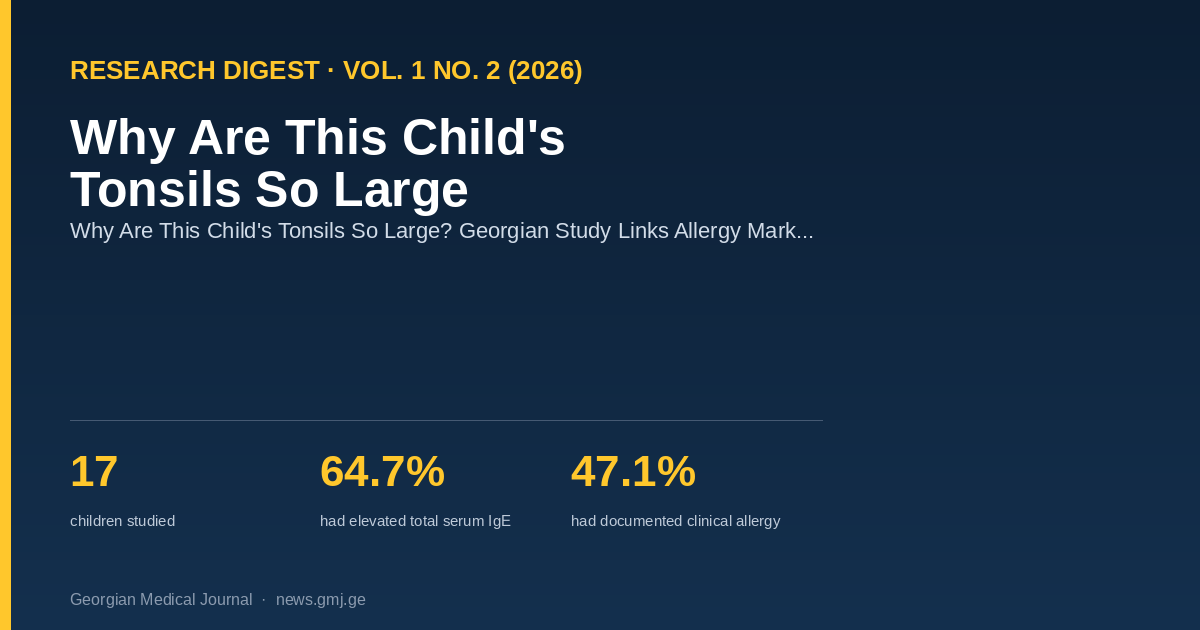
At a glance — the headline figures.
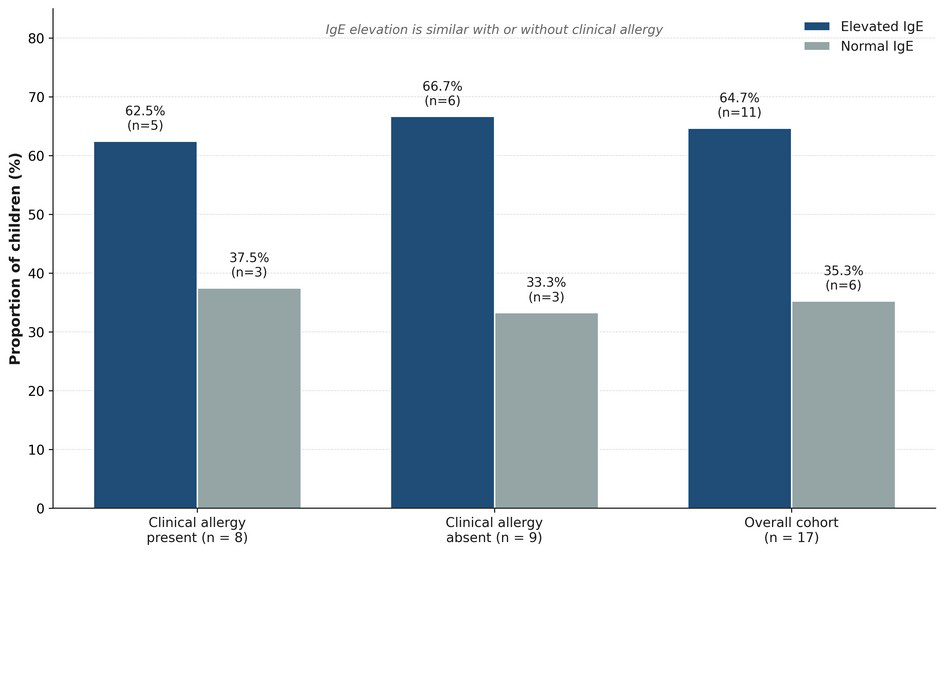
Distribution of clinical allergy status and elevated IgE among children with Grade III tonsil/adenoid hypertrophy (n=17). Figure from the study. Source: Georgian Medical Journal, Vol. 1 No. 2 (2026), DOI: 10.66636/gmj.v1.i2.a82.
That overlap is the study’s key finding: elevated IgE wasn’t restricted to children with obvious clinical allergy, suggesting subclinical, IgE-mediated sensitisation may be contributing to tonsil and adenoid enlargement even in children who show no outward allergic symptoms. With only 17 children studied, the authors are explicit this is hypothesis-generating, not confirmatory — but it points toward pre-operative allergy evaluation as a pathway worth investigating in larger studies with proper non-hypertrophy control groups.
🗺️ Find certified Georgian healthcare providers: sheniekimi.ge — Georgia Health Map · 998 clinics · 6,600+ doctors · 2,296 pharmacies
Read the Original Research
Original article: Why Are This Child’s Tonsils So Large? Georgian Study Links Allergy Marker to Severe Tonsil Enlargement
Published in: Georgian Medical Journal, Vol. 1 No. 2 (2026)
DOI: 10.66636/gmj.v1.i2.a82
📄 Read the full article at gmj.ge →
Georgian Medical Journal (GMJ) · ISSN 3088-4322 · gmj.ge · Open Access CC BY 4.0 · Published by the Public Health Institute of Georgia (PHIG). This summary is an independent editorial product of GMJ News; for clinical decisions, consult the original peer-reviewed article and a qualified professional.
Was this article helpful?
Disclaimer. This article is health journalism intended for general information and education. It is not medical advice and is not a substitute for professional diagnosis or treatment. Always consult a qualified healthcare provider about your individual circumstances. Full disclaimer →
Related Coverage




Editorial standards. This article was produced under the GMJ News editorial process, with oversight by the GMJ Editorial Board. Our editorial process. Spotted an error? Contact the editorial team.