Updated 13/09/2026
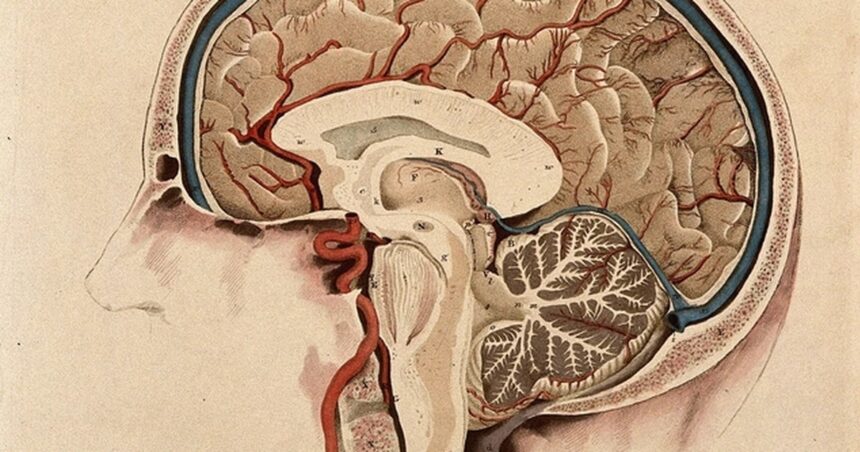
Photo: Brain: lateral section. Coloured line, by None · Public domain / CC0 · Source
Plain-language summary of research published in the Georgian Medical Journal. Written for the general public by the GMJ News editorial team.
Serotonergic degeneration is known to happen early in Parkinson’s disease, but how it changes as the disease progresses — and whether it differs by symptom type — has remained incompletely mapped, with zero prior data from the South Caucasus. A case-control study in the Georgian Medical Journal tracks serum serotonin against disease duration in 50 Georgian patients, filling that gap directly.

The Hypothesis Being Tested
Researchers tested whether peripheral serum serotonin (5-HT) declines steadily with how long someone has had Parkinson’s, and whether that decline is steepest in patients whose dominant symptom is bradykinesia (slowness of movement) rather than tremor. This single-centre case-control study in Batumi compared 50 adults with clinically diagnosed PD against 20 sex-matched healthy controls, excluding anyone on medications that would directly affect serotonin levels.
A Clean, Monotonic Decline
Serum serotonin declined steadily with disease duration (Pearson r = –0.62): patients diagnosed within the past year looked similar to healthy controls, while those with more than 10 years of disease showed the lowest levels measured. The decline wasn’t uniform across symptom types, though — bradykinesia-predominant patients showed by far the largest drop, 61% lower than controls, while tremor-predominant patients showed the smallest decrease.
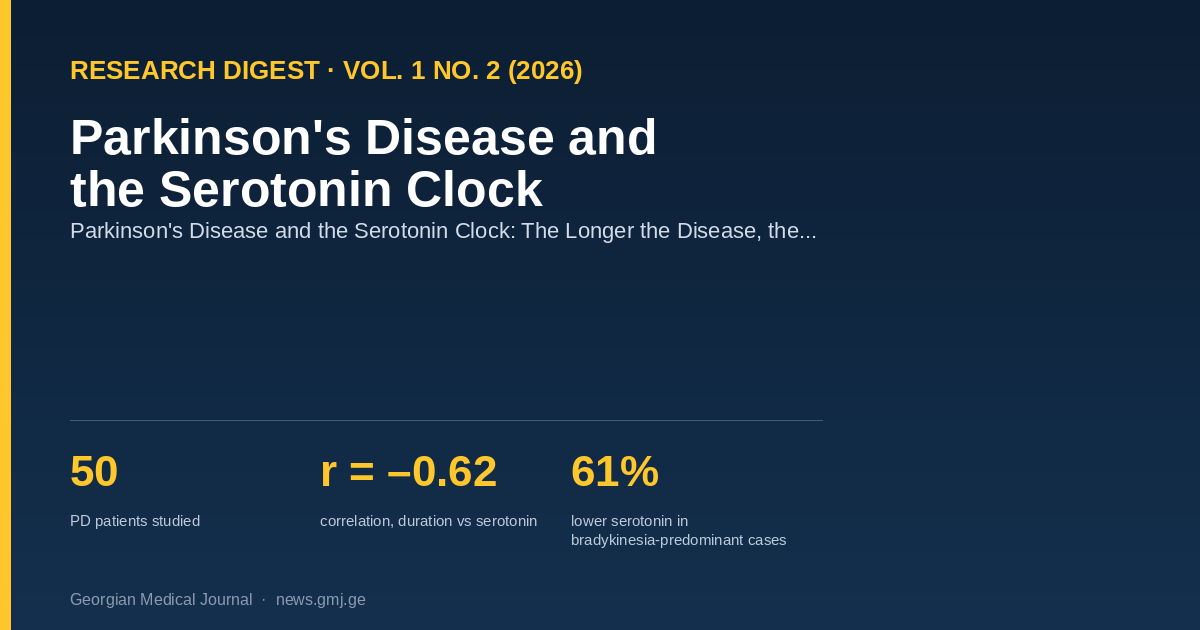
At a glance — the headline figures.
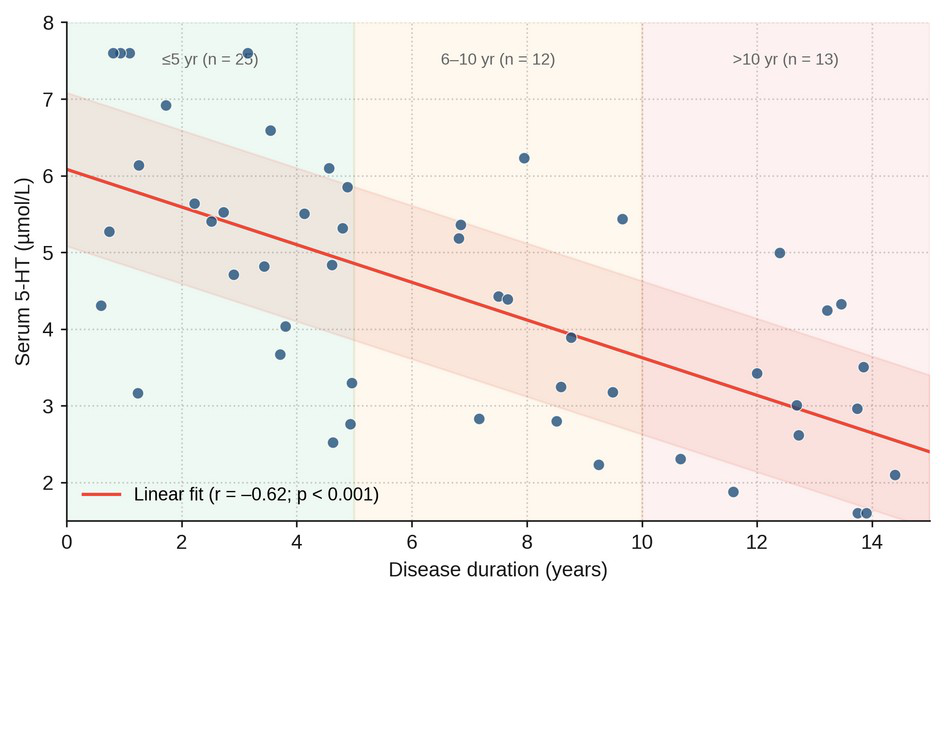
Serum serotonin (5-HT) versus Parkinson’s disease duration, showing a steady decline across the study cohort. Figure from the study. Source: Georgian Medical Journal, Vol. 1 No. 2 (2026), DOI: 10.66636/gmj.v1.i2.a112.
The clinical link didn’t stop at biochemistry: patients in the lowest serotonin tertile reported depressive symptoms far more often than those in the highest tertile (roughly 68% versus 25%) — connecting a measurable blood marker to how patients actually felt, not just to their movement symptoms.
As the first South Caucasus dataset of its kind, the study extends serotonergic PD research to a population that had simply never been measured before — and the pattern it found lines up with what brain-imaging studies (using PET tracers that directly visualise serotonin neurons) have already shown about stage-dependent central serotonergic loss. The authors describe this as groundwork for a planned multicentre Georgian study using validated motor and depression scales, rather than a final word on its own.
🗺️ Find certified Georgian healthcare providers: sheniekimi.ge — Georgia Health Map · 998 clinics · 6,600+ doctors · 2,296 pharmacies
Read the Original Research
Original article: Parkinson’s Disease and the Serotonin Clock: The Longer the Disease, the Lower the Level
Published in: Georgian Medical Journal, Vol. 1 No. 2 (2026)
DOI: 10.66636/gmj.v1.i2.a112
📄 Read the full article at gmj.ge →
Georgian Medical Journal (GMJ) · ISSN 3088-4322 · gmj.ge · Open Access CC BY 4.0 · Published by the Public Health Institute of Georgia (PHIG). This summary is an independent editorial product of GMJ News; for clinical decisions, consult the original peer-reviewed article and a qualified professional.
Was this article helpful?
Disclaimer. This article is health journalism intended for general information and education. It is not medical advice and is not a substitute for professional diagnosis or treatment. Always consult a qualified healthcare provider about your individual circumstances. Full disclaimer →
Related Coverage




Editorial standards. This article was produced under the GMJ News editorial process, with oversight by the GMJ Editorial Board. Our editorial process. Spotted an error? Contact the editorial team.