Updated 28/08/2026
Photo: Providing medical care in Zaatari with Doctors of the World, by DFID – UK Department for International Development (Flickr), cropped for layout · Licensed CC BY 2.0 · Source
Plain-language summary of research published in the Georgian Medical Journal. Written for the general public by the GMJ News editorial team.
More than 281 million people are international migrants, and over 114 million are forcibly displaced — yet whether they can actually access healthcare depends entirely on statutory rules that vary enormously by country. A study in the Georgian Medical Journal introduces the Health Entitlement Index for Refugees and Migrants (HEIRM), the first tool to systematically measure and compare that legal architecture across 41 nations.

What HEIRM Actually Measures
The index scores statutory health entitlement across six domains: legal access to primary care, emergency care entitlement, preventive service inclusion, enrolment complexity (reverse-coded, so simpler is better), financing integration, and firewall protection — whether seeking care can trigger immigration enforcement. Forty-one countries, representing all six WHO regions, were scored using verified statutory and institutional documentation from January–June 2025.
The Scores
HEIRM scores ranged from 6 to 15 out of a possible 18 (mean 11.3). Five countries were classified Inclusive (15–18), 29 Conditional (9–14), and 7 Restrictive (0–8) — and notably, not a single country in the study achieved the theoretical maximum. Emergency care entitlement showed the highest convergence across countries, while firewall protections from immigration enforcement were the least consistently codified into law anywhere.

At a glance — the headline figures.
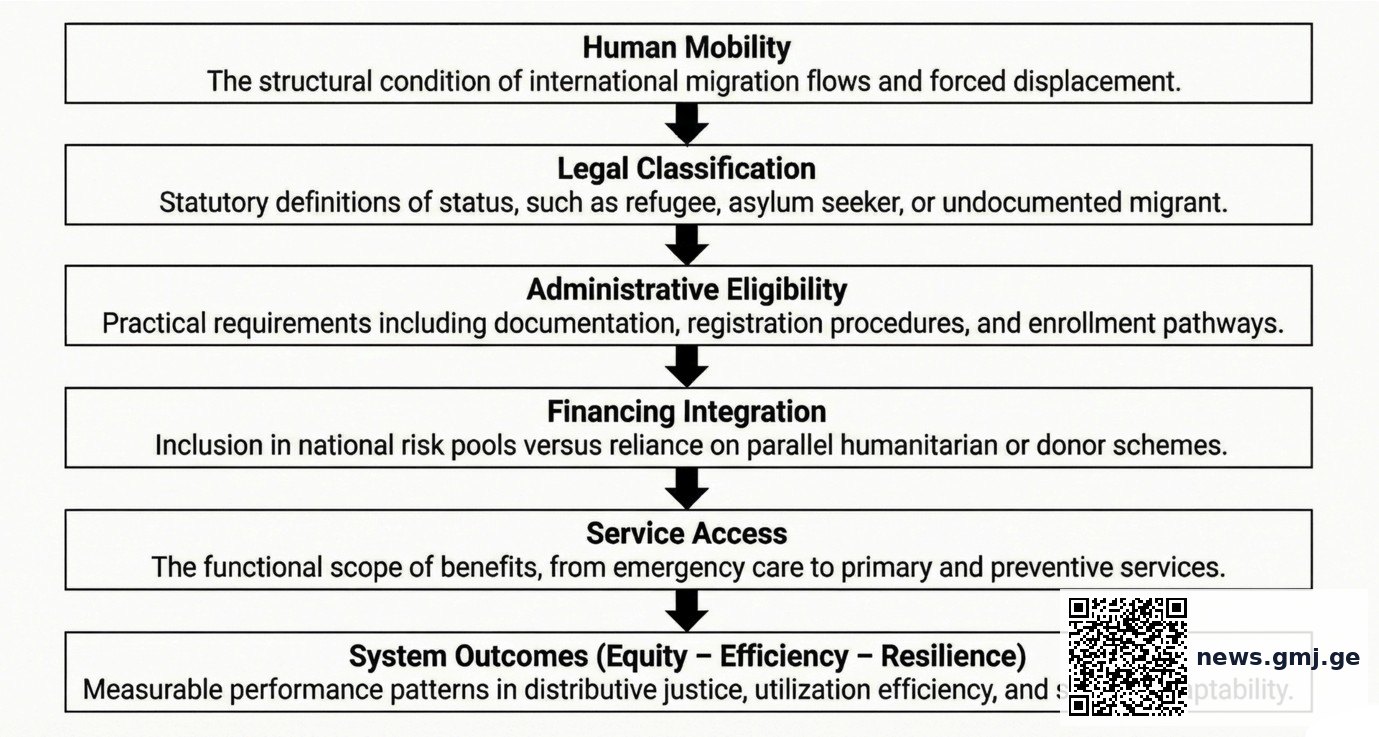
HEIRM scores across the 41 countries assessed, by WHO region. Figure from the study. Source: Georgian Medical Journal, Vol. 1 No. 2 (2026), DOI: 10.66636/gmj.v1.i2.a32.
The index wasn’t just descriptive — it was predictive. Higher HEIRM scores correlated with lower preventable hospitalisation rates (r = –0.46) and lower emergency department utilisation (r = –0.41), meaning countries with more generous statutory entitlement actually saw fewer people ending up in expensive, avoidable emergency care. The association with out-of-pocket spending was moderate and weakened after adjusting for national wealth, but the core pattern held.
The paper’s broader point is that legal entitlement architecture isn’t just a humanitarian nicety — it’s a measurable governance variable tied directly to system-level efficiency and equity. With sustained global human mobility now the norm rather than the exception, the authors argue that genuinely operationalising universal health coverage requires aligning entitlement design with demographic reality, not treating migrants and refugees as an edge case the system wasn’t built for.
Read the Original Research
Original article: Which Countries Actually Give Refugees Health Care? A New Index Compares 41 Nations
Published in: Georgian Medical Journal, Vol. 1 No. 2 (2026)
DOI: 10.66636/gmj.v1.i2.a32
📄 Read the full article at gmj.ge →
Georgian Medical Journal (GMJ) · ISSN 3088-4322 · gmj.ge · Open Access CC BY 4.0 · Published by the Public Health Institute of Georgia (PHIG). This summary is an independent editorial product of GMJ News; for clinical decisions, consult the original peer-reviewed article and a qualified professional.
Was this article helpful?
Disclaimer. This article is health journalism intended for general information and education. It is not medical advice and is not a substitute for professional diagnosis or treatment. Always consult a qualified healthcare provider about your individual circumstances. Full disclaimer →
Related Coverage




Editorial standards. This article was produced under the GMJ News editorial process, with oversight by the GMJ Editorial Board. Our editorial process. Spotted an error? Contact the editorial team.