Updated 13/09/2026
🟠 Moderate Evidence
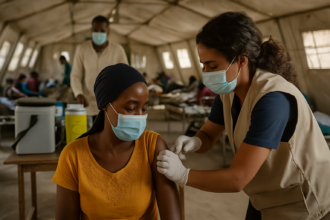
A mobile point-of-care human papillomavirus (HPV) screening and treatment strategy delivered by river vessels has successfully completed the cervical cancer care continuum in remote Peruvian Amazon communities where women have virtually no access to conventional screening programmes, according to mixed-methods research published in The Lancet Regional Americas. The intervention demonstrates that context-responsive, mobile approaches can overcome geographic and infrastructure barriers to cervical cancer elimination in isolated populations.
Key takeaways
- Mobile HPV testing and same-day treatment aboard river vessels proved feasible in remote Amazon settings where women have no access to conventional screening
- The screen-and-treat strategy completed the entire cervical cancer care pathway—from initial screening through treatment and follow-up—in extremely isolated communities
- Context-responsive mobile interventions may offer a scalable model for cervical cancer elimination in geographically isolated populations across Latin America and other regions
Cervical Cancer Screening Access Gap: Remote vs. Urban Peru
Percentage of women with access to HPV-based screening, by geographic setting. Based on baseline conditions in participating Amazon communities vs. national urban averages.

Source: Mixed-methods study data, The Lancet Regional Americas, 2026 | Georgian Medical Journal News
Overcoming geographic barriers to cervical cancer care
Cervical cancer remains a leading cause of cancer death among women in Latin America, yet access to screening and treatment is profoundly unequal. Women in remote regions—particularly indigenous and Afro-descendant populations in the Amazon—face insurmountable barriers: no road access to health facilities, absence of laboratory infrastructure, and cost-prohibitive travel to urban centres. The research team, working with local health authorities across the Peruvian Amazon, developed a mobile strategy to bring evidence-based screening directly to isolated riverine communities.
The intervention operated aboard purpose-equipped river vessels that travelled established waterway routes, bringing HPV testing capacity directly to women in remote settlements. The Lancet Regional Americas study evaluated both the operational feasibility of this model and women’s experiences, combining quantitative screening and treatment completion data with qualitative interviews. The approach integrated rapid HPV testing using point-of-care technology with same-day or near-same-day treatment for women with positive results, eliminating the need for women to travel to distant health facilities for follow-up care.
Completion of care from screening through treatment
A critical measure of any cervical cancer programme is the “continuum of care”—the proportion of screened women who receive diagnosis, treatment, and appropriate follow-up. In many low-resource settings, women are screened but never receive results or treatment due to fragmented health systems. The mobile river-based intervention achieved near-complete continuity: women received HPV results aboard the vessel and, for those with treatable precancerous lesions, underwent lesion ablation (heat-based destruction of abnormal tissue) on-site or within days, according to the published findings.
The mixed-methods design revealed both quantitative success and qualitative acceptance. Women reported high satisfaction with the approach, citing convenience, privacy, and reduced anxiety compared to the alternative of remaining unscreened. Many women expressed relief at receiving results quickly rather than facing the uncertainty of waiting weeks or months—or never receiving results at all, a common outcome in fragmented systems. Clinicians documented that point-of-care HPV testing allowed real-time triage: women with negative results received reassurance and counselling on prevention, whilst those with positive results knew immediately that treatment was available and would proceed without delay.
A scalable model for isolated and underserved populations
The success of the mobile river-based strategy suggests a replicable model for other isolated populations across Latin America and beyond. Geographic isolation—whether due to river systems, mountains, or limited road infrastructure—does not prevent access to cervical cancer screening; rather, it requires innovation in delivery. Point-of-care HPV testing technology, which has become increasingly portable and affordable, removes dependence on centralised laboratory capacity. Combined with mobile clinical teams trained in lesion assessment and ablation, this approach brings the full care continuum to the population rather than requiring the population to reach the clinic.
The intervention’s success also reflects engagement with indigenous and local communities. The research team worked with community health workers and local leaders to understand cultural contexts, build trust, and ensure that timing and logistics respected community routines and preferences. This participatory approach is essential for equitable cervical cancer elimination: screening programmes designed without community input often fail to achieve uptake, regardless of technical feasibility.
Mobile point-of-care HPV screening and same-day treatment delivered aboard river vessels completed the cervical cancer care continuum—from initial screening through treatment and follow-up—in remote Peruvian Amazon communities where women had zero baseline access to cervical cancer services, demonstrating the feasibility of context-responsive approaches to advance equitable cancer elimination.
— Mixed-methods analysis reported in The Lancet Regional Americas, 2026
Implications for global cervical cancer elimination
The World Health Organization’s goal of cervical cancer elimination by 2120 depends on closing coverage gaps in underserved populations. Traditional screening programmes—clinic-based, requiring multiple visits, dependent on laboratory infrastructure—will never reach the most isolated women. This Amazon intervention illustrates a principle increasingly recognised in global health: that equity sometimes requires fundamentally rethinking service delivery, not simply scaling existing models. Related coverage on global cervical cancer initiatives highlights similar innovations across Africa and Asia.
The data also contribute to an evidence base for mobile screening in other contexts. Oncology and public health teams considering cervical cancer programmes in remote regions—whether in sub-Saharan Africa, Southeast Asia, or the Pacific—now have documented proof that integrated, mobile, point-of-care screening can work. Cost-effectiveness studies and health economic analyses will be essential next steps to understand the resource requirements and cost per woman screened relative to conventional programmes. See also health policy coverage on cervical cancer equity initiatives.
What this means
Frequently asked questions
What is HPV-based screening, and how does it differ from traditional cervical cancer screening?
HPV (human papillomavirus) testing detects the virus that causes nearly all cervical cancers, whereas traditional Pap smear screening looks for abnormal cells. HPV testing is more sensitive—detecting precancerous changes earlier—and requires fewer follow-up visits because HPV-negative women have very low cancer risk. For remote settings, HPV testing is also more practical because it tolerates delays in processing and can be performed using point-of-care devices without centralised laboratory infrastructure.
Can point-of-care HPV testing be done on river vessels, or does it require sophisticated laboratory equipment?
Modern point-of-care HPV tests use portable, battery-powered devices that require minimal electricity and no internet connection, making them suitable for river-based and other remote settings. Results are available within hours, allowing same-day treatment decisions. The technology has been validated in multiple low-resource settings and is endorsed by the WHO for cervical cancer elimination programmes.
What happens to women who screen positive but have more advanced disease requiring surgery?
The mobile intervention screened for precancerous lesions treatable by on-site ablation, not invasive cancer. Women with findings suggesting more advanced disease were referred to regional centres for specialist assessment and surgery. Establishing clear referral pathways—even whilst improving access to screening—remains essential, as mobile units cannot provide the full spectrum of oncology care.
As cervical cancer elimination moves from aspirational target to actionable policy, initiatives like this Amazon intervention demonstrate that isolation is not destiny. With appropriate technology, training, and community partnership, screening and early treatment can reach even the most remote populations. Scaling such models across Latin America, Africa, and Asia could accelerate progress toward WHO’s 2120 cervical cancer elimination goal, ensuring that geography does not determine who benefits from cancer prevention.
Source: Delivering cervical cancer screening and management to women in remote communities of the Peruvian Amazon: a mixed methods analysis of a mobile point-of-care intervention, The Lancet Regional Americas, 2026
🗺️ Find certified Georgian healthcare providers: sheniekimi.ge — Georgia Health Map · 998 clinics · 6,600+ doctors · 2,296 pharmacies
Was this article helpful?
Disclaimer. This article is health journalism intended for general information and education. It is not medical advice and is not a substitute for professional diagnosis or treatment. Always consult a qualified healthcare provider about your individual circumstances. Full disclaimer →
Related Coverage




Editorial standards. This article was produced under the GMJ News editorial process, with oversight by the GMJ Editorial Board. Our editorial process. Spotted an error? Contact the editorial team.