Updated 13/09/2026
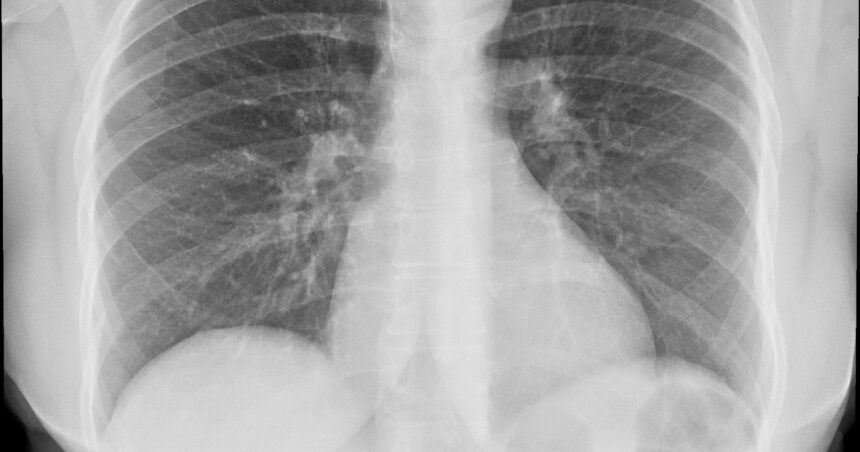
Photo: Chest x-ray plain film normal, by Ptrump16 (Wikimedia), cropped for layout · Licensed CC BY-SA 4.0 · Source
Plain-language summary of research published in the Georgian Medical Journal. Written for the general public by the GMJ News editorial team.
Every chest X-ray report, every CT description, every radiology information system depends on standardised terminology — and the global standard, the RSNA’s RadLex lexicon, exists overwhelmingly in English. A study in the Georgian Medical Journal documents RadLexUA: a grassroots effort to build a complete Ukrainian localisation of that lexicon, and a candid analysis of why work like this is so hard to finish and even harder to make official.

The Problem: Radiology Without a Shared Vocabulary
In Ukraine, radiological reporting today is still predominantly free-text. There is no nationally mandated reporting structure and no obligatory terminology that every radiologist, every hospital information system, and every research database is required to use. That might sound like a minor administrative gap, but the paper is explicit about what it actually costs: reports mix ad-hoc translations with English loanwords and terms inherited from a Russian-language medical education system that Ukraine is now deliberately moving away from; hospital software cannot be properly localised because there is nothing stable to localise it to; structured reporting and the clinical natural-language-processing tools increasingly used to mine radiology reports for research or quality assurance don’t transfer, because they were trained on standardised vocabularies that Ukrainian text doesn’t consistently use; and, looking outward, Ukraine’s stated ambition to align its health data with the European Health Data Space (EHDS) runs straight into the fact that there is, as yet, no Slavic language with a complete RadLex localisation to align with.
What the Team Actually Built
RadLexUA was constructed through a systematic translation pipeline that produced Ukrainian preferred names for all 46,846 RadLex concepts, and went a step further for a substantial subset: full translated definitions, not just labels, for 3,840 of them. To make sure the translations weren’t just linguistically plausible but clinically usable, the team validated the lexicon against a real-world corpus of roughly 49,000 anonymised reports spanning CT, MRI, ultrasound, and X-ray.
The ten-stage pipeline
The technical backbone of the project was a ten-stage natural-language-processing pipeline: anonymisation of source reports, lemmatisation of Ukrainian words to their dictionary root forms, dictionary-based named-entity recognition to flag candidate terms, fuzzy and semantic matching to connect candidates to the correct RadLex concept, and human-in-the-loop validation. Every accepted mapping was anchored to a stable RadLex Identifier (RID) rather than to a Ukrainian word alone, and the pipeline’s output is emitted as standard HL7 FHIR Observation resources keyed on those RIDs — meaning RadLexUA plugs directly into structured reporting systems rather than sitting as a static glossary.
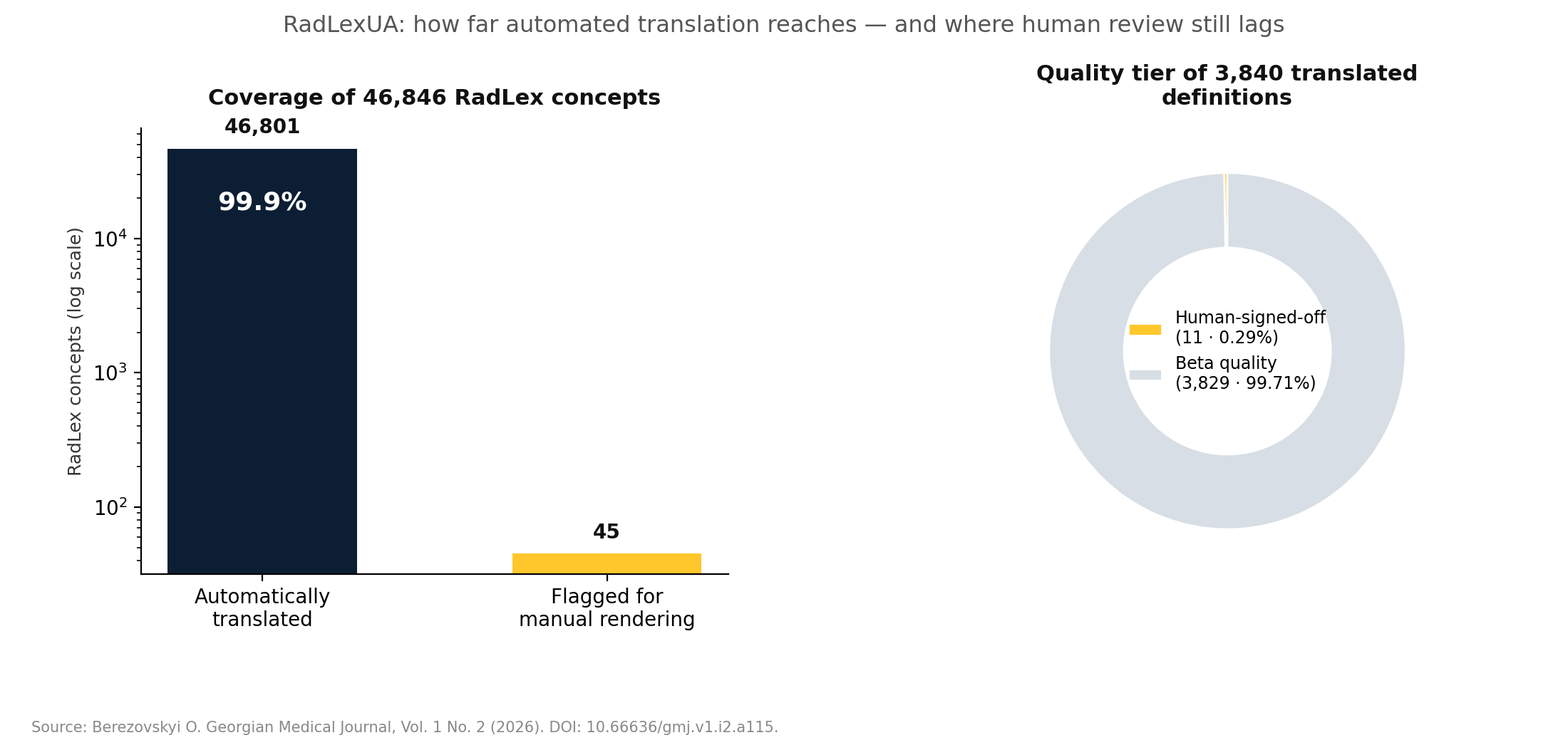
Automated translation reached 99.9% of the 46,846-concept lexicon, but formal human sign-off on definitions has so far reached just 11 of 3,840. Source: Berezovskyi O., Georgian Medical Journal, Vol. 1 No. 2 (2026), DOI: 10.66636/gmj.v1.i2.a115.
Lexical Variability: One Concept, Several Ukrainian Names
Validating the lexicon against real clinical reports surfaced lexical variability: multiple, clinically near-equivalent Ukrainian surface forms often map to a single RadLex ID, a pattern the paper traces directly to Ukraine’s medical-education history, where terminology inherited from Russian-language training is being actively but unevenly displaced.
Where This Leaves the Field
The study’s most transferable insight is the naming of what the authors call the institutional gap: no single body — not RSNA as the international lexicon owner, not any Ukrainian national authority — is clearly responsible for funding and maintaining medical terminology localisation. In that absence, the work falls to grassroots volunteer efforts, with all the energy that brings, and all the fragility.
Only eleven definitions currently carry a radiologist’s formal sign-off; the remaining 3,829 are described as beta quality. Without a host institution, a sustained reviewer workforce, and regulatory recognition, the authors warn that even a technically complete lexicon risks remaining an academic artifact rather than becoming the clinical tool it was built to be.
Why It Matters — Including for Georgia
Published alongside the Georgian Dictionary of Public Health in GMJ’s orbit, this study speaks directly to the Georgian experience: smaller languages get medical terminology infrastructure only when someone deliberately builds it. RadLexUA offers both a working method and a pointed warning for every language community doing this work.
🗺️ Find certified Georgian healthcare providers: sheniekimi.ge — Georgia Health Map · 998 clinics · 6,600+ doctors · 2,296 pharmacies
Read the Original Research
Original article: RadLexUA: a grassroots localization of the RSNA radiology lexicon for the Ukrainian language — technical foundations, lexical variability, and the institutional gap
Authors: Oleksandr Berezovskyi (Omega Medical Center, Kyiv, Ukraine)
Published in: Georgian Medical Journal, Vol. 1 No. 2 (2026) — Health Systems Performance and Quality of Care
DOI: 10.66636/gmj.v1.i2.a115
📄 Read the full article at gmj.ge →
Georgian Medical Journal (GMJ) · ISSN 3088-4322 · gmj.ge · Open Access CC BY 4.0 · Published by the Public Health Institute of Georgia (PHIG). This summary is an independent editorial product of GMJ News; for clinical decisions, consult the original peer-reviewed article and a qualified professional.
Was this article helpful?
Disclaimer. This article is health journalism intended for general information and education. It is not medical advice and is not a substitute for professional diagnosis or treatment. Always consult a qualified healthcare provider about your individual circumstances. Full disclaimer →
Related Coverage



Editorial standards. This article was produced under the GMJ News editorial process, with oversight by the GMJ Editorial Board. Our editorial process. Spotted an error? Contact the editorial team.