Updated 13/09/2026
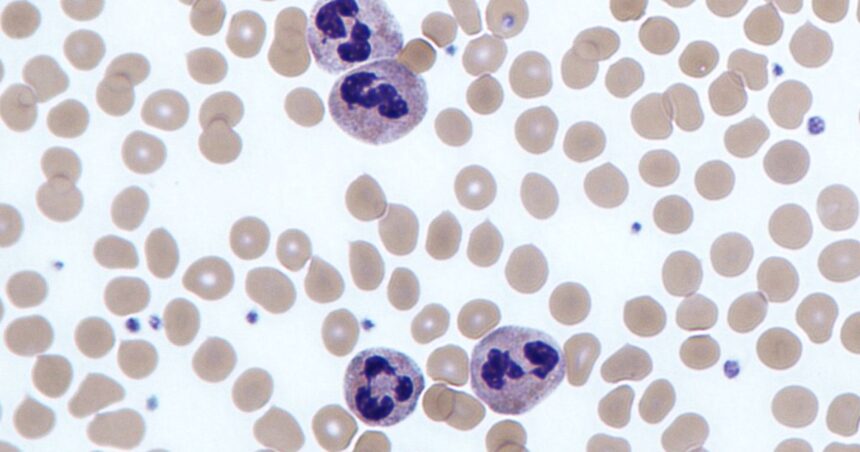
Photo: File:Neutrophils, by Dr Graham Beards (Wikimedia), cropped for layout · Licensed CC BY-SA 3.0 · Source · Illustrative image, not the patient/participants discussed.
Plain-language summary of research published in the Georgian Medical Journal. Written for the general public by the GMJ News editorial team.
Modern automated haematology analysers classify white blood cells at extraordinary speed, using volume, conductivity, and light-scatter properties. But a case study in the Georgian Medical Journal, documenting a familial cluster of a benign hereditary condition in two siblings in Tbilisi, shows exactly where that automation quietly breaks down.

A Benign Condition That Looks Dangerous on a Screen
Pelger-Hüet anomaly (PHA) is a hereditary, autosomal-dominant condition arising from mutations in the lamin B receptor (LBR) gene. It’s clinically harmless — but its hallmark feature, neutrophils with hyposegmented (under-divided) and densely condensed nuclei, produces a reduced light-scatter complexity on automated analysers that closely resembles that of immature “band form” neutrophils. That resemblance matters because band forms are a classic marker of a pathological “left shift” — the kind of finding that, in a real infection, would prompt urgent clinical concern.
The Family and the Method
This case documents a familial cluster of PHA in two siblings evaluated in Tbilisi, Georgia, with a reported paternal history of the same trait — consistent with the autosomal-dominant inheritance pattern the condition is known for. Peripheral blood smears from both patients were prepared using the standard wedge technique, stained with Wright-Giemsa, and evaluated under oil-immersion microscopy, with 100 neutrophils per patient classified by nuclear lobe number and chromatin architecture.
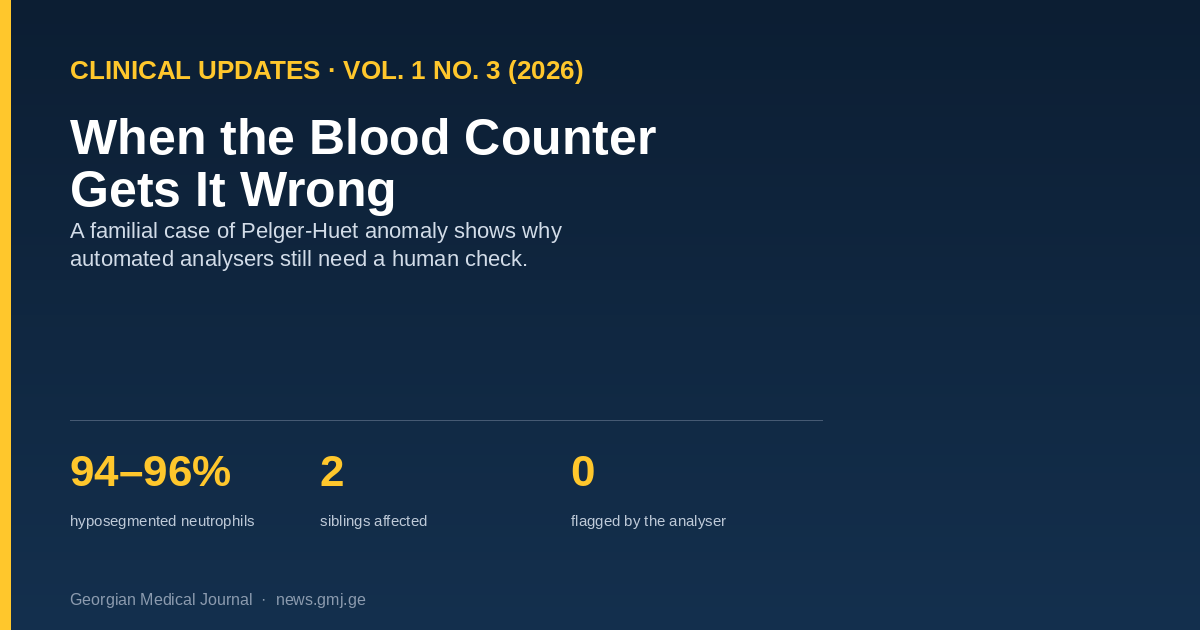
At a glance — the study’s headline figures.
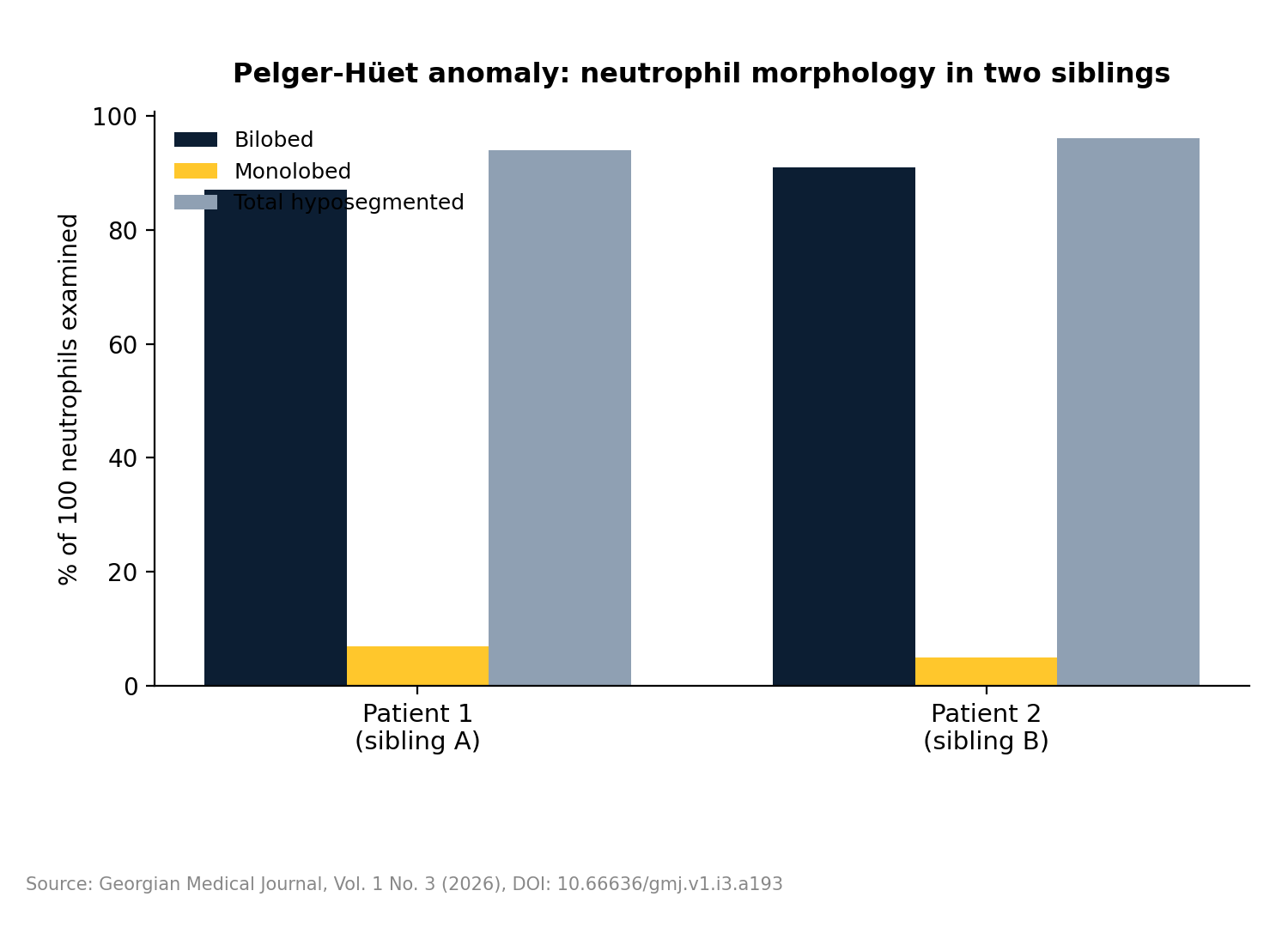
Both siblings showed strikingly similar, and strikingly high, rates of hyposegmented neutrophils on manual review. Source: Georgian Medical Journal, Vol. 1 No. 3 (2026), DOI: 10.66636/gmj.v1.i3.a193.
The manual counts were remarkably consistent between the two siblings: Patient 1 showed 94% hyposegmented neutrophils (87% bilobed, 7% monolobed), and Patient 2 showed 96% (91% bilobed, 5% monolobed) — a pattern entirely consistent with genetically inherited PHA rather than chance. Critically, the automated five-part differential on both samples did not report an independent hyposegmented-neutrophil or PHA category at all; the affected cells were simply distributed across the ordinary neutrophil and band-form channels, with no distinguishing flag raised.
The teaching point is a direct one for laboratory medicine: manual smear evaluation — actually looking at chromatin condensation, nuclear architecture, and cytoplasmic maturity under a microscope — remains necessary to distinguish a harmless inherited nuclear variant from a genuinely pathological left shift, precisely because current automated platforms aren’t built to tell the two apart. For a family carrying PHA across generations, that distinction is the difference between a benign lab curiosity and an unnecessary infection workup.
🗺️ Find certified Georgian healthcare providers: sheniekimi.ge — Georgia Health Map · 998 clinics · 6,600+ doctors · 2,296 pharmacies
Read the Original Research
Original article: When the Blood Counter Gets It Wrong: A Teaching Case in Haematology
Published in: Georgian Medical Journal, Vol. 1 No. 3 (2026)
DOI: 10.66636/gmj.v1.i3.a193
📄 Read the full article at gmj.ge →
Georgian Medical Journal (GMJ) · ISSN 3088-4322 · gmj.ge · Open Access CC BY 4.0 · Published by the Public Health Institute of Georgia (PHIG). This summary is an independent editorial product of GMJ News; for clinical decisions, consult the original peer-reviewed article and a qualified professional.
Was this article helpful?
Disclaimer. This article is health journalism intended for general information and education. It is not medical advice and is not a substitute for professional diagnosis or treatment. Always consult a qualified healthcare provider about your individual circumstances. Full disclaimer →
Related Coverage


Editorial standards. This article was produced under the GMJ News editorial process, with oversight by the GMJ Editorial Board. Our editorial process. Spotted an error? Contact the editorial team.