World Health Organization · 1st edition, 2026 · 77 pages
Operational guidance for implementing G6PD testing and radical cure with primaquine or tafenoquine for clinicians and malaria programme staff
- Issuer
- World Health Organization
- Edition
- 1st edition, 2026
- Audience
- National malaria programme managers, clinicians, nurses, laboratory staff, public health officials, community health workers, NGOs supporting malaria programmes
- Evidence
- Based on WHO Guidelines for Malaria (2024) which include GRADE-rated recommendations; incorporates operational evidence from pilot implementations in Brazil, Thailand, Peru, Cambodia, Indonesia, Papua New Guinea
- Reviewed
- 17 Oct 2026 · GMJ
What this guideline says
GMJ summary
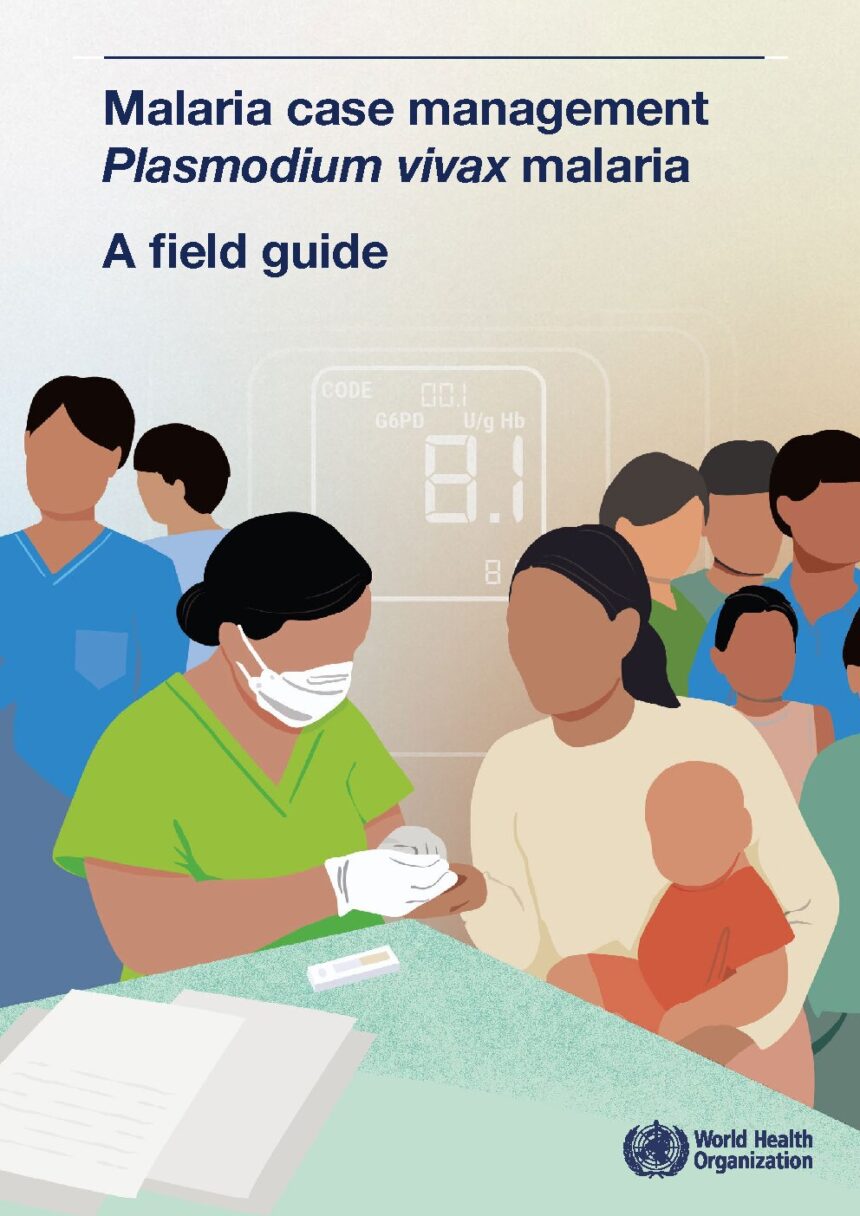
This field guide provides comprehensive operational guidance for implementing the updated WHO recommendations on Plasmodium vivax malaria case management, particularly the introduction of near-patient glucose-6-phosphate dehydrogenase (G6PD) testing and new treatment options including tafenoquine and high-dose primaquine. The document is designed to support national malaria programmes, clinicians, and public health professionals in planning, implementing, and monitoring radical cure strategies that eliminate both blood-stage parasites and dormant liver-stage hypnozoites.
The central message is that radical cure of P. vivax malaria requires both a schizontocide (chloroquine or ACT) to clear blood-stage infection and an 8-aminoquinoline (primaquine or tafenoquine) to eliminate hypnozoites and prevent relapse. G6PD testing is essential to guide safe administration of these medicines, as both primaquine and tafenoquine can cause acute haemolytic anaemia in G6PD-deficient individuals. Semi-quantitative G6PD testing enables identification of patients with ≥70% of normal G6PD activity who can receive single-dose tafenoquine or high-dose 7-day primaquine, while qualitative testing guides lower-dose 14-day primaquine regimens.
The guide emphasizes that successful implementation requires integrated planning across supply chain management, health worker training, patient counselling, pharmacovigilance systems, and monitoring and evaluation frameworks. Lessons learned from pilot implementations in Brazil, Thailand, Cambodia, Peru, Indonesia, and Papua New Guinea demonstrate the operational feasibility of G6PD testing and radical cure in real-world settings, while highlighting the importance of quality training, supportive supervision, and community engagement.
Key points
For clinicians — doses and thresholds as stated in the guideline
- Blood-stage treatment: Use chloroquine in areas with chloroquine-susceptible infections or ACT in resistant areas; tafenoquine must be given with chloroquine only, primaquine can be given with either
- G6PD testing mandatory before tafenoquine or high-dose primaquine: Semi-quantitative tests required to identify patients with ≥70% of normal G6PD activity; qualitative tests identify <30% activity (deficient)
- Tafenoquine 300 mg single dose (adults >35 kg) or weight-based dosing (children ≥2 years, 10–35 kg) only for patients with ≥70% normal G6PD activity; not for pregnant/breastfeeding women
- High-dose primaquine 7 mg/kg total: either 1 mg/kg/day for 7 days (requires ≥70% G6PD activity) or 0.5 mg/kg/day for 14 days (requires ≥30% G6PD activity)
- G6PD intermediate patients (30–70% activity): receive primaquine 0.5 mg/kg/day for 14 days; G6PD deficient (<30%): primaquine 0.75 mg/kg weekly for 8 weeks with strict medical supervision
- Acute haemolytic anaemia typically occurs days 2–5 after starting 8-aminoquinolines; symptoms include dark ('cola-coloured') urine, pallor, jaundice, severe fatigue, breathlessness
- Patient counselling essential: explain G6PD testing purpose, treatment options, importance of adherence (for primaquine), haemolysis symptoms, and when to seek care immediately
- Pharmacovigilance and follow-up: monitor for adverse drug reactions on days 3–5, assess adherence, confirm parasite clearance day 28, and evaluate recurrence prevention
Summary of considerations for 8-aminoquinoline administration
Table extracted from the guideline
| Consideration | Primaquine | Tafenoquine |
|---|---|---|
| Schizontocidal treatment | Chloroquine or ACT | Chloroquine |
| Use in pregnant women | No | No |
| Use in breastfeeding women | ≥1 month breastfeeding | No |
| Use in children | ≥1 month old | ≥2 years old |
| Treatment regimen | 7-day, 14-day or 8-week regimens | Single dose |
| G6PD testing | Different dosing regimens based on G6PD test availability (semi-quantitative or qualitative), or risk–benefit assessment if no G6PD testing available. Semi-quantitative test required for high-dose primaquine: 1 mg/kg daily for 7 days can only be used in patients with ≥70% of normal G6PD activity. | Semi-quantitative test required: tafenoquine can only be used in patients with ≥70% of normal G6PD activity. |
Source: World Health Organization, Malaria case management: Plasmodium vivax malaria – A field guide. Reproduced in summary form.
What changed in this edition
Versus the previous edition
- Tafenoquine recommended as alternative to primaquine for preventing relapses in patients ≥2 years with ≥70% G6PD activity receiving chloroquine (2024 recommendation)
- Semi-quantitative near-patient G6PD tests with fixed thresholds for deficient (<30%), intermediate (30–70%), and normal (≥70%) activity recommended to guide treatment (2024)
- High-dose primaquine regimen (7 mg/kg total) recommended: 1 mg/kg/day for 7 days (≥70% G6PD activity) or 0.5 mg/kg/day for 14 days (≥30% G6PD activity) to prevent relapse (2024)
- Qualitative near-patient G6PD tests recommended to distinguish G6PD above or below 30% threshold, enabling 0.5 mg/kg/day primaquine for 14 days or 7 days (2024)
- Good practice statement added: G6PD status should be used to guide administration of either primaquine or tafenoquine for preventing relapse (2024)
From the guideline
Verbatim
“Radical cure is required to eliminate both blood-stage and latent liver-stage infection, thereby curing acute malaria as well as preventing relapse.”
Editor’s perspective
Why this matters for Georgia and the region
Prof. Giorgi Pkhakadze, MD, MPH, PhD
Editor-in-Chief, Georgian Medical Journal · Chair, Public Health Institute of Georgia · WHO consultant, health and migration
As WHO consultant on health and migration and Chair of Georgia's Public Health Institute, I recognize this field guide addresses a challenge relevant beyond elimination settings. Georgia receives migrant populations from <em>P. vivax</em>-endemic Central Asian countries, and our health system must maintain capacity for appropriate case management to prevent reintroduction. The recommendation I would stress to Georgian clinicians is the absolute requirement for G6PD testing before tafenoquine or high-dose primaquine—we cannot assume G6PD deficiency prevalence in diverse migrant populations, and the Mediterranean variant is present in our region. The realistic implementation caveat is procurement and maintenance: semi-quantitative G6PD tests have shorter shelf life (18 months for devices, 12 months for controls) than standard malaria diagnostics, requiring careful supply chain planning for a low-caseload setting. National programmes in elimination phase should consider centralized testing capacity with clear referral protocols rather than widespread distribution of analyzers that may see insufficient use to maintain staff competency.
ORCID 0000-0001-7609-4515 · Perspective written for the GMJ Guidelines Library, 17 Oct 2026
Applicability
Georgia and the South Caucasus
While Georgia is currently in the prevention-of-reintroduction phase for malaria (zero indigenous cases since 2010), this field guide remains highly relevant for the South Caucasus and Eastern Europe region. Armenia and Azerbaijan also achieved elimination but face reintroduction risk from imported cases, particularly among migrant populations from P. vivax-endemic countries. Georgia’s National Malaria Programme must maintain capacity for case detection and appropriate treatment of imported P. vivax cases, especially given migration patterns from Central Asia and the South Caucasus diaspora. For national programmes considering G6PD testing implementation, key considerations include: assessing G6PD deficiency prevalence in relevant populations (Mediterranean variants present in the region), ensuring access to quality-assured diagnostics and medicines, training health workers in case management algorithms, establishing pharmacovigilance systems for detecting acute haemolytic anaemia, and coordinating with neighbouring countries on cross-border case management protocols to prevent reintroduction.
Questions this guideline answers
Quick answers
Why is G6PD testing necessary before giving primaquine or tafenoquine?
Both primaquine and tafenoquine can cause acute haemolytic anaemia in people with G6PD deficiency, a genetic condition affecting about 500 million people worldwide. G6PD testing identifies patients at risk so that appropriate treatment doses can be selected. Patients with ≥70% of normal G6PD activity can receive tafenoquine (single dose) or high-dose primaquine (1 mg/kg/day for 7 days). Patients with 30–70% activity (intermediate) receive lower-dose primaquine (0.5 mg/kg/day for 14 days). Patients with <30% activity (deficient) receive weekly primaquine (0.75 mg/kg weekly for 8 weeks) under strict medical supervision.
What are the main advantages of tafenoquine compared to primaquine?
Tafenoquine is given as a single dose (300 mg for adults over 35 kg), which ensures complete treatment adherence through directly observed therapy and overcomes the adherence challenges of daily primaquine for 7–14 days. However, tafenoquine can only be used with chloroquine (not ACTs), only in patients ≥2 years old with body weight over 10 kg, requires mandatory semi-quantitative G6PD testing to confirm ≥70% of normal activity, and cannot be given to pregnant or breastfeeding women. Primaquine offers more flexibility in these situations.
How do I recognize and manage acute haemolytic anaemia from 8-aminoquinolines?
Acute haemolytic anaemia typically occurs between days 2 and 5 after starting primaquine or tafenoquine. Key signs include dark ('cola-coloured') urine (haemoglobinuria), pallor, jaundice (yellowing of skin/eyes), severe fatigue, breathlessness, dizziness, and abdominal pain. If suspected: stop primaquine immediately, give oral hydration, assess haemoglobin and serum creatinine if available, and refer to higher-level facility if needed. Blood transfusion may be required if haemoglobin drops below 7 g/dL (or 8–9 g/dL in high-risk patients). Patients should be counselled before treatment to recognize these symptoms and seek care immediately.
Can primaquine be given without G6PD testing, and if so, when?
Where G6PD testing is not available, a decision to prescribe primaquine should be based on risk–benefit assessment at individual and population levels. Primaquine without G6PD testing may be considered when: relapse rates and P. vivax incidence are high, G6PD deficiency prevalence is very low or absent, patients have consistent access to counselling on haemolysis symptoms, and health facilities can manage acute haemolytic anaemia including blood transfusion. The risk may outweigh benefits when: relapse rates are low, P. vivax incidence is low, and G6PD deficiency prevalence is high. Semi-quantitative G6PD testing is mandatory before tafenoquine or high-dose primaquine (1 mg/kg/day for 7 days).
Related on GMJ
Interconnected resources
Dictionary of Public Health
Drugs A–Z
Conditions A–Z
GMJ News coverage
Quality & accreditation
Other guidelines on this topic
- Root cause analysis of a yellow fever outbreak: user manual and questionnaire
- Manual for respiratory virus vaccination coverage: monitoring and reporting seasonal influenza, COVID-19, and respiratory syncytial virus immunization
- User manual for the Member State Rapid Risk Assessment (MS-RRA) tool
- Framework of a national program for preventing and controlling diseases caused by respiratory viruses with epidemic and pandemic potential
- Microplanning Manual for Malaria Elimination in the Region of the Americas. Version for field personnel
- Issuer
- World Health Organization
- Type
- Manual
- Edition
- 1st edition, 2026
- Status
- Current
- Published
- 2026-03-07
- Languages
- English
- Scope
- Global; operational guidance for P. vivax malaria case management in endemic and elimination settings
- Audience
- National malaria programme managers, clinicians, nurses, laboratory staff, public health officials, community health workers, NGOs supporting malaria programmes
- Pages
- 77
- Licence
- CC BY-NC-SA 3.0 IGO
- ISBN
- 978-92-4-012080-8
- Evidence
- Based on WHO Guidelines for Malaria (2024) which include GRADE-rated recommendations; incorporates operational evidence from pilot implementations in Brazil, Thailand, Peru, Cambodia, Indonesia, Papua New Guinea
- Record history
- Created 17 Oct 2026 · updated 17 Oct 2026 · next check Apr 2027
Malaria case management: Plasmodium vivax malaria – A field guide. Geneva: World Health Organization; 2026. Licence: CC BY-NC-SA 3.0 IGO.GMJ Guidelines Library records are original summaries written by the GMJ editorial team from the issuer’s published document and reviewed by a physician. They do not replace the full guideline. The document is the copyright of its issuer and is linked, not hosted. Spotted an error or a newer edition? Tell the Guidelines Desk.
Was this article helpful?