Pan American Health Organization · 2020
PAHO guidance on cleaning and disinfection protocols for public facilities to prevent SARS-CoV-2 transmission during COVID-19.
- Issuer
- Pan American Health Organization
- Edition
- 2020
- Audience
- Facility managers, cleaning staff, public health authorities, business operators
- Evidence
- Expert consensus
- Reviewed
- 19 Oct 2026 · GMJ
What this guideline says
GMJ summary
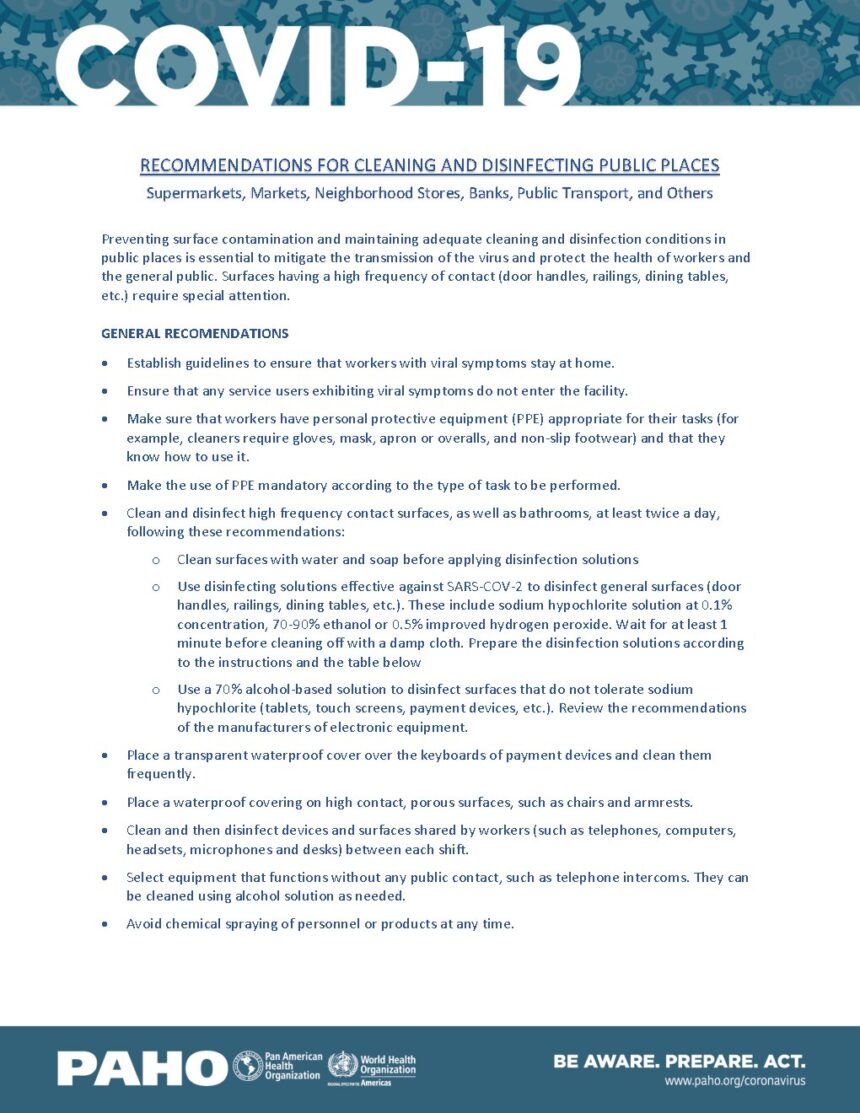
This PAHO guidance document provides practical protocols for cleaning and disinfecting high-frequency contact surfaces in public places including supermarkets, markets, banks, transport facilities, and other commercial establishments to mitigate SARS-CoV-2 transmission during the COVID-19 pandemic.
The guidance recommends cleaning and disinfecting high-frequency contact surfaces and bathrooms at least twice daily using effective disinfectant solutions: sodium hypochlorite at 0.1% concentration, 70–90% ethanol, or 0.5% improved hydrogen peroxide, with at least 1 minute contact time before wiping. Surfaces should first be cleaned with water and soap before applying disinfectants. The document provides specific recommendations by facility type and includes detailed instructions for preparing disinfection solutions from various concentrations of sodium hypochlorite.
Key preventive measures include ensuring symptomatic workers and service users stay away, providing appropriate personal protective equipment to workers, removing non-essential contamination sources, establishing handwashing stations at critical points, and limiting occupancy in enclosed spaces. Special protocols are outlined for home delivery services, transport vehicles, and payment devices.
Key points
For clinicians — doses and thresholds as stated in the guideline
- Clean and disinfect high-frequency contact surfaces and bathrooms at least twice daily using sodium hypochlorite solution at 0.1% concentration, 70–90% ethanol, or 0.5% improved hydrogen peroxide
- Wait at least 1 minute after applying disinfectant before cleaning off with a damp cloth; always clean surfaces with water and soap before applying disinfection solutions
- Use 70% alcohol-based solution for surfaces that do not tolerate sodium hypochlorite (tablets, touch screens, payment devices)
- Delivery staff should use 62–70% alcoholic gel between each client and after touching money; wash hands with soap and water for 40–60 seconds before entering each store
- For hand washing where soap unavailable, use 0.05% sodium hypochlorite solution (least recommended option due to dermatitis risk) or 70% alcohol gel
- Clean and disinfect transport vehicle high-touch surfaces (steering wheel, handles, seat belts) at least twice daily; disinfect shelves before stocking products
- Workers performing cleaning tasks require personal protective equipment: gloves, mask, apron or overalls, and non-slip footwear
- Prepare disinfection solutions daily; to make 0.1% solution from 5% sodium hypochlorite, mix 20 ml (4 teaspoons) with 1 litre water
Preparation of sodium hypochlorite disinfection solutions for 1 litre
Table extracted from the guideline
| Sodium hypochlorite concentration (as per label) | 0.05% solution for hand washing and laundry | Quantity of water | 0.1% solution for disinfection of surfaces | Quantity of water |
|---|---|---|---|---|
| 1% | 50 ml (1/5 cup) | 1 L | 100 ml (2/5 cup) | 1 L |
| 3% | 16 ml (3 tsp) | 1 L | 30 ml (1 oz) | 1 L |
| 4% | 13 ml (1/2 oz) | 1 L | 25 ml | 1 L |
| 5% | 10 ml (2 tsp) | 1 L | 20 ml (4 tsp) | 1 L |
| 10% | 5 ml (1 tsp) | 1 L | 10 ml (2 tsp) | 1 L |
Source: Pan American Health Organization, Recommendations for Cleaning and Disinfection Public Places: Supermarkets, Markets, Neighborhood Stores, Banks, Public Transport, and Others. Reproduced in summary form.
From the guideline
Verbatim
“Clean and disinfect high frequency contact surfaces, as well as bathrooms, at least twice a day”
Editor’s perspective
Why this matters for Georgia and the region
Prof. Giorgi Pkhakadze, MD, MPH, PhD
Editor-in-Chief, Georgian Medical Journal · Chair, Public Health Institute of Georgia · WHO consultant, health and migration
As Chair of the Public Health Institute of Georgia, I recognise that this PAHO guidance addresses practical infection prevention challenges highly relevant to our region, where small shops, open markets, and shared transport remain integral to daily life. The most critical recommendation for Georgian facilities is the twice-daily cleaning and disinfection protocol with specific contact times and concentrations, which can be feasibly implemented even in resource-limited settings using locally available sodium hypochlorite products. However, implementation will require sustained investment: many small businesses and transport operators lack the financial capacity for twice-daily professional cleaning, dedicated handwashing stations with running water remain uncommon in older buildings and rural areas, and enforcement mechanisms for occupancy limits in marshrutkas and minibuses are weak. Georgia's experience with tuberculosis infection control and our recent success with the hepatitis C elimination programme demonstrate our capacity to scale up environmental health interventions, but this guidance will require tailored national protocols, training materials in local languages, and financial support mechanisms for small enterprises.
ORCID 0000-0001-7609-4515 · Perspective written for the GMJ Guidelines Library, 19 Oct 2026
Applicability
Georgia and the South Caucasus
This guidance remains highly relevant for Georgia and the South Caucasus region, where public markets, shared transport (marshrutkas), and cash-based transactions remain prevalent. National public health programmes would need to adapt these protocols to local contexts, including the availability of cleaning supplies, the capacity of small businesses to implement twice-daily disinfection, and the feasibility of handwashing stations in older Soviet-era infrastructure. The guidance on home delivery services is particularly pertinent given the growth of e-commerce in Tbilisi and regional centres. Local authorities should consider the affordability and availability of sodium hypochlorite products in rural areas and provide clear instructions in Georgian, Armenian, Azerbaijani, and other languages spoken in the region. The protocols for public transport are especially applicable to minibus and metro systems across the Caucasus, where occupancy limits and enhanced cleaning may require operational and financial support from municipal governments.
Questions this guideline answers
Quick answers
What concentration of disinfectant should be used for general surface disinfection?
Use sodium hypochlorite solution at 0.1% concentration, 70–90% ethanol, or 0.5% improved hydrogen peroxide. First clean surfaces with water and soap, apply disinfectant, wait at least 1 minute, then wipe with a damp cloth. For electronic devices like payment terminals and touch screens, use 70% alcohol-based solution.
How often should high-frequency contact surfaces be cleaned and disinfected?
High-frequency contact surfaces (door handles, railings, dining tables, payment devices, transport vehicle handles) and bathrooms must be cleaned and disinfected at least twice daily. Transport vehicles and surfaces in high-traffic areas may require more frequent cleaning. If capacity to clean surfaces at least twice daily is limited, restricting access to the facility should be considered.
How do I prepare a 0.1% disinfection solution from household bleach?
Check the sodium hypochlorite concentration on the bleach label. For 5% bleach (most common), mix 20 ml (4 teaspoons) with 1 litre of water. For 3% bleach, use 30 ml (1 oz); for 10% bleach, use 10 ml (2 teaspoons). Always prepare solutions daily, use protective equipment when mixing, and store in clearly labelled containers away from children. Do not mix with soap or cleaners.
What personal protective equipment do cleaning workers need?
Workers performing cleaning and disinfection tasks require gloves, mask, apron or overalls, and non-slip footwear. When mixing disinfection solutions, use gloves, mask, eye protection, and apron. Delivery staff need mask, gloves, work clothes, and glasses; work clothing must be washed daily, and shower facilities should be provided for staff to shower and change before going home.
Related on GMJ
Interconnected resources
Dictionary of Public Health
GMJ News coverage
- UK flu and COVID-19 surveillance data to May 2027 shows continued monitoring amid seasonal trendsOct 2026
- Community Health Workers Boost COVID-19 Testing Among Formerly Incarcerated PeopleAug 2026
- How fiber actually works: bacterial fermentation, not digestive 'cleaning'Oct 2026
- Fiber's True Function: Fueling Gut Cells, Not Just 'Cleaning Out' the SystemMay 2026
Quality & accreditation
Other guidelines on this topic
- Requirements and technical specifications of personal protective equipment (PPE) for the novel coronavirus (2019-nCoV) in healthcare settings
- The COVID-19 Risk Communication Package for Healthcare Facilities
- Ongoing Living Update of Potential COVID-19 Therapeutics: summary of rapid systematic reviews
- Influenza at the Human-Animal Interface: PAHO Recommendations to Strengthen Intersectoral Work for Surveillance, Early Detection, and Investigation
- Administrative Controls to Guarantee Implementation of Infection Prevention and Control Measures in the Context of COVID-19
- Issuer
- Pan American Health Organization
- Type
- Procedures, manuals, guidelines
- Status
- Current
- Published
- 2020-01-01
- Scope
- Supermarkets, markets, neighborhood stores, banks, public transport stations and vehicles, home delivery services
- Audience
- Facility managers, cleaning staff, public health authorities, business operators
- Licence
- CC BY-NC-SA 3.0 IGO
- Evidence
- Expert consensus
- Record history
- Created 19 Oct 2026 · updated 19 Oct 2026 · next check Apr 2027
Pan American Health Organization. Recommendations for Cleaning and Disinfection Public Places: Supermarkets, Markets, Neighborhood Stores, Banks, Public Transport, and Others, 11 May 2020. Washington, D.C.: PAHO; 2020. (PAHO/CDE/CE/COVID-19/20-0015).GMJ Guidelines Library records are original summaries written by the GMJ editorial team from the issuer’s published document and reviewed by a physician. They do not replace the full guideline. The document is the copyright of its issuer and is linked, not hosted. Spotted an error or a newer edition? Tell the Guidelines Desk.
Was this article helpful?