Pan American Health Organization · 2020
Operational guidance for safe handling of municipal and health-care waste during the COVID-19 pandemic.
- Issuer
- Pan American Health Organization
- Edition
- 2020
- Audience
- Waste management operational personnel, health-care facility staff, municipal authorities, public health professionals
- Evidence
- Expert consensus
- Reviewed
- 20 Oct 2026 · GMJ
What this guideline says
GMJ summary
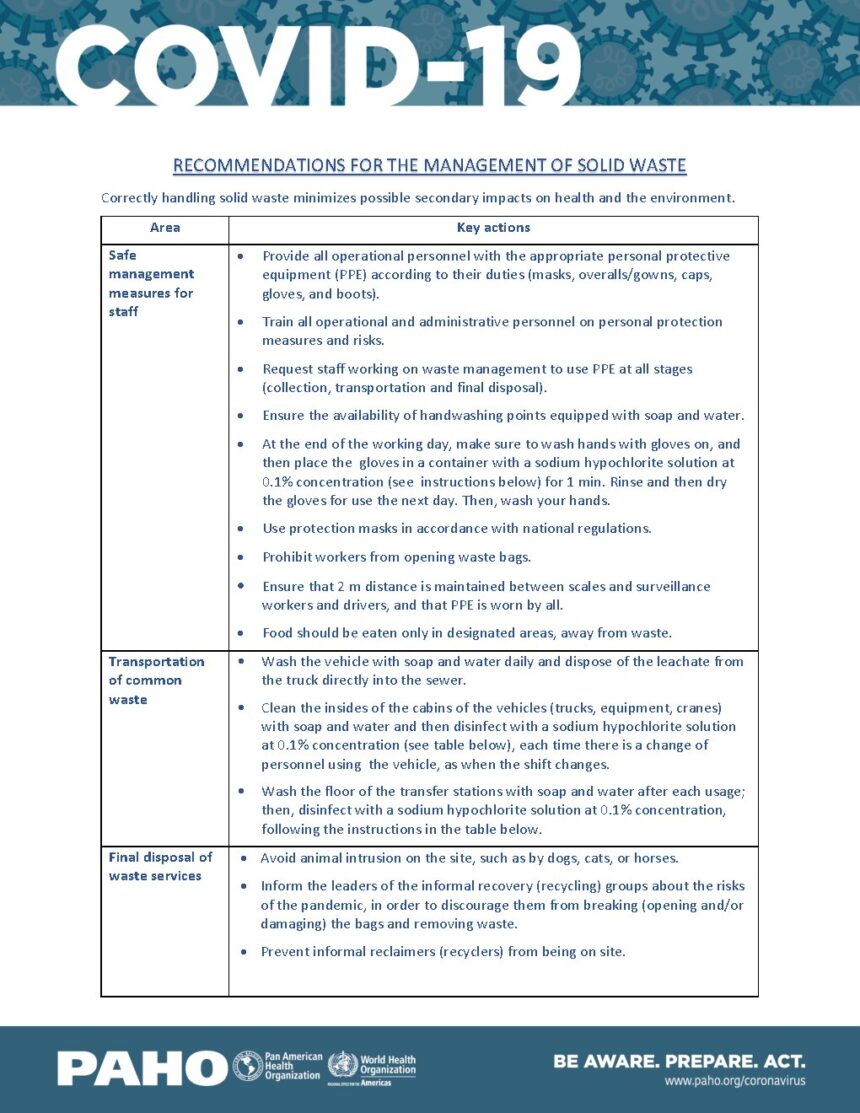
This operational guidance, issued by the Pan American Health Organization in May 2020, provides recommendations for the safe management of solid waste during the COVID-19 pandemic to minimise secondary health and environmental impacts. The document addresses municipal waste collection and disposal, health-care waste management, and household waste handling.
Key safety measures include provision of appropriate personal protective equipment (PPE) to all waste management workers, hand hygiene facilities, and maintenance of 2-metre physical distancing. For health-care waste, the guidance specifies separate handling and transportation of infectious, sharp, pathological, chemical, and radioactive waste from common waste, with specific routes and dedicated closed vehicles without compaction. Final disposal methods include autoclaving (121–134 °C for 20–40 minutes at 103–200 kPa), incineration (double chamber at 850 °C and 1,100 °C with 2-second gas burning time), or burial in safety cells with daily lime and soil covering.
The guidance includes detailed instructions for preparing sodium hypochlorite disinfection solutions at 0.1% concentration from various stock concentrations, emphasising daily preparation and proper storage. Special provisions address COVID-19 household cases, requiring double-bagging of patient waste before municipal collection.
Key points
For clinicians — doses and thresholds as stated in the guideline
- All waste management workers must use appropriate PPE (masks, overalls/gowns, caps, gloves, boots) at all stages of collection, transportation and disposal
- Maintain 2 metres distance between scales and surveillance workers and drivers, with all personnel wearing PPE
- Disinfect gloves by washing hands with gloves on, then placing gloves in 0.1% sodium hypochlorite solution for 1 minute, rinsing and drying for next-day use
- Clean vehicle cabins with soap and water, then disinfect with 0.1% sodium hypochlorite solution at each personnel change
- Autoclave infectious waste at 121–134 °C for 20–40 minutes at 103–200 kPa with HEPA-filtered air evacuation, verifying decontamination with temperature indicator bands
- Incinerate health-care waste using double-chamber incinerators reaching 850 °C and 1,100 °C respectively, with 2-second gas burning time in secondary chamber
- Transport infectious, sharp, pathological, chemical and radioactive waste separately in closed, designated vehicles without compaction; double-bag if bags are broken
- For COVID-19 household cases, dispose of all patient waste (tissues, gloves, masks) in a dedicated container, seal when 2/3 full, and place inside another bag for municipal collection
Sodium Hypochlorite Disinfection Solution at 0.1% Concentration
Table extracted from the guideline
| Concentration of sodium hypochlorite | Quantity of sodium hypochlorite | Quantity of water |
|---|---|---|
| 1% | 100 ml (2/5 cup) | 1 L (1 qt) |
| 3% | 30 ml | 1 L (1 qt) |
| 4% | 25 ml (1 oz) | 1 L (1 qt) |
| 5% | 20 ml (4 tsp) | 1 L (1 qt) |
| 10% | 10 ml (2 tsp) | 1 L (1 qt) |
Source: Pan American Health Organization, Recommendations for the Management of Solid Waste. Reproduced in summary form.
From the guideline
Verbatim
“Correctly handling solid waste minimizes possible secondary impacts on health and the environment.”
Editor’s perspective
Why this matters for Georgia and the region
Prof. Giorgi Pkhakadze, MD, MPH, PhD
Editor-in-Chief, Georgian Medical Journal · Chair, Public Health Institute of Georgia · WHO consultant, health and migration
As Chair of the Public Health Institute of Georgia, I recognise that solid waste management remains a critical environmental health challenge across the South Caucasus, intensified during infectious disease outbreaks. This PAHO guidance addresses a gap in our regional capacity, particularly the practical specifications for autoclave parameters (121–134 °C for 20–40 minutes) and incinerator standards (double chamber, 850 °C and 1,100 °C), which many Georgian health facilities still struggle to meet. The most actionable recommendation for our context is the sodium hypochlorite dilution protocol, offering a cost-effective disinfection solution readily applicable in resource-limited settings. The primary implementation challenge in Georgia and neighbouring countries is the large informal waste collection sector; achieving compliance with PPE requirements and preventing informal reclaimers from accessing infectious waste requires both enforcement capacity and social protection measures that are often lacking in municipal budgets.
ORCID 0000-0001-7609-4515 · Perspective written for the GMJ Guidelines Library, 20 Oct 2026
Applicability
Georgia and the South Caucasus
This guidance remains relevant for Georgia and the South Caucasus, where waste management infrastructure varies significantly between urban and rural areas. National programmes would need to assess existing capacity for autoclave or incineration facilities, as many smaller health-care facilities may lack on-site treatment capacity and require designated collection routes. The recommendations for physical distancing, PPE provision, and disinfection protocols are universally applicable. Georgian authorities should consider adaptations for informal waste collection sectors common in the region, ensuring that reclaimers are protected and informed. The sodium hypochlorite dilution tables are practical for resource-limited settings where commercial disinfectants may be costly or unavailable, aligning with Georgia’s primary health-care and infection control programmes.
Questions this guideline answers
Quick answers
How should gloves be disinfected for reuse by waste workers?
At the end of the working day, wash hands with gloves on, then place gloves in 0.1% sodium hypochlorite solution for 1 minute. Rinse and dry the gloves for use the next day, then wash your hands.
What temperature and duration are required for autoclaving infectious waste?
The autoclave must operate at 121–134 °C for 20–40 minutes at 103–200 kPa pressure. Air must be evacuated with a vacuum pump and filtered using HEPA or equivalent filters. Verify decontamination using temperature indicator bands before disposing as common waste.
How should health-care waste be transported if on-site treatment is unavailable?
Establish a specific collection route using specially designated closed vehicles without compaction. Transport infectious, sharp, pathological, chemical and radioactive waste separately from common waste. If bags break during transport, immediately place in another bag (double-bag).
How should households manage waste if a COVID-19 patient is present?
Dispose of all patient waste (disposable tissues, gloves, masks) in a dedicated container within a bag. Seal the bag when 2/3 full and place inside another bag before delivering to the municipal collection service.
Related on GMJ
Interconnected resources
Dictionary of Public Health
GMJ News coverage
Quality & accreditation
- ASF Hospital — Standard 18 — Sustainable Care
- ASF Hospital — Standard 5 — Safety & Emergency Preparedness
- ASF Medical Transport — Standard 5 — Infection Prevention & Control
- ASF Laboratory — Standard 7 — Examination: Process & Safety
- ASF Hospital — Standard 11 — Critical Care
- ASF Medical Transport — Standard 6 — Emergency Response During Transport
Other guidelines on this topic
- Considerations for the Use of Hotels during the COVID-19 Pandemic
- Considerations for the Use of Hotels during the COVID-19 Pandemic
- Guidelines to Plan for COVID-19 Vaccine Introduction
- Technical recommendations for configuration of a triage area for patients with respiratory symptoms
- Recommendations on Chemical Safety for Cleaning and Disinfection Supplies
- Issuer
- Pan American Health Organization
- Type
- Procedures, manuals, guidelines
- Status
- Current
- Published
- 2020-01-01
- Audience
- Waste management operational personnel, health-care facility staff, municipal authorities, public health professionals
- Licence
- CC BY-NC-SA 3.0 IGO
- Evidence
- Expert consensus
- Record history
- Created 20 Oct 2026 · updated 20 Oct 2026 · next check Apr 2027
Pan American Health Organization. Recommendations for the Management of Solid Waste, 11 May 2020. Washington, D.C.: PAHO; 2020. (PAHO/CDE/CE/COVID-19/20-0018). Licence: CC BY-NC-SA 3.0 IGO.GMJ Guidelines Library records are original summaries written by the GMJ editorial team from the issuer’s published document and reviewed by a physician. They do not replace the full guideline. The document is the copyright of its issuer and is linked, not hosted. Spotted an error or a newer edition? Tell the Guidelines Desk.
Was this article helpful?